-
 West must embrace 'national power' or face decline: Rubio
-
Kyiv 'cannot agree' to EU membership limiting food exports: minister
-
 Shell refining margins reach record highs as wars hit supply
-
Arteta targets more Arsenal glory after signing new deal until 2030

-
 Former Spain, Barca winger Pedro retires from football
-
Russell hit with Singapore grid penalty for taking new power unit
-
 Arteta signs new Arsenal deal until 2030
-
Spotify expands audiobooks to more than 180 markets

-
 Stocks decline as oil climbs on Mideast flareup
-
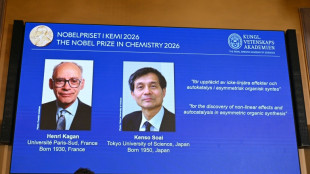
French-Japanese duo wins chemistry Nobel for solving molecular 'mystery'
-
 Gauff says online abuse was 'draining' after China Open exit
-
England's Nations League surge helps heal World Cup wounds

-
 As sector struggles, Porsche puts luxury ahead of volume
-
Mayor of opposition stronghold Izmir defects to Erdogan party
-
 'It's personal': Fiji minister pushes better climate finance at pre-COP
-
Mertens beats Gauff to set up Swiatek clash at China Open

-
 Russia glosses over dark Soviet past in reinvented museum
-
Benin full of pride at role in Messi's last dance

-
 UK tax body opened probe into Man City in 2018: FT
-
France suspends stun grenade use at student protests ahead of PM speech

-
 Yemen's Houthis claim new attacks on Saudi airports as conflict deepens
-
Indonesian court hears 'negligence' complaint against state over fires, haze
-
 Germany factory production at highest level for 18 months
-
Rubio in Greece to urge against Western civilisation 'decline'
-
 Thailand floods death toll rises to 60 since mid-September
-
Micron workers at Taiwan plant vote in favour of strike

-
 US pushes Russia for information on plague reports
-
In 'The Social Reckoning,' Jeremy Allen White takes on Facebook's 'frightening' ambition

-
 Myanmar leader lands in Malaysia for migrant return talks
-
Chip industry activists call for South Korea to recognise cancer cases

-
 Indian central bank hikes rates for first time since 2023
-
Famine-scarred southern Madagascar braces for El Nino
-
 US military on Okinawa face curfew, alcohol ban after murder case
-
How the EU regulates lobbyists
-
 Fierce lobbying in EU over 'forever chemicals'
-
I.Coast refuge offers lifelong care for youngsters scorned as 'sorcerers'

-
 Dodgers beat Braves and Padres avoid sweep in MLB playoffs
-
Indian central bank hikes rates for first time in more than 3 years
-
 Mourning, war and elections as Israel marks October 7
-
Hotel Blacklist Launches New Accommodation Industry Risk Assessment Tool

-
 Messi says Argentina retirement is 'saddest day of my career'
-
Bangladesh nuclear plant draws hope -- and worry

-
 Oil rises and stocks fall as Hormuz worries flare
-
US beat Canada 1-0 to wrap up four-win international break

-
 Pacific presses world for help 'surviving' climate change at pre-COP summit
-
Turkey, Australia's joint COP31 leadership raises doubts
-
 Verstappen revival to be put to the test in steamy Singapore
-
For Turkish NGOs, COP31 offers rare space for action
-
 US woman who survived botched execution is conscious, speaking: lawyers
-
Sleep, appetite, gene-editing experts contend for Nobel chemistry prize

Risk of monkeypox spreading widely 'very low'
The risk of monkeypox spreading widely among the general population is very low and transmission can be stopped outside endemic countries in Central and West Africa, health officials said Monday, after cases exploded this month in Europe and North America.
Fewer than 200 confirmed and suspected cases had been recorded since early May in Australia, Europe and North America, the World Health Organization (WHO) said, sparking fears over the spread of the disease.
Although monkeypox has been known for 40 years, WHO said it was the first time there had been several cases across many countries simultaneously and among people who had not travelled to the endemic regions in Africa.
But the UN agency said the outbreaks in non-endemic countries could be brought under control and human-to-human transmission of monkeypox stopped.
The EU's European Centre for Disease Prevention and Control (ECDC) also played down fears of a spread among the wider public.
Monkeypox, which is not usually fatal, can cause a fever, muscle aches, swollen lymph nodes, chills, exhaustion and a chickenpox-like rash on the hands and face.
The virus can be transmitted through contact with skin lesions or droplets of bodily fluid from an infected person.
No treatment exists, but the symptoms usually clear up after two to four weeks. The disease is considered endemic in 11 African nations.
US President Joe Biden insisted Monday "extra efforts" would not be needed to prevent the spread.
- 'Remain vigilant' -
"This is a containable situation, particularly in the countries where we are seeing these outbreaks that are happening across Europe, in North America as well," the WHO's emerging disease lead Maria Van Kerkhove said Monday via the UN health agency's social media channels.
"We want to stop human-to-human transmission. We can do this in the non-endemic countries," she said.
Meanwhile, the European Centre for Disease Prevention and Control (ECDC) director, Andrea Ammon, said most of the cases had mild symptoms.
"For the broader population, the likelihood of spread is very low," Ammon added in a statement.
"However, the likelihood of further spread of the virus through close contact, for example during sexual activities among persons with multiple sexual partners, is considered to be high," she said.
Stella Kyriakides, European Commissioner for Health and Food Safety, said it was important to "remain vigilant" despite the low risk, ensuring contact tracing and adequate diagnostics capacity.
The agency also pointed to the risk of "human-to-animal transmission", and said if the virus is spread to animals "there is a risk that the disease could become endemic in Europe".
burs-raz/ach
E.Qaddoumi--SF-PST