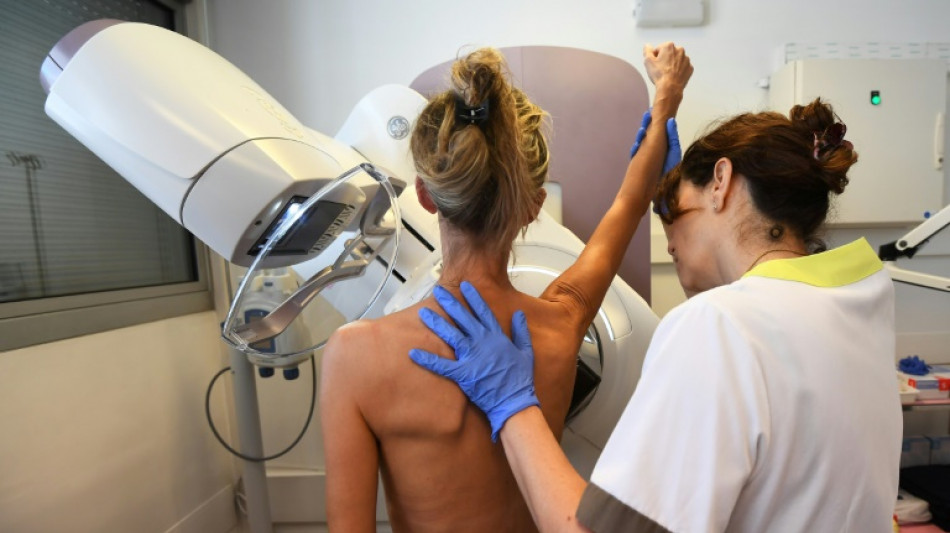
US breast cancer rate rising sharply even as deaths fall: study / Photo: ANNE-CHRISTINE POUJOULAT - AFP/File

 'Never again Bolsonaro': thousands march ahead of Brazil election runoff

 After botched execution, US woman was nearly taken off life support before revival

 Searing AIDS drama 'Elsinore' opens London film festival

 Evicted pensioner who sparked Spain housing protests dies: tenant union

 Golf star Rahm quitting LIV tour over 'unacceptable' terms

 Thousands march fearing return of a Bolsonaro presidency in Brazil

 French PM denies police ordered to confront student protesters
 Rubio touts US power, calls on Europe to emerge from 'slumber'

 Trump says 'we don't think' Russian plague is bio-weapon

 Five children among 26 killed in Ukraine after Russian strikes

 Man City should 'accept' punishment for rule breaches, says Lineker

 US woman who survived botched execution is awake and speaking
 From 1800s to modern pharma: a Nobel-winning chemistry quest

 Southampton boss Eckert given suspended ban over 'Spygate'

 Russia warns of 'false' information as second plague case reported

 IEA ready to release more oil reserves if necessary

 HSBC 'consults' over UK unit job cuts amid AI adoption

 UK court quashes five ex-traders' Libor rate rigging convictions
 XM Receives “Global Customer Experience Leader Award 2026” at the TrustFinance Performance Awards
 Stocks slide as oil climbs on Mideast flareup

 Heavy casualties in Ukraine after Russian strikes
 French wine harvest set to hit historic low

 Kyiv 'cannot agree' to EU membership limiting food exports: minister

 Arteta targets more Arsenal glory after signing new deal until 2030

 Russell hit with Singapore grid penalty for taking new power unit

Breast cancer rates are rising sharply in the United States, driven by increases among younger women and Asian Americans, a study said Tuesday.
The biennial report by the American Cancer Society found the number of cases grew by one percent each year from 2012 to 2021, even as the overall death rate continued its historic trend of decline, falling 44 percent from 1989 to 2022.
Breast cancer is the second most common cancer diagnosed among US women, and the second leading cause of death from cancer, after lung cancer.
Approximately one-in-eight women in the US will be diagnosed with invasive breast cancer in their lifetime and one-in-43, or two percent, will die from the disease.
Over the past decade, the report said, breast cancer rates grew faster for women under the age of 50 than those older -- 1.4 percent annually versus 0.7 percent annually -- for reasons that aren't immediately clear.
By race, Asian American women had the most rapid increase in incidence followed by Hispanic, which the paper said "may be related in part to the influx of new immigrants, who have elevated breast cancer risk."
Overall, the breast cancer mortality rate fell 44 percent from 33 deaths per 100,000 women in 1989 to 19 deaths per 100,000 in 2022, resulting in around 517,900 averted deaths.
But despite decades of medical advancements in treatment and earlier detection, the benefits have been felt unevenly.
Mortality has remained unchanged since 1990 among Native Americans, while Black women experience 38 percent more deaths than white women despite five percent lower cases.
The paper said these findings highlighted "disadvantages in social determinants of health" and "longstanding systemic racism and has translated to less access to quality care across the cancer continuum."
For example, although Black women report getting mammograms more than White women, "they are more likely to have screening at lower resourced facilities and/or those that are not accredited by the American College of Radiology," the study said.
The authors recommended increasing racial diversity in clinical trials as well as community partnerships that boost access to high-quality screening among underserved women.
In April, an influential US medical body recommended women should get screened for breast cancer every other year starting from the age of 40.
The US Preventive Services Task Force (USPSTF) had previously said that women in their 40s should make an individual decision about when to start mammograms based on their health history and reserved its mandatory recommendation for people turning 50.
X.AbuJaber--SF-PST