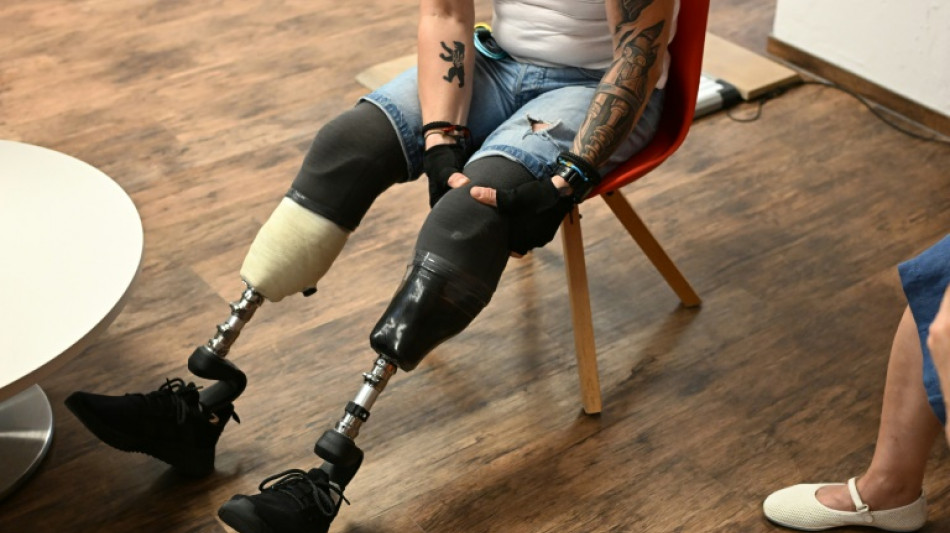
German engineering helps Ukrainian amputees walk again / Photo: Ralf Hirschberger - AFP

 El Nino’s Weakening Grip on Tamil Nadu Rainfall Hinges on Potential Cyclone

 South Africa Places 36 Hospitals on Standby for Possible Imported Ebola Cases

 Two A1 Crashes Create Kilometres of Rush-Hour Congestion

 Luxembourg City Plans €13 Million Abrigado Centre for 2029

 Luxembourg Housing Petition Passes Threshold for Parliamentary Consideration

 Raheem Sterling Receives Suspended Sentence After Lamborghini Crash

 Tamil Nadu Secures Rs 58,214 Crore in Investments at Vettri Conclave

 فرنسا تدعو لتجريم "الفصل العنصري القائم على الجنس" دولياً

 أزمة الصواريخ الاعتراضية في البنتاغون: استنزاف المخزونات يفرض تعبئة صناعية حتى 2030

 Huawei Found Guilty of Trade Secret Theft in Landmark US Case

 Indian Markets Set for Gain as Foreign Inflows Offset Tariff Fears
Double amputee Vitaliy Saiko, a veteran of the war in Ukraine, compares the artificial limbs made for him by a Berlin-based prosthetics specialist to a sports car.
"This is individual work. It's like making a Lamborghini, it's assembled according to the client's order," Saiko told AFP.
The 42-year-old is among the first patients to be fitted for new prostheses in Germany with the help of an initiative to bring better care to Ukrainian amputees.
Russia's invasion has killed thousands and left many more with life-changing injuries. The World Health Organization said in May that more than 20,000 amputations had been carried out there since February 2022.
But effective treatment for such severe injuries is often lacking in Ukraine.
"There is better knowledge here (in Germany) on how to make a unique prosthesis," according to Janine von Wolfersdorff, whose organisation Life Bridge Ukraine is behind the programme.
So far, her organisation has brought around 40 amputees to Germany for care, as well as six trainees, who will return to Ukraine with new expertise.
- 'Unusual sensation' -
Walking on the prostheses is an "unusual sensation", said Saiko, but the former soldier is satisfied.
"I was not walking at all, I was confined to a wheelchair," said Saiko, who has undergone more than 15 operations and months of rehabilitation since losing his legs in combat last year.
Three months after coming to Berlin, Saiko said he feels "complete again", he said.
"I had my wings clipped, and now they have reappeared."
Saiko's new limbs -- a pair of sleek metal rods shod in black sneakers -- were custom made for him at the Seeger health centre in Berlin.
Amputations done under pressure in Ukraine, sometimes in the field, do not always leave the stump in "optimal condition" for fitting with a prosthesis, according to Michael Koehler from Seeger.
For Saiko, like others, the operation left too little flesh to cover the end of his leg bones well -- a cause of additional discomfort for the veteran.
"Due to the bony structures, we have to make sure that we provide soft support" inside the cup of the prosthesis, Koehler said.
At Seeger's workshop in south Berlin, Koehler has been sharing his expertise with trainees from Ukraine, like Anastasiia Tkach.
A physical therapist by training, 23-year-old Tkach has been learning techniques ranging from making plaster casts of stumps to testing the finished prosthesis.
- 'Catastrophic' supply -
"As long as the war continues, we will continue to bring patients here," said von Wolfersdorff.
After the initial phase, the "occasional" severely wounded patient from Ukraine will still be evacuated to Germany, while new trainees will come to Berlin.
However, the plan is to slowly hand over to the new prosthetics centre which the programme is helping to establish in Kyiv.
The specialist equipment and materials needed to begin making high-quality prostheses will be supplied initially by Life Bridge Ukraine.
"We are looking to see what still needs to be ordered so that the prosthetics centre is fully equipped," said von Wolfersdorff.
Because the Ukrainian capital continues to face Russian rocket attacks, the new centre will be established in the basement of one of the city's hospitals.
The underground location means "it will be able to operate even if there is an air raid warning", said von Wolfersdorff.
Currently, the supply of prosthetics in Ukraine is "catastrophic", said Saiko, who spent nine months of his rehabilitation in Ukraine.
"We need help," he said.
With his German prostheses, Saiko is managing to climb a staircase with ease, balance on a board or ride a bike -- even if the effort brings him out in a sweat.
When he returns home, the former soldier wants to "be useful at the front in a different way".
"I have a lot of things, a lot of work to do. You can always find something to do in the rear."
A.AlHaj--SF-PST

