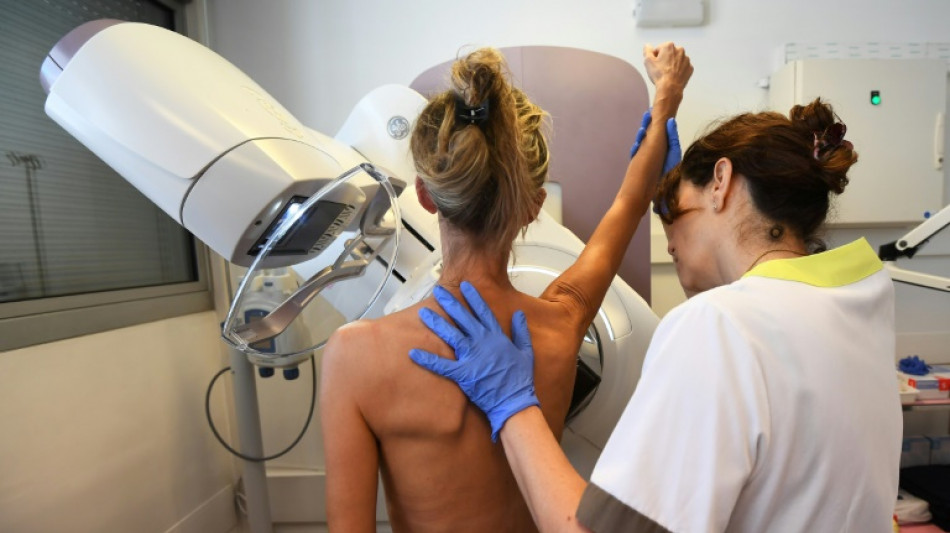
US panel recommends all women receive breast cancer screening from 40 / Photo: ANNE-CHRISTINE POUJOULAT - AFP/File

 Samsung expects 780% quarterly operating profit jump on AI boom

 Guardians survive with 9-3 win over White Sox

 Saudi Arabia says 3 dead at airports after Houthis claim attacks

 Stocks slide as oil sees volatile trading day over Iran war fears

 Microsoft pushes AI vision with new, expensive Surface laptop
 Five children among 28 killed in Russian strikes on Ukraine
 Odell Beckham Jr signs with Minnesota Vikings

 Saudi Arabia says three dead at airports after Houthis claim attacks
 Trump plans to turn Florida golf course into presidential retreat

 WHO says cannot conduct full risk assessment on Russia plague reports

 After botched execution, US woman is awake and shackled to bed

 New Zealand fly-half Mo'unga ruled out of Australia Tests

 Protests in major Turkish city after mayor defects to Erdogan party

 Climate change strips island's title of largest penguin colony: study

 Rubio says West must choose between national power or decline
 Russia's plague scare: What we know

 French luxury giant to fund redevelopment of two Paris streets: city hall

 Trump wants to turn Florida golf course into presidential retreat

 Mayor of Turkish opposition stronghold defects to Erdogan party

 Children among heavy casualties in Ukraine after Russian strikes

 Court orders German ex-spy chief kept in jail after spying, treason arrest

 Guinea caps bottled water prices after sachets banned

 Spared, married, hanged: the last weeks of Iranian protester Alireza Sepahi

 Nobel physics winner's pride at pioneering AI role

 IMF preparing El Nino assistance, concerned about AI bubble burst: chief to AFP

Women should get screened for breast cancer every other year starting from the age of 40 to reduce their risk of dying from the disease, an influential US body recommended on Tuesday.
The US Preventive Services Task Force, an independent panel of experts that receives federal funding, previously said that women in their 40s should make an individual decision about when to start mammograms based on their health history and reserved its mandatory recommendation for people turning 50.
Its new guidance was based on a review of evidence and a modeling study published in the Journal of the American Medical Association, and finalizes a draft recommendation proposed last year.
"More women in their 40s have been getting breast cancer, with rates increasing about 2 percent each year, so this recommendation will make a big difference for people across the country," Task Force chair Wanda Nicholson said in a statement.
"By starting to screen all women at age 40, we can save nearly 20 percent more lives from breast cancer overall."
Breast cancer is the second most common cancer and the second most common cause of cancer death for women in the United States, with more than 43,000 deaths last year.
Black women are 40 percent more likely to die of the disease than white women, and so ensuring they start screening at 40 "has even greater potential benefit for Black women," said Nicholson.
The new recommendation applies to nearly all women -- those who are at average risk of breast cancer, as well as those with a family history of breast cancer, and those with dense breasts.
Nearly half of all women have what's known as dense breast tissue, which they generally only find out during their first mammogram. Dense breast tissue increases their risk for breast cancer and means that mammograms may not work as well for them.
"Unfortunately, there is not yet enough evidence for the Task Force to recommend for or against additional screening with breast ultrasound or MRI," the experts said, urgently calling for more research.
The new recommendation doesn't apply however to those with a personal history of the disease, or those at very high rise due to certain genetic markers, or who have a lesion detected on previous biopsies -- they could benefit from more regular screening, in consultation with their doctor.
The new recommendation applies up until the age of 74, after which the balance of benefit-to-risk becomes uncertain, the task force said.
While screening is a powerful tool in the fight against cancer, there are also limits, the task force said, explaining why it is not recommending annual mammograms. Over-testing increases the number of harms, such as false positives, or receiving treatment that wasn't required.
Q.Bulbul--SF-PST