
US approves gene therapy treatment for hemophilia / Photo: SPENCER PLATT - GETTY IMAGES NORTH AMERICA/AFP/File

 Samsung expects 780% quarterly operating profit jump on AI boom

 Guardians survive with 9-3 win over White Sox

 Saudi Arabia says 3 dead at airports after Houthis claim attacks

 Stocks slide as oil sees volatile trading day over Iran war fears

 Microsoft pushes AI vision with new, expensive Surface laptop

 Five children among 28 killed in Russian strikes on Ukraine

 Odell Beckham Jr signs with Minnesota Vikings

 Saudi Arabia says three dead at airports after Houthis claim attacks

 Trump plans to turn Florida golf course into presidential retreat

 WHO says cannot conduct full risk assessment on Russia plague reports

 After botched execution, US woman is awake and shackled to bed

 New Zealand fly-half Mo'unga ruled out of Australia Tests

 Protests in major Turkish city after mayor defects to Erdogan party

 Climate change strips island's title of largest penguin colony: study

 Rubio says West must choose between national power or decline

 Russia's plague scare: What we know

 French luxury giant to fund redevelopment of two Paris streets: city hall

 Trump wants to turn Florida golf course into presidential retreat

 Mayor of Turkish opposition stronghold defects to Erdogan party

 Children among heavy casualties in Ukraine after Russian strikes

 Court orders German ex-spy chief kept in jail after spying, treason arrest

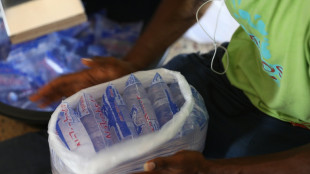 Guinea caps bottled water prices after sachets banned

 Spared, married, hanged: the last weeks of Iranian protester Alireza Sepahi

 Nobel physics winner's pride at pioneering AI role

 IMF preparing El Nino assistance, concerned about AI bubble burst: chief to AFP

Pharmaceutical giant Pfizer has received US approval for a gene therapy against a form of hemophilia, a rare and inherited blood clotting disorder, the company said Friday.
Beqvez, which is given as a single intravenous infusion, was shown in a clinical trial of 45 people to be better at preventing bleeding among adults with moderate to severe hemophilia B, compared to regular infusions of a protein that promotes clotting, called protein factor IX (FIX).
The current standard of care is cumbersome, requiring infusions up to several times per week.
"Many people with hemophilia B struggle with the commitment and lifestyle disruption of regular FIX infusions, as well as spontaneous bleeding episodes, which can lead to painful joint damage and mobility issues," said Adam Cuker, director of the University of Pennsylvania's Comprehensive Hemophilia and Thrombosis Program, in a Pfizer statement.
"A one-time treatment with BEQVEZ has the potential to be transformative for appropriate patients by reducing both the medical and treatment burden over the long term."
The therapy was generally well tolerated but a common side effect was elevated liver enzymes, a sign of liver inflammation that wasn't accompanied by outward symptoms. Still, patients are advised to avoid alcohol for up to a year following their treatment, to prevent liver damage.
Patients will be followed up to gather more data for up to 15 years.
Pfizer's genetic therapy targets hemophilia B, the second most common form of the condition, which primarily affects males. More than 38,000 people worldwide live with hemophilia B, according to the World Federation of Hemophilia.
It works by infecting the body with a virus, modified to be harmless, which delivers a functional copy of the factor IX gene to liver cells, instructing them to produce the protein that promotes clotting that the patient otherwise lacks.
It received approval by Canada in January and is awaiting review by the European Medicines Agency.
Pfizer's statement did not mention a list price, which is often a limiting factor for gene therapy treatments. Recently approved sickle cell gene therapies run to $3 to $4 million before insurance.
Z.Ramadan--SF-PST