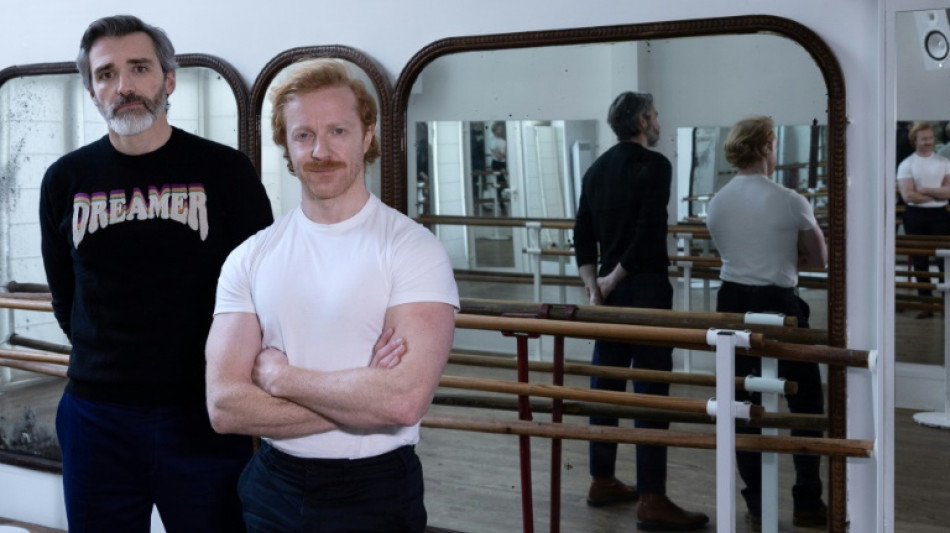
Ballet star and survivor Steven McRae says dance must change / Photo: ALAIN JOCARD - AFP

 The British historian helping the French rediscover de Gaulle

 Dodgers beat Braves to advance, Guardians survive in MLB playoffs
 Latin American, Caribbean women top Nobel literature buzz
 US says Fiji-based Chinese official paid bribes for Beijing

 After botched US execution, Christa Pike was nearly taken off life support

 Guinea-Bissau junta urges military unit loyal to ex-president to disarm

 As species decline, green turtles offer glimmer of hope

 Brothers Scott and Beauden Barrett named to start for All Blacks

 EU trade chief seeks to dial down China tensions

 'Never again Bolsonaro': thousands march ahead of Brazil election runoff

 After botched execution, US woman was nearly taken off life support before revival
 Searing AIDS drama 'Elsinore' opens London film festival

 Evicted pensioner who sparked Spain housing protests dies: tenant union

 Golf star Rahm quitting LIV tour over 'unacceptable' terms

 Thousands march fearing return of a Bolsonaro presidency in Brazil

 French PM denies police ordered to confront student protesters

 Rubio touts US power, calls on Europe to emerge from 'slumber'

 Trump says 'we don't think' Russian plague is bio-weapon
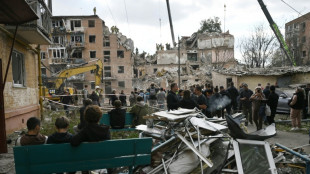 Five children among 26 killed in Ukraine after Russian strikes

 Man City should 'accept' punishment for rule breaches, says Lineker

 US woman who survived botched execution is awake and speaking
 From 1800s to modern pharma: a Nobel-winning chemistry quest

 Southampton boss Eckert given suspended ban over 'Spygate'

 Russia warns of 'false' information as second plague case reported
 IEA ready to release more oil reserves if necessary
After an almost super-human recovery from an injury, star dancer Steven McRae says the ballet world must take much better care of its artists.
As charted in the upcoming documentary "A Resilient Man", McRae thought his high-flying career as a principal dancer in London's Royal Ballet was over when he heard the horrific sound of his Achilles tendon snapping midway through a performance of "Manon" in October 2019.
It took months for McRae to walk again, but he was lucky: the Royal Ballet is one of the only companies in the world with a dedicated medical team.
"In the world of dance, injuries have always been seen as a sign of weakness," he told AFP. "You're injured, you're useless. Out. Next!"
It took a Herculean two-year effort, supported by his physios, for McRae to return to the stage and get back in peak form.
But the experience has radically changed his view of the ballet world.
- 'Go go go' -
McRae had unlikely origins in Australia.
He is the son of a mechanic and drag-racer, with his family having limited funds for a classical dance education.
But talent and determination ultimately led him to first prize at the world's biggest dance competition, in Lausanne, and a scholarship to the Royal Ballet School.
"None of it was handed to me on a silver platter, and anyone who has to fight for something then protects it," he said.
"In that fear of losing it all, you say yes to everything. You don't complain about anything. Just go go go."
McRae became one of the company's biggest stars, but he did it by pushing his body to extremes with little care for his physical and mental well-being, relying on a steady intake of painkillers to survive performances and being so burned-out that he felt emotionally numb when he came off stage.
Something had to give, and, aged 35, it was his Achilles.
"Now I know I was dangerously underweight and not as powerful as I thought," he said.
"And the culture of ballet means I was surrounded by these alien bodies... it didn't matter how small or ill I looked, there were always many more people that looked worse than me."
- 'Stop torturing children' -
McRae is 10 kilos heavier than before his injury thanks to the muscle he has acquired in the gym. He sees that added strength as common sense and wants ballet to give up its obsession with slender figures.
"The reality is our profession is a visual art form so there's a certain look that complements what we're trying to create," he said.
"But over the years it's become so warped. There's this preconceived idea of that image... but who is this ballet god telling everybody what it should be?"
He said ballet academies often judge children more on appearance than skill.
"That's wrong... we need to be looking at them as young artists, as individuals. Not 'How long are their legs? How thin are they?'"
Even companies with physios and gyms are still not making time in weekly schedules for dancers to use them, he added.
"Now we have a medical team, we are receiving a lot of new information from sports scientists about our physical and mental well-being and how it's correlated," he said.
"Now it's time to respond. It doesn't have to be huge -- just small, incremental changes. We can still achieve excellence without sacrificing our entire world."
Stephane Carrel, the director of "A Resilient Man", which will be released in Britain and elsewhere later this year, said he hopes the film will encourage change.
"It would be good to stop torturing children and ensure that dancing remains, above all, a pleasure," said Carrel.
Nonetheless, he said watching the extreme efforts of dancers helped motivate his own work.
"Trying to get a documentary made is extremely difficult... so to see Steve's fight, it helped me a lot. I told myself: I'm not giving up."
W.AbuLaban--SF-PST