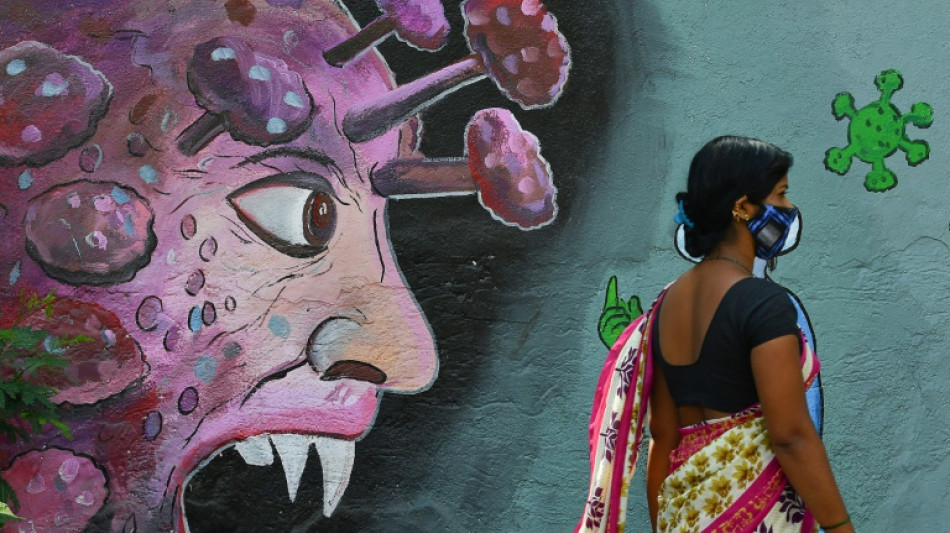
Researchers start to find clues on the trail of long Covid / Photo: INDRANIL MUKHERJEE - AFP/File

 Morikawa says LIV players face 'business decision' after Rahm exit
 Tenzing Norgay's son says Himalayas sending climate warning

 On your bike! Bottas opts for two wheels to reach Singapore GP

 Alcaraz, Sinner, Osaka commit to Australian Open '1 Point Slam'

 Dodgers beat Braves to advance in MLB playoffs, Rays oust Yankees

 'A sun as black as my lungs': how corruption crucified a polluted Albania city

 The British historian helping the French rediscover de Gaulle

 Dodgers beat Braves to advance, Guardians survive in MLB playoffs

 Latin American, Caribbean women top Nobel literature buzz
 US says Fiji-based Chinese official paid bribes for Beijing

 After botched US execution, Christa Pike was nearly taken off life support

 Guinea-Bissau junta urges military unit loyal to ex-president to disarm

 As species decline, green turtles offer glimmer of hope

 Brothers Scott and Beauden Barrett named to start for All Blacks

 EU trade chief seeks to dial down China tensions

 'Never again Bolsonaro': thousands march ahead of Brazil election runoff

 After botched execution, US woman was nearly taken off life support before revival
 Searing AIDS drama 'Elsinore' opens London film festival

 Evicted pensioner who sparked Spain housing protests dies: tenant union

 Golf star Rahm quitting LIV tour over 'unacceptable' terms

 Thousands march fearing return of a Bolsonaro presidency in Brazil
 French PM denies police ordered to confront student protesters
 Rubio touts US power, calls on Europe to emerge from 'slumber'

 Trump says 'we don't think' Russian plague is bio-weapon

 Five children among 26 killed in Ukraine after Russian strikes

Tens of millions of people across the world are thought to suffer from long Covid, but four years after the pandemic was declared this elusive condition still cannot be tested for -- let alone treated.
However research could be finally starting to find early clues on the trail of long Covid, raising hopes of future breakthroughs that may also illuminate other stubbornly ambiguous chronic syndromes.
Long Covid is the name given to a wide variety of symptoms still being suffered by people weeks and months after they first contracted the SARS-CoV-2 virus.
The most common are fatigue, shortness of breath, muscle pain and brain fog.
One notable study released last month showed there were significant differences in the proteins of the blood of more than 110 long Covid patients.
Onur Boyman, a Swiss researcher and senior author of the Science study, told AFP he believes this is a "central puzzle piece" in what keeps Covid raging for so long in the bodies of some people.
Part of the body's immune system called the complement system, which normally fights off infection by killing infected cells, remains active in people with long Covid, continuing to attack healthy targets and causing tissue damage, the researchers said.
Boyman said that when people recovered from long Covid, their complement system also improved, suggesting a strong link between the two.
"It shows that long Covid is a disease and you can actually measure it," Boyman said, adding the team hopes this could lead to a future test.
Researchers not involved in the study cautioned that this complement system "dysregulation" could not explain all the different ways that long Covid seems to attack patients.
Still, it is "great to see papers coming out now showing signals which might start to explain long Covid", said Claire Steves, professor of ageing and health at King's College London.
- 'Every aspect of my life' -
Lucia, a US-based long Covid sufferer who preferred not to give her last name, told AFP that "studies like these bring us a lot closer to understanding" the condition.
She pointed to another recent paper which found damage and fewer mitochondria in the muscles of long Covid patients, which could indicate why many patients become exhausted after even a small amount of exercise.
For Lucia, long Covid turned climbing up the stairs to her apartment into a daily battle.
When she first caught Covid in March 2020, Lucia said she could not have imagined how the condition would "affect every aspect of my life -- including socially and financially".
Lucia, a member of the Patient-Led Research Collaborative, emphasised that people with long Covid do not only have to deal with their many health issues.
They also have "to contend with disbelief or dismissal from the medical community or from within their social circles", she said.
The importance of supporting patients was highlighted by a BMJ study this week, which found that group rehab improved the quality of life of long Covid patients.
- Why has it been so hard? -
Ziyad Al-Aly, a clinical epidemiologist at Washington University in St Louis, said long Covid has been so elusive because it is a "multi-system disease".
"Our minds are trained to think about diseases based on organ systems" such as heart or lung disease, he told AFP.
But understanding the mechanisms behind long Covid could more broadly answer "why and how acute infections cause chronic disease", he said.
This means solving the mystery of long Covid may bolster the fight against other conditions such as chronic fatigue syndrome or lingering symptoms after influenza, increasingly referred to as "long flu".
While the true number of long Covid sufferers is difficult to determine, the World Health Organization says it could be between 10-20 percent of all people who have contracted the disease.
Research from the US Centers for Disease Control and Prevention has suggested that the percentage of people who get long Covid has decreased as new coronavirus variants have become less severe.
Vaccination against Covid has been shown to significantly reduce the chance that people will get long Covid, emphasising the importance of booster shots, researchers say.
Q.Bulbul--SF-PST