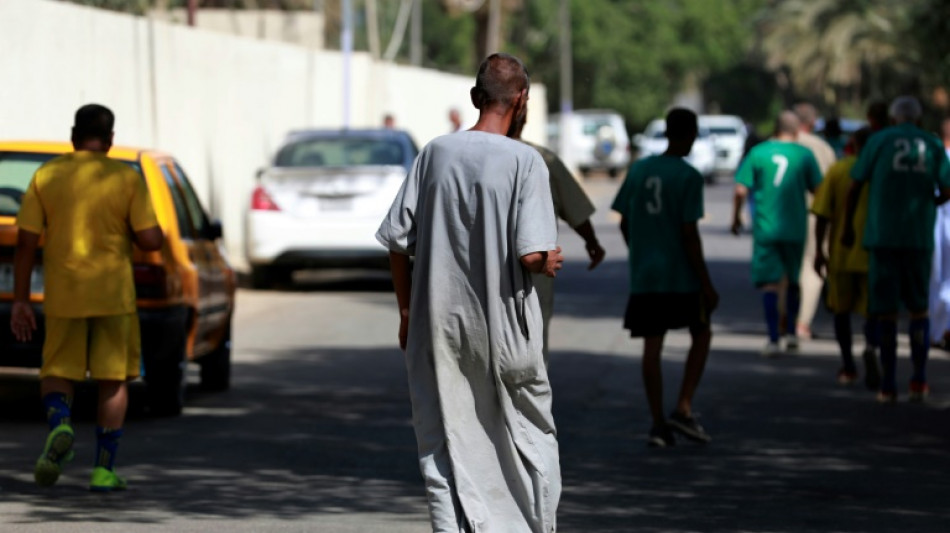
Iraqis haunted by war battle mental health issues / Photo: Ahmad AL-RUBAYE - AFP

 Sri Lanka's de Silva quits as Test captain

 Alcaraz feeling 'mentally fresh' ahead of Shanghai return
 Israel drastically reduces British diplomatic presence in Jerusalem
 Stocks fall further as oil surge fans fresh inflation worries

 North Korea demands South show 'utmost respect' to restore relations
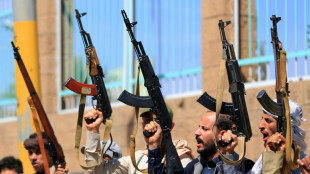 Saudi says three dead in airport attacks claimed by Houthis

 'Mad dream': New showcase for African film opens in London

 All Blacks coach Rennie says Wallabies exit 'part of the game'

 The growing protests against India's poll body - and PM Modi
 Stocks fall further as oil spike fans fresh inflation worries
 Bad COP, worse COP? EU tempers hopes for UN climate summit

 Rookie Henry named in Wallabies midfield to face All Blacks
 Housing crisis set to dominate Spain's snap election
 Gas, health care, utilities: high costs squeeze US midterm voters
 New Zealand Rugby seeks injunction over PNG Chiefs name
 Samsung expects 780% quarterly operating profit jump on AI boom

 Guardians survive with 9-3 win over White Sox

 Saudi Arabia says 3 dead at airports after Houthis claim attacks

 Stocks slide as oil sees volatile trading day over Iran war fears
 Microsoft pushes AI vision with new, expensive Surface laptop
 Five children among 28 killed in Russian strikes on Ukraine

 Odell Beckham Jr signs with Minnesota Vikings

 Saudi Arabia says three dead at airports after Houthis claim attacks
 Trump plans to turn Florida golf course into presidential retreat
 WHO says cannot conduct full risk assessment on Russia plague reports
Raghad Qassem searched all over Iraq's capital Baghdad for a psychologist she could talk to about her problems, before finally settling for consultations online.
It was the best she could do in a state haunted by decades of conflict and trauma, where mental health is poorly treated and professionals are few and far between.
The World Health Organization estimates that in a country of 43 million, there are just two mental health workers for every 100,000 Iraqis.
Qassem admitted she was long oblivious to her mental health needs, and only became aware of their importance "when hitting my thirties".
It was while quarantined during the Covid pandemic that she "began to recognise symptoms of depression", Qassem said.
"I realised that's what I had," said the 34-year-old women's activist.
She wanted to talk directly to a psychologist in Baghdad, because "when I speak I like to have the person in front of me".
Many of her friends recommended that she see a doctor, but she was hesitant to do so because those who did "were treated with pills".
Turning instead to the internet, she spoke to several psychologists, including a Lebanese woman with whom she was able to unravel the reasons for her unhappiness.
- Demand is great -
"It's because of her that I became aware of an accumulation of trauma from the war, the fear and anxiety I had in 2003 and since," she said, harking back to the US-led invasion to oust Saddam Hussein which precipitated one of the bloodiest eras in Iraqi history.
The world has closely followed the war in Gaza between Israel and Palestinian militant group Hamas, which has claimed many thousands of lives –- but such suffering and the psychological trauma it triggers have also plagued Iraq.
Ravaged by war and rocked by Islamic State group attacks, Iraq's demand for mental health professionals is great, but help is hard to come by.
Baghdad's Al-Rashad psychiatric hospital receives patients suffering from serious psychological illnesses, such as schizophrenia, and offers outpatient treatment for depression, anxiety and post-traumatic stress disorder.
At the hospital, haggard-looking patients can be seen wandering alone through the corridors. Some have been at Al-Rashad for decades, said its director Firas al-Kadhimi.
"There's a shortage of specialised doctors," he told AFP.
Kadhimi's hospital has only 11 psychiatrists for its 1,425 patients, aged between 14 and 70, the director said.
"I don't think there's anywhere else in the world where a doctor has to treat 150 patients in the space of 30 days," he said.
Another five social workers are on staff at the facility, but they have to see 100 patients daily and sometimes do their consultations three at a time.
There are however music and art workshops for patients.
In a small theatre with red seats, three elderly people on stage rehearsed a skit prepared by a former hospital employee, who comes in to help.
- People more receptive -
Previously, it might have been difficult for an Iraqi to say, "I have a mental problem", but attitudes have become more accepting thanks to news and social media.
"The number of visitors is rising in the consultation clinics," Kadhimi said.
Psychologist Zeinab Abdel Razaq works with French charity Doctors Without Borders (MSF) in Baghdad.
Razaq told AFP that while there may still be a mental health "stigma" in Iraq, it had "begun to decrease".
"People are more receptive to psychology," she said.
One patient, Zeinab Abdelwahab, said she initially came for physiotherapy and stayed for mental health care.
After several months of sessions, "I noticed a radical change in my mood," said the thirty-something with a painful personal history.
Her mother died, she said, her father was sick, she suffers from polio and has had several falls, fracturing her knees and pelvis.
Abdelwahab recognised that her own perception of psychological care had been distorted by social beliefs.
"When I came here, I realised that it is not just for crazy people," she said.
"They're just people who need to speak to someone else, seeking comfort about how they feel. And with no restrictions."
C.AbuSway--SF-PST