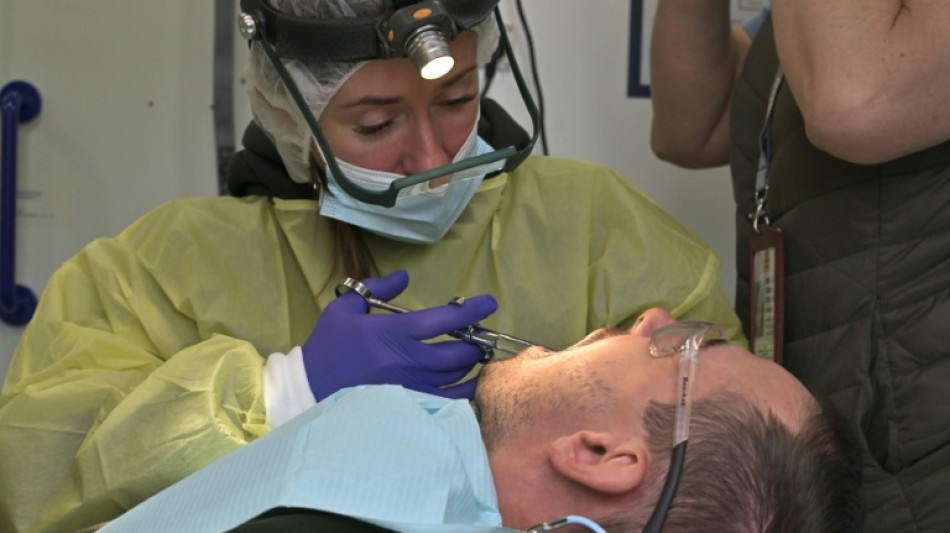
Ukraine dentists brave frontline fire to treat troops / Photo: Genya SAVILOV - AFP

 أين الأمن القومي العربي؟.. تحليل نقدي لغياب الرؤية المشتركة

 Crude Oil Prices Rise on Reports of Houthi Attack on Saudi Refinery

 El Nino’s Weakening Grip on Tamil Nadu Rainfall Hinges on Potential Cyclone

 Black Friday Discounts Cut Prices on Two Top-Rated Wiper Blades

 Twickenham Grounds Team Prepares Pitch for Six Matches in Three Days

 Luxembourg City Plans €13 Million Abrigado Centre for 2029

 Two A1 Crashes Create Kilometres of Rush-Hour Congestion

 South Africa Places 36 Hospitals on Standby for Possible Imported Ebola Cases

 Tamil Nadu Secures Rs 58,214 Crore in Investments at Vettri Conclave

 فرنسا تدعو لتجريم "الفصل العنصري القائم على الجنس" دولياً

 أزمة الصواريخ الاعتراضية في البنتاغون: استنزاف المخزونات يفرض تعبئة صناعية حتى 2030

Oleksandr Kovalyov is groggy but happy to be rid of his toothache.
The Ukrainian soldier has just spent 90 minutes getting treated in a mobile dental clinic some 30 kilometres (19 miles) from the front line.
"The dentist removed nerves and made a new filling. Everything's going okay. I can still feel the anaesthetic," the 31-year-old soldier told AFP, emerging from a brand-new yellow mobile unit donated by Luxembourg which contains a fully equipped dental surgery.
Looking weary, he said he dozed off in the dentist's chair because he has not had enough sleep recently.
For soldiers like him, with little opportunity to see a dentist, toothache is a common problem. The mobile unit brings dental treatment to them through civilian volunteers willing to risk the dangers.
- 'Premium clinic' -
The yellow truck has set off from the city of Kramatorsk in east Ukraine and parked in a hamlet with a dozen inhabitants deep in the countryside.
Kovalyov and four other members from his mortar unit have arrived at the meeting point to get treatment.
Wearing a yellow gown, face mask and gloves and equipped with a magnifying device and a torch, 49-year-old dentist Laya Sarayeva is treating patients in a cramped space measuring around six square metres (65 square feet).
"Obviously we are used to working in a different way, to having more space," she said.
"But we are operating here at the level of a premium clinic. Not all city clinics have what we have here," she added.
Sarayeva and her colleague Igor Ryskin, a 46-year-old dental surgeon, are volunteers for a Ukrainian NGO called Life Saving Centre.
Since the start of the year, they have been driving out together in the mobile unit covering areas near the eastern frontlines.
"We started off doing it together and we were working all the time. Then Laya found some other dentists through social media who are (now also) treating our heroes," said Ryskin.
The pair now volunteer at weekends, taking time out from treating civilian patients in the large city of Kharkiv further north.
A second mobile unit, staffed by other volunteer dentists, stays on a fixed site in Kramatorsk.
- Long wait -
The other soldiers are sitting patiently in an SUV, sheltering from wind and rain.
They have driven over from the Lyman area, where they are fighting Russian forces.
The driver, a 41-year-old who only gave his first name Oleksiy, said he needs a checkup since he has not had one for more than a year.
Soldiers try to access dental clinics in nearby towns, he said but "there are long waiting lines... So it's not always possible to see a dentist."
Kovalyov said the mobile unit "is really necessary" since "there are places, isolated villages where we have neither the time nor the opportunity to make an appointment and get treated".
Yevgen Gorbunov, a 29-year-old military nurse based in the hamlet, said apart from combat injuries, "toothaches are probably the number one problem after back pain" for soldiers.
"Due to lack of vitamins, stress and nerves, teeth are the first thing to crumble."
"It is a great thing that these mobile dental clinics exist."
- 'Better to be happy' -
"It is difficult to work in such conditions, but for professionals it is an exciting experience," Sarayeva said.
The dentists say they try not to think about danger like the soldiers they treat.
"The guys aren't scared. And we have to show them that we're not scared either, we're in it together," dental surgeon Ryskin said.
"Sometimes you treat the boys, you shake hands, you hug, and a week later you find out that that person is no longer there. That's the hardest part for me."
Sarayeva said she refused to be scared.
"Fear doesn't change the situation. If a missile comes, whether you're afraid or not, you'll die either way, in joy or in tears. It's better to be happy," she said.
G.AbuHamad--SF-PST

