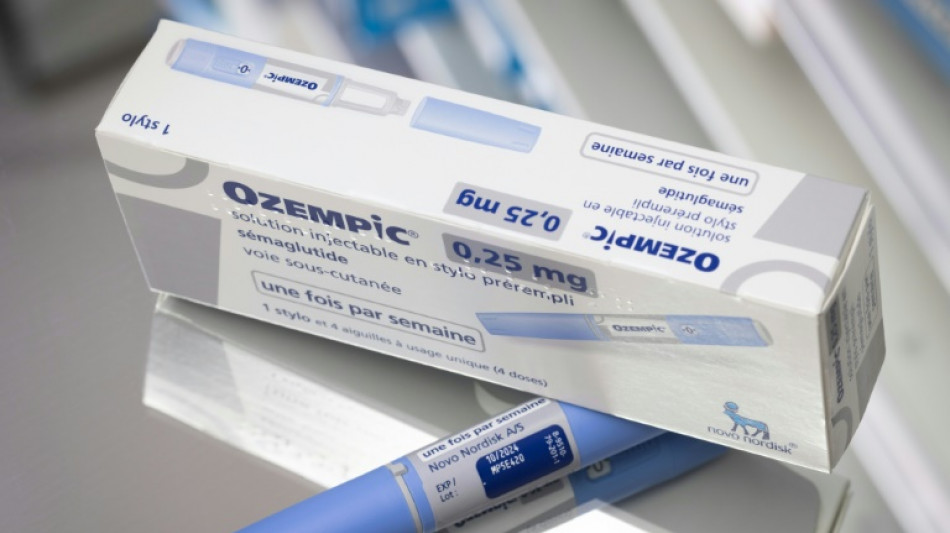
Popular weight loss drugs linked to higher risk of stomach paralysis / Photo: JOEL SAGET - AFP/File

 Alex Bodi pushes ahead with expansion: ALIX LASERS showroom planned for Bucharest

 Fossil fuels off COP31 agenda as global output keeps rising

 Haze not 'a threat' to Singapore F1 race: organisers

 COP31 organisers say to seek 'ambitious' action with their text

 Bartunkova thrashes Muchova to reach China Open semi-finals

 Drone hits Yandex data centre, in first such attack on Russia

 Oil prices surge and stocks sink on fresh inflation worries

 AI startup Manus raises $500m after Meta acquisition blocked by China

 From refuge to repatriations: Malaysia's Myanmar U-turn

 Morikawa says LIV players face 'business decision' after Rahm exit

 Tenzing Norgay's son says Himalayas sending climate warning

 On your bike! Bottas opts for two wheels to reach Singapore GP

 Alcaraz, Sinner, Osaka commit to Australian Open '1 Point Slam'

 Dodgers beat Braves to advance in MLB playoffs, Rays oust Yankees

 'A sun as black as my lungs': how corruption crucified a polluted Albania city

 The British historian helping the French rediscover de Gaulle

 Dodgers beat Braves to advance, Guardians survive in MLB playoffs

 Latin American, Caribbean women top Nobel literature buzz

 US says Fiji-based Chinese official paid bribes for Beijing

 After botched US execution, Christa Pike was nearly taken off life support

 Guinea-Bissau junta urges military unit loyal to ex-president to disarm

 As species decline, green turtles offer glimmer of hope

 Brothers Scott and Beauden Barrett named to start for All Blacks

 EU trade chief seeks to dial down China tensions

 'Never again Bolsonaro': thousands march ahead of Brazil election runoff

Drugs like Ozempic, which have become increasingly popular for losing weight, heighten the risk of certain severe gastrointestinal problems including stomach paralysis, according to a large study published Thursday.
The paper, published in the Journal of the American Medical Association (JAMA), looked at a class of drugs called GLP-1 agonists that includes the brands Wegovy, Ozempic, Rybelsus and Saxenda.
It then compared the rate of serious side effects to another class of weight loss drug, bupropion-naltrexone.
The GLP-1 agonists were associated with an almost four times increased risk of stomach paralysis, a nine times higher risk of pancreatitis and four times greater risk of bowel obstruction.
These conditions can cause hospitalization and require surgery, depending on their severity.
"Given the wide use of these drugs, these adverse events, although rare, must be considered by patients thinking about using them for weight loss," said lead author Mohit Sodhi, a medical student at the University of British Columbia in Canada, in a statement.
"The risk calculus will differ depending on whether a patient is using these drugs for diabetes, obesity or just general weight loss," he added. "People who are otherwise healthy may be less willing to accept these potentially serious adverse events."
Originally developed for managing Type 2 diabetes, GLP-1 agonists have soared in popularity in recent years as a means to lose weight, mainly through "off-label" use.
Saxenda and Wegovy were approved for weight loss in 2020 and 2021, but the clinical trials used to greenlight them involved too few people with too short a follow-up time to detect very rare events, the researchers said.
Epidemiologist and co-author Mahyar Etminan said that while there had been anecdotal reports of some patients using these drugs for weight loss and then having repeated episodes of nausea and vomiting as a result of stomach paralysis, the current study was the first to examine the question at a larger scale.
The authors trawled through US patient records searching for people prescribed liraglutide or semaglutide -- the two main GLP-1 agonists -- or bupropion/naltrexone, a non GLP-1 weight loss medication, to see how many went on to develop certain gastrointestinal conditions.
Their analysis included patients with a recent history of obesity, but excluded those with diabetes or who had been prescribed another antidiabetic drug. Just over 5,400 records were included in the final analysis.
"The results from this study highlight how important it is that patients access these drugs only through trusted medical professionals, and only with ongoing support and monitoring," said Simon Cork, a senior lecturer at Anglia Ruskin University, who was not involved in the research.
"It is vital that regulation is tightened to ensure that these drugs are only prescribed under the right circumstances."
R.Shaban--SF-PST