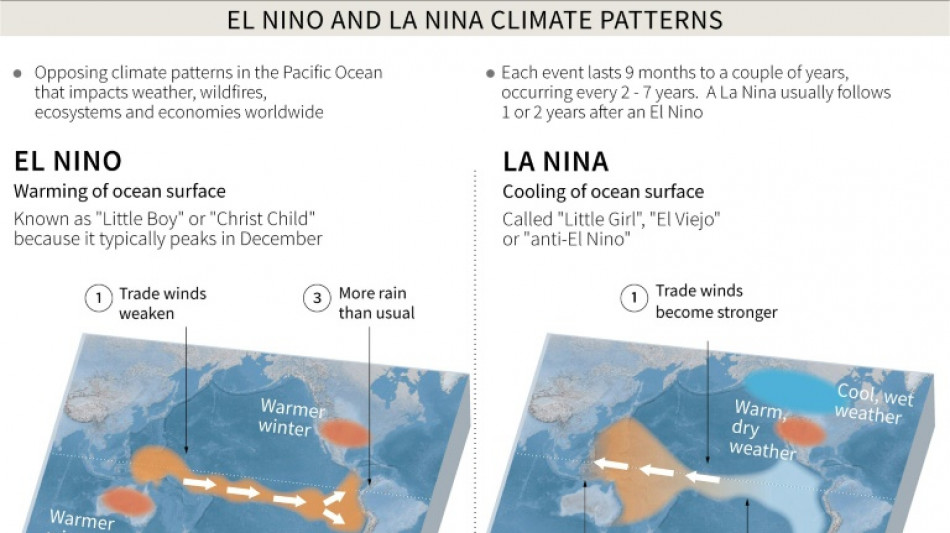
How El Nino could impact health, food and the economy / Photo: Gal ROMA, Sophie RAMIS - AFP

 Alex Bodi pushes ahead with expansion: ALIX LASERS showroom planned for Bucharest

 Fossil fuels off COP31 agenda as global output keeps rising

 Haze not 'a threat' to Singapore F1 race: organisers

 COP31 organisers say to seek 'ambitious' action with their text

 Bartunkova thrashes Muchova to reach China Open semi-finals
 Drone hits Yandex data centre, in first such attack on Russia

 Oil prices surge and stocks sink on fresh inflation worries

 AI startup Manus raises $500m after Meta acquisition blocked by China

 From refuge to repatriations: Malaysia's Myanmar U-turn

 Morikawa says LIV players face 'business decision' after Rahm exit
 Tenzing Norgay's son says Himalayas sending climate warning

 On your bike! Bottas opts for two wheels to reach Singapore GP

 Alcaraz, Sinner, Osaka commit to Australian Open '1 Point Slam'

 Dodgers beat Braves to advance in MLB playoffs, Rays oust Yankees

 'A sun as black as my lungs': how corruption crucified a polluted Albania city

 The British historian helping the French rediscover de Gaulle
 Dodgers beat Braves to advance, Guardians survive in MLB playoffs

 Latin American, Caribbean women top Nobel literature buzz

 US says Fiji-based Chinese official paid bribes for Beijing

 After botched US execution, Christa Pike was nearly taken off life support

 Guinea-Bissau junta urges military unit loyal to ex-president to disarm

 As species decline, green turtles offer glimmer of hope

 Brothers Scott and Beauden Barrett named to start for All Blacks

 EU trade chief seeks to dial down China tensions
 'Never again Bolsonaro': thousands march ahead of Brazil election runoff

The El Nino weather phenomenon is just warming up, according to scientists, potentially paving the way for higher temperatures and extreme weather events in a year that has already seen plenty of both.
The first El Nino in years began last month, according to the World Meteorological Organization.
The naturally occurring warming of temperatures in the Pacific Ocean typically lasts between nine to 12 months, and is expected become stronger towards the end of the year.
Scientists have warned the impacts of El Nino -- combined with human-induced global warming -- will likely stretch beyond the weather.
- Disease -
Vector-borne diseases, such as malaria and dengue, have been shown to expand their range as temperatures rise.
Scientists warned that El Nino, coming in addition to already dire global warming, could make the situation worse.
"We can see from previous El Ninos that we get increases and outbreaks of a wide range of vector-borne and other infectious diseases around the tropics, in the area that we know is most affected by El Nino," Madeleine Thomson, head of climate impacts at the Wellcome Trust charity, told journalists on Thursday.
The rise stems from two effects of El Nino: unusual rainfall that increases breeding sites for transmitters such as mosquitoes, and higher temperatures that speed up transmission rates of various infectious diseases.
An El Nino in 1998 was linked to a major malaria epidemic in the Kenyan Highlands.
– Health -
It is difficult to calculate exactly how much El Nino contributes to extreme weather events such as wildfires.
But heatwaves themselves pose a significant danger to health.
"It's sometimes named the silent killer because you don't necessarily see it as a threat," said Gregory Wellenius, head of a climate and health centre at Boston University.
"But heatwaves in fact kill more people than any other type of severe weather events."
More than 61,000 people are estimated to have died due to the heat in Europe alone last summer -- when there was no El Nino.
And July 2023 has now been confirmed as the hottest month in recorded history.
- Food security -
"In an El Nino year, there are countries where the chances of having a bad harvest increase, for example in South and Southeast Asia," said Walter Baethgen of the International Research Institute for Climate and Society.
Last month India, the largest rice exporter in the world, restricted its exports due to crop damage from irregular monsoon rains.
According to the researchers, such actions have the potential for dire consequences for countries dependent on the exports, such as Syria and Indonesia, that could face a "triple challenge" during El Nino.
"The rice harvest in those countries may be lower than normal, the rice trade may be more difficult or less accessible in the international market and because of that, the price of rice will be high," said Baethgen.
"This combination of factors pretty rapidly affects the food insecurity problems," he added.
- Economic growth -
The Panama Canal is central to global trade routes, but last week the passageway announced that low rainfall -- which meteorologists said was exacerbated by El Nino -- forced operators to restrict traffic, resulting in an expected $200 million drop in earnings.
The sidelined ships are just one example of how El Nino can hurt the global economy.
A study published in the journal Science in May estimated that past El Ninos cost the global economy more than $4 trillion in the years that followed them.
Impacts from both El Nino and global warming were "projected to cause $84 trillion in 21st-century economic losses", it said.
However researchers at Oxford Economics have argued against these projections, calling El Nino a "new risk, but not a gamechanger".
The costs may remain unclear, but the scientists hope the predictability of El Nino will improve preparedness for the challenges ahead posed by a warming world.
"Preparation is much more effective than emergency responses," Wellenius said.
Y.AlMasri--SF-PST