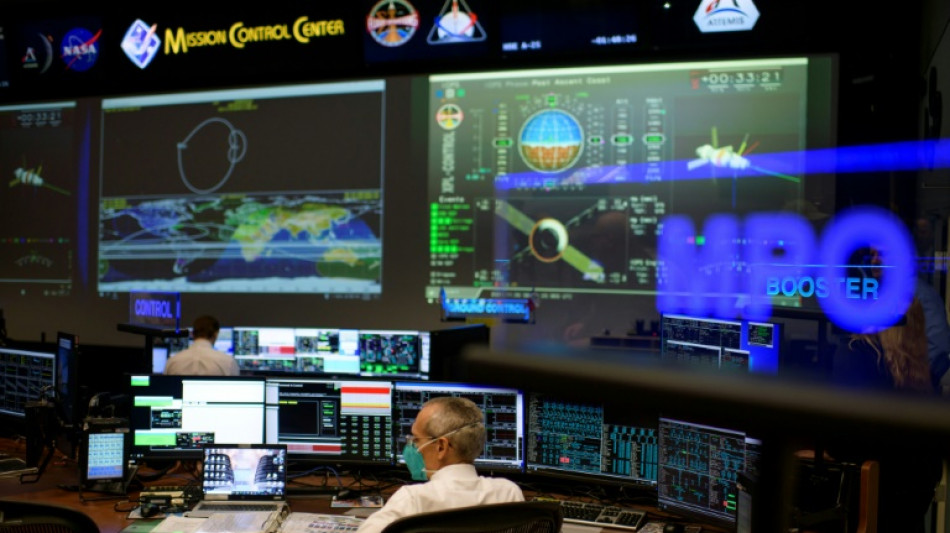
All systems go in Houston as NASA prepares return to Moon / Photo: Mark Felix - AFP

 Brazil's Lula turns 81, vows to work '24 hours a day'

 Starc takes six as Australia fight back in South Africa decider

 UK man offered drugged wife to strangers online for sex: court

 مقتل حسام الزاملي برصاصة أصابت خيمة عائلته في مواصي خان يونس

 الأردن يعلن مقتل عناصر من داعش ويعرب عن الأسف لسقوط مدنيين في سوريا

 Bayern 'risk' reaps huge reward for Ballon d'Or winner Kane

 Record turnout as Israeli voters deliver verdict on Netanyahu

 Boeing reports smaller loss as it aims for stable output growth

 Iraola says Isak 'feels the trust' after Liverpool scoring streak

 Tech firms gain on Anthropic IPO optimism; HSBC slumps in London

 French media protest manhandling of journalists at far-right party rally

 EU seeks deportation powers for beefed up border agency

 أميرات أوروبيات يخترن التدريب والخدمة في صفوف القوات المسلحة

 Two charged with UK security offences over airbase plot: police

 الحزب الليبرالي يقبل فوز لولا ويتجه إلى مسار قانوني بشأن الحملة الانتخابية

 Greenhouse gas levels hit new record highs in 2025: UN

 Rybakina looking to clinch year-end number one in Tokyo

 Tech firms track Wall St rally on mixed day for stock markets

 Kane says Ballon d'Or win 'feels like a dream' as tributes pour in

 HSBC profit jumps on higher rates, lower costs

 Rams rediscover offensive balance in 35-21 victory over Raiders

 Mercedes-Benz cuts 2026 profit outlook on tough China market

 Reparations calls follow Charles on tough Caribbean trip

 Jammu and Kashmir ministers resign before planned council expansion

 Germany, EU, stable investment stops despite upheaval: Merz

Rick LaBrode has worked at NASA for 37 years, but he says the American quest to return to the Moon is by far the crowning moment of his career.
LaBrode is the lead flight director for Artemis 1, set to take off later this month -- the first time a capsule that can carry humans will be sent to the Moon since the last Apollo mission in 1972.
"This is more exciting than really anything I've ever been a part of," LaBrode told journalists at the US space agency's Mission Control Center in Houston, Texas.
The 60-year-old confided to AFP that the eve of the launch is likely to be a long night of anticipation -- and little rest.
"I'm going to be so excited. I won't be able to sleep too much, I'm sure of that," he said, in front of Mission Control's iconic giant bank of screens.
Artemis 1, an uncrewed test flight, will feature the first blastoff of the massive Space Launch System (SLS) rocket, which will be the most powerful in the world when it goes into operation.
It will propel the Orion crew capsule into orbit around the Moon. The spacecraft will remain in space for 42 days before returning to Earth.
From 2024, astronauts will travel aboard Orion for the same trip, and the following year, at the earliest, Americans will once again step foot on the Moon.
For the duration of Artemis 1, a team of about a dozen NASA personnel will remain in Mission Control 24 hours a day. The center has been renovated and updated for the occasion.
Teams have been rehearsing for this moment for three years.
"This is a whole new deal -- a whole new rocket, a whole new spacecraft, a whole new control center," explained Brian Perry, the flight dynamics officer, who will be in charge of Orion's trajectory immediately following the launch.
"I can tell you, my heart is going to be tum tum, tum tum. But I'll work hard to keep focused," Perry, who worked on numerous space shuttle flights over the years, told AFP, tapping his chest.
- Moon pool -
Beyond upgrades to Mission Control for the mission, the entire Johnson Space Center is a bit over the Moon about Artemis.
In the middle of the giant astronaut training tank -- the world's largest indoor swimming pool at more than 200 feet long, 100 feet wide and 40 feet deep -- a black curtain has been erected.
On one side of the so-called Neutral Buoyancy Lab is a mockup of the International Space Station, submerged.
On the other, the lunar environment is gradually being recreated at the bottom of the pool, with giant model rocks made by a company specializing in aquarium decorations.
"It's only been in the last few months that we started to put the sand on the bottom of the pool. We just got that large rock in two weeks ago," said the lab's deputy chief Lisa Shore. "It's all very new for us and very much in development."
In the water, astronauts can experience a sensation that approaches weightlessness. To train for eventual voyages to the Moon, simulations must replicate the Moon's one-sixth gravity.
From a room above the pool, the astronauts are guided remotely -- with the four-second communications delay they will experience on the lunar surface.
Six have already done training and six more will do so by the end of September. The latter group will wear the new spacesuits made by NASA for Artemis missions.
"The heyday of this facility was when we were still flying the space shuttle and we were assembling the space station," explained the lab's office chief John Haas.
At that time, 400 training sessions with astronauts in full spacesuits took place every year, as compared with about 150 today. But the Artemis program has infused the lab with new urgency.
When AFP visited the facility, engineers and divers were testing how to pull a cart on the Moon.
- 'New golden age' -
Each session in the pool can last up to six hours.
"It's like running a marathon twice, but on your hands," astronaut Victor Glover told AFP.
Glover returned to Earth last year after spending six months on the International Space Station. Now, he works in a building dedicated to simulators of all varieties.
He said his job is to help "verify procedures and hardware" so that when NASA finally names the Artemis astronauts who will take part in crewed missions to the Moon (Glover could be on that list himself), they can be "ready to go."
Using virtual reality headsets, the astronauts can get used to walking in dark conditions at the Moon's South Pole, where the missions will land.
The Sun barely rises above the horizon there, meaning there are always long, dark shadows that impair visibility.
The astronauts must also get used to the new spacecraft like the Orion capsule, and the equipment on board.
In one of the simulators, seated in the commander's chair, personnel are trained to dock with the future lunar space station Gateway.
Elsewhere at the space center, a replica of the Orion capsule, which measures a mere 316 cubic feet (nine cubic meters) for four people, is in use.
"They do a lot of emergency egress training here," Debbie Korth, deputy manager of the Orion program, told AFP.
Korth, who has worked on Orion for more than a decade, said everyone in Houston is excited for the return to the Moon and for NASA's future.
"Definitely, I feel like it is like a new golden age," she said.
V.AbuAwwad--SF-PST