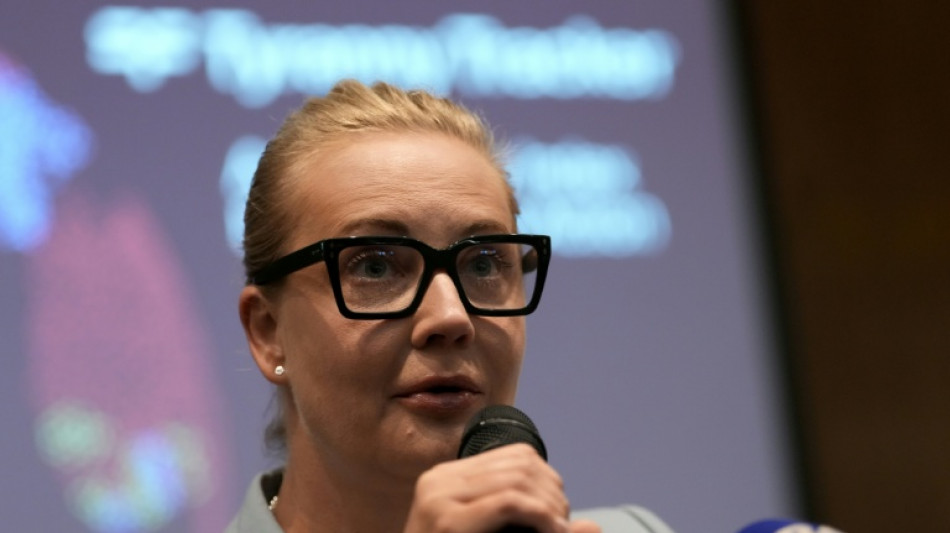
Exiled Russian dissident Navalnaya warns dictators becoming 'more cunning' / Photo: CARLOS JASSO - AFP

 Indiana River Otters Make Comeback After Decades of Conservation Efforts

 Tamil Film 'Arivu' Selected for 57th International Film Festival of India

 أسعار الديزل في الولايات المتحدة تنخفض دون 6 دولارات لأول مرة منذ شهرين
 Why Wind Farms Paint One Turbine Blade Black to Protect Birds
 Dianna Russini Seeks Super Bowl Radio Row Credential Amid Media Return
 Clare Luvanga Leads Washington Spirit to Third Straight NWSL Championship with 2-1 Win

 Malta Stuns Sweden with Late Penalty Comeback in Rugby Europe Trophy

 BingX: Major Announcement of Far-Reaching Significance

 أونروا تحذر من أزمة إنسانية في غزة بسبب القيود على الإغاثة
 Big Brother’s Omar El Mayer Addresses Backlash, Confirms Relationship with Rhianna Collins
The widow of Russian opposition leader Alexei Navalny warned Tuesday that dictators are becoming "more cunning", as she helped launch a report revealing deepening global ties between autocrats and authoritarian-leaning parties.
Yulia Navalnaya, who heads the US-based Human Rights Foundation (HRF), urged people not to underestimate the threat that "very dangerous" dictators and their networks pose, arguing they can "only be defeated if those who fight for freedom cooperate too".
"They learn from one another, they work together," she told journalists in London at the launch of the new report, which finds European far-right parties are increasingly coordinating with authoritarian regimes beyond the continent.
"They turn to their own advantage the tools that free and democratic countries give them," she said.
"They know how to exploit the financial and legal systems of Western countries, how to get around restrictions and sanctions."
Navalnaya's husband Navalny, a staunch critic of Russian President Vladimir Putin, died in prison in 2024 while serving a 19-year sentence.
Five European countries, including Britain, France and Germany, concluded earlier this year that he was killed by a "rare toxin" from a dart frog and that the Russian state was the prime suspect.
Navalnaya, 50, has become Russia's leading exiled opposition figure, touring the world to meet foreign leaders, organising opposition rallies and publishing investigations into the alleged corruption of Putin's inner circle.
Asked about US special envoy Steve Witkoff recently telling Putin he was a humanitarian, she called the comment "nonsense" and "a pity".
- 'Crush dissent' -
The HRF collaborated with another US-based non-profit, Action for Democracy, to produce its latest "Authoritarian Collaboration Index" trends report.
It relies on data from HRF's "Tyranny Tracker", a real-time monitoring tool of ties between autocratic regimes, authoritarian-leaning governments and far-right parties.
The paper reported that such parties in Europe, such as Nigel Farage's Reform UK, Marine Le Pen's National Rally in France and Alice Weidel's Alternative for Germany (AfD), are now formalising links to "legitimise" each other.
The study said the AfD had this year "deepened its relations with Russia" beyond financial support towards more "dialogue and engagement".
The warnings come ahead of imminent elections in a host of European countries, including Spain, Germany and France, when far-right parties could make unprecedented gains.
The report found that while China and Russia remain the "primary anchors of a global axis of autocracy", media and technological cooperation has become "institutionalised" between similarly minded countries and parties, particularly across Africa and southeast Asia.
Domonkos Kovacs, project lead for the index, said that, amid "global democratic backsliding", the index aimed to "shed light" on this growing "global authoritarian solidarity".
"This is dictators helping each other crush dissent," he told reporters.
L.AbuAli--SF-PST