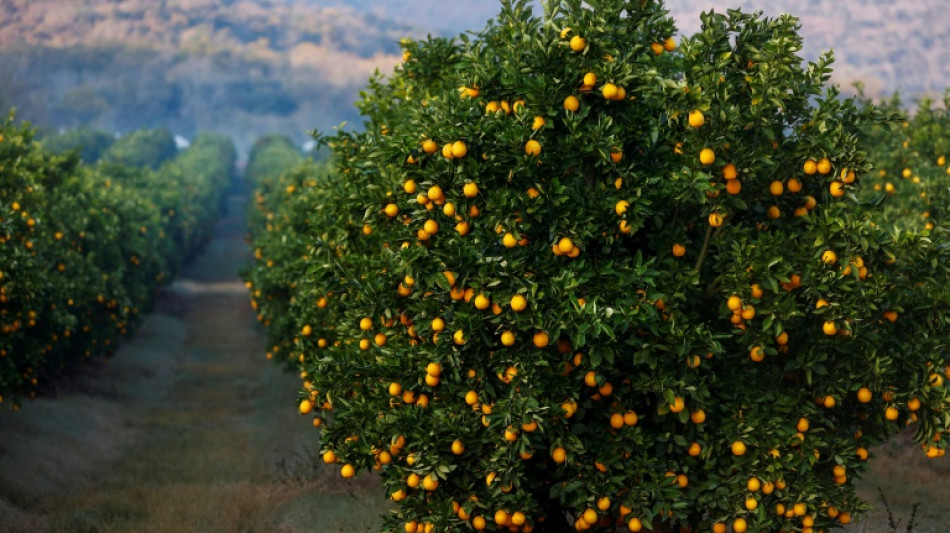
Tonnes of fruit stranded in EU, S.Africa battle of oranges / Photo: Phill Magakoe - AFP

 UN nuclear watchdog chief urges Iran to grant access

 الأسهم الأوروبية تتراجع تحت ضغط اضطرابات فرنسا ونتائج الشركات

 Boeing shares tumble after it releases cautious growth forecast

 Allegri suspended for two Serie A games after red card

 مصر تعمل على أدوات تمويل لتقليص مخاطر الاستثمار الصناعي
 قفزة بنسبة 58% في أسعار الكهرباء الفورية بألمانيا

 Carney moves to remake Canada alliances as US ties strained

 Serbia's students demand state media chiefs resign after poll win

 أسهم التكنولوجيا تدفع الأسواق الصينية إلى أدنى إغلاق في 14 شهراً

 Boeing releases cautious growth plan as shares fall sharply

 منع وفد دولي من دخول الضفة للمشاركة في مؤتمر بجامعة بيرزيت

 Exiled Russian dissident Navalnaya warns dictators becoming 'more cunning'

 Africa Ebola outbreak passes 10,000 cases, mostly in DR Congo

 EU pushes for more nations to pay to protect nature

 صحة غزة تسجل ستة قتلى و32 مصاباً خلال يوم واحد

 مقتل الطفلة جوري الصوفي برصاصة داخل خيمة نزوح في مواصي خان يونس

 بلدية الخليل: النزوح القسري تجاوز ثلاثة آلاف شخص مع استمرار الإخلاء والهدم

 محمد الغول يدعو إلى وحدة فلسطينية لمواجهة مخاطر المرحلة

 Sri Lanka end England hopes with crushing win over Pakistan
 ملاعب وأندية غزة تتحول إلى مراكز لإيواء العائلات النازحة

 Dangote, Nigeria's oil tycoon rewriting Africa's story

 Carrick to remain Man Utd boss for Chelsea clash: reports

 Maresca defends Donnarumma, Guehi after Man City defeat

 Nordic leaders call Putin as local truce begins in Ukraine

 Osaka unveils crane outfit in Tokyo before win over Paolini

Millions of boxes of oranges are spoiling in containers stranded at European ports as South Africa and the European Union lock horns in a dispute over import rules, citrus growers have said.
South Africa, the world's second largest exporter of fresh citrus after Spain, filed a complaint with the World Trade Organisation (WTO) last month after the EU introduced new plant and health safety requirements that orange farmers say threaten their survival.
The measures came into force in July as ships were already at sea carrying hundreds of containers full of South African fruit to Europe, resulting in them being held up on arrival, South Africa's Citrus Growers' Association (CGA) says.
"It's a complete and utter disaster," CGA's CEO Justin Chadwick told AFP by phone.
"Food that has fantastic quality and is safe is (just) sitting there -- and this at a time when people are worried about food security."
The EU rules aim at tackling the potential spread of an insect called the false codling moth, a pest native to sub-Saharan Africa that feeds on fruits including oranges and grapefruits.
The new measures require South African farmers to apply extreme cold treatment to all Europe-bound oranges and keep the fruits at temperatures of two degrees Celsius (35 degrees Fahrenheit) or lower for 25 days.
But the CGA says this measure is unnecessary as the country already has its own, more targeted way of preventing infestation.
In its WTO complaint, South Africa argued that the EU requirements were "not based on science", more restrictive than necessary and "discriminatory".
South African citrus growers say the requirement puts undue extra pressure on an industry already in dire straits.
"This is going to add a lot of costs... and at the moment, that is what no grower in the world can afford," said Hannes de Waal, who heads of the almost 100-year-old farm Sundays River Citrus.
De Waal, whose company has orange, clementine and lemon trees straddling 7,000 hectares (17,000 acres) near the southeastern coast city of Gqeberha, said revenues were already squeezed by high shipping and fertiliser costs.
Freight costs have rocketed since Covid-19 struck, and so has the price of fertilisers due to the war in Ukraine -- Russia being one of the world's largest producers.
- 'Under pressure' -
Europe is the largest market for South Africa's almost $2 billion citrus industry, accounting for 37 percent of all exports, according to the CGA.
The new rules hit at the height of South Africa's orange season, during the southern hemisphere's winter, when export operations were in full swing.
This gave fruit growers too little time to adapt, said Chadwick.
Some 3.2 million cartons of citrus worth about 605 million rand ($36 million) left port with paperwork that would be wrong on arrival.
The South African government was scrambling to issue new documents for shipments that met the new criteria, but hundreds of containers could be slated for destruction, said Chadwick.
South Africa already has an effective anti-moth system, the CGA says.
"Our system does involve cold treatment, but targeted at the risk, whereas the EU measure is a blanket measure that covers all oranges," Chadwick said.
"The higher the risk, the more extreme the cold treatment," he said, of the South African measures.
The dispute is now with the WTO. The parties have 60 days to negotiate a solution. Failing that, the complainant can request the matter be decided by a panel of experts.
The EU said it was confident of the "WTO-compatibility" of its measures.
"The objective of the EU's plant and health safety criteria is to protect the union territory from the potential significant impact on the agriculture and the environment, should this pest establish itself in the union," a spokesperson for the EU Commission said in a statement.
Chadwick hopes that "sense" will prevail and a quick fix can be found.
"Our industry is under pressure. It's basically a year of survival," he said.
L.Hussein--SF-PST