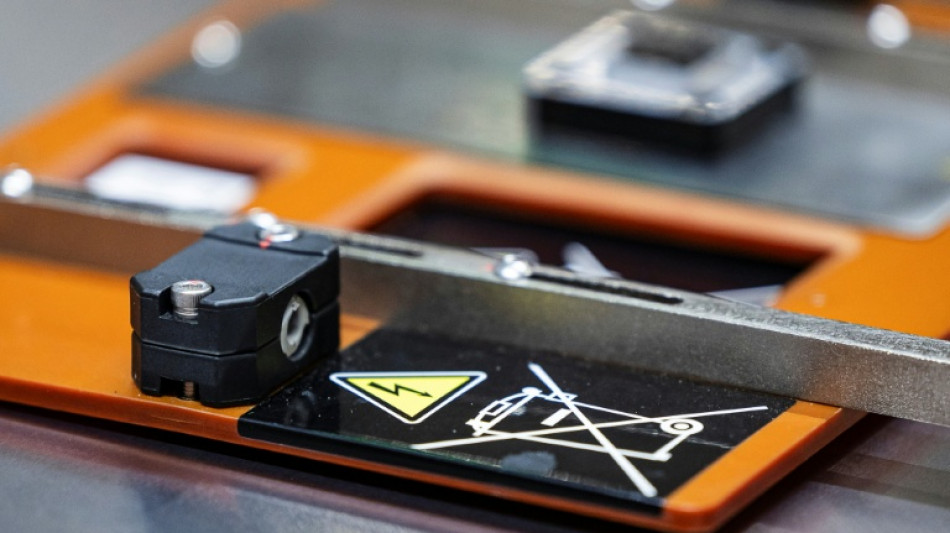
Export ban sparks rush to process lithium in Zimbabwe / Photo: Sameer Al-DOUMY - AFP/File

 Hundreds arrested in French school protests as Macron summons ministers

 WADA seeks tough anti-doping stance from Kenya

 German ex-spy chief arrested for suspected espionage, treason
 Furyk vows US will 'do more' to end Ryder Cup losing streak

 Iyer hits ton as India hammer West Indies in T20 opener

 Mandhana named India women's team captain after Kaur quits

 'The sound keeps coming back': children maimed in Ethiopia's Tigray clashes

 Paris Women's Fashion Week: the key trends

 i-payout Introduces a New Approach to Payments, Closing the Beneficiary Information Gap

 New Generation of Crypto Miners Released by ASICID

 New investor forecasts LIV Golf teams could be worth $100 mn each

 Shakira, Pique return to court over children visit arrangements

 Nobel physics prize hails 'ghostly messengers' from space
 France's Mistral unveils latest model in sovereign AI push

 Stocks climb as oil prices retreat

 Vstock Transfer Names Securities Industry Veteran Erica Goodstein General Counsel and Chief Compliance Officer

 Four Indonesian seamen return home after Somali pirate ordeal

 Crisis-striken Haiti postpones elections

 Germany arrests ex-spy chief on suspicion of giving secrets to foreign powers

 Djokovic wins China Open after de Minaur retires
 IMF warns cost-of-living shocks cause 'lasting deterioration' in affordability

 Alcaraz wins Japan Open for first title since injury return

 'We're working to keep football clean', Turkish minister says

 FIFA chief Infantino hit by Norwegian double complaint

 Exiled Catalan separatist leader Puigdemont cleared to return to Spain

Zimbabwe's ban on raw lithium exports is forcing Chinese miners to rethink their strategy, speeding up plans to process the metal locally instead of shipping it to China's vast rechargeable battery industry.
The country is Africa's largest lithium producer and has one of the world's largest reserves, according to the US Geological Survey (USGS).
Zimbabwe already banned the export of lithium ore in 2022 and in 2025 announced it would halt exports of lithium concentrates from January 2027.
But on Wednesday it imposed the ban with immediate effect, leaving unclear what the lithium mining sector will do in the short term as Zimbabwe currently has no facilities to process lithium concentrates.
The move, which also included a blanket ban on export of all raw minerals, aims to capture the added value of refining and processing, thus creating jobs and additional government tax revenue.
But critics say the push to refine should have come sooner, with Zimbabwe already having lost out on several years of revenues for the hard-pressed local economy.
Prospect Lithium Zimbabwe, owned by Zhejiang Huayou Cobalt, has spent $400 million on a processing plant that should be operational in the coming weeks, its representative Patience Chizodza told state broadcaster ZBC.
It will reportedly be the first factory in Africa to refine lithium concentrate into lithium sulfate -- a powdered form that is one step closer to the product used in batteries.
The facility should be capable of handling 400,000 tonnes a year of concentrate.
The Zimbabwe state-owned Mutapa Energy Minerals is set to start work in the coming months on a similar plant, chief executive officer Innocent Rukweza told reporters earlier this month.
"We expect that by mid-year -- around June at the latest -- construction of a concentrate-processing plant will be under way," Rukweza said.
The $270-million facility funded by Chinese firms would be able to process 600,000 tonnes annually, he said.
- 'Too little, too late' -
Bikita Minerals, Zimbabwe's largest lithium mine and owned by Sinomine Resources Group, is working on feasibility studies for the construction of a lithium sulphate plant in December, spokesperson Tinomuda Chakanyuka said.
"The project, which will be developed in phases, represents an estimated investment of approximately $500 million from shareholders," Chakanyuka told AFP.
He said the facility will increase local capacity to separate minerals and "contribute to Zimbabwe's broader industrialisation and export diversification objectives."
Global demand for the soft, white metal was up 20 percent last year from 2024, with a key factor being EV sales growth in China and Europe and increased demand for batteries, the USGS said.
Zimbabwe's exports of lithium concentrate rose to 1.5 million metric tonnes last year, generating government revenue of $571.6 million, the Minerals Marketing Authority of Zimbabwe (MMCZ) announced in early February.
The Zimbabwean government's moves to ban exports of raw minerals didn't impress its critics.
"Government is doing too little, too late," said Farai Maguwu, executive director of Zimbabwe's Centre for Natural Resource Governance (CNRG).
With the new rush for critical minerals around the world, "people are asking serious questions about the benefits to the producer country," he said.
"A country like Zimbabwe is exporting raw lithium and, in the process, enriching China at its own expense," Maguwu said.
Instead it should be building its own "mine-to-market ecosystem" that manufactures and markets lithium products, he added.
Economist Godfrey Kanyenze accused the government of a "deficit in policy implementation" when it effectively gave a five-year grace period on the 2022 lithium ore ban by allowing exports of raw concentrates.
Kanyenze said state oversight at Chinese-owned lithium mines was limited, making it difficult to determine how much companies actually produced and earned.
There have also been allegations of environmental damage and exploitation of workers, including by paying low wages.
"Zimbabwe must learn from countries like Norway, Botswana and Kuwait, which safeguard their natural resources through firm, consistent and strategic policy frameworks," he said.
Y.Shaath--SF-PST