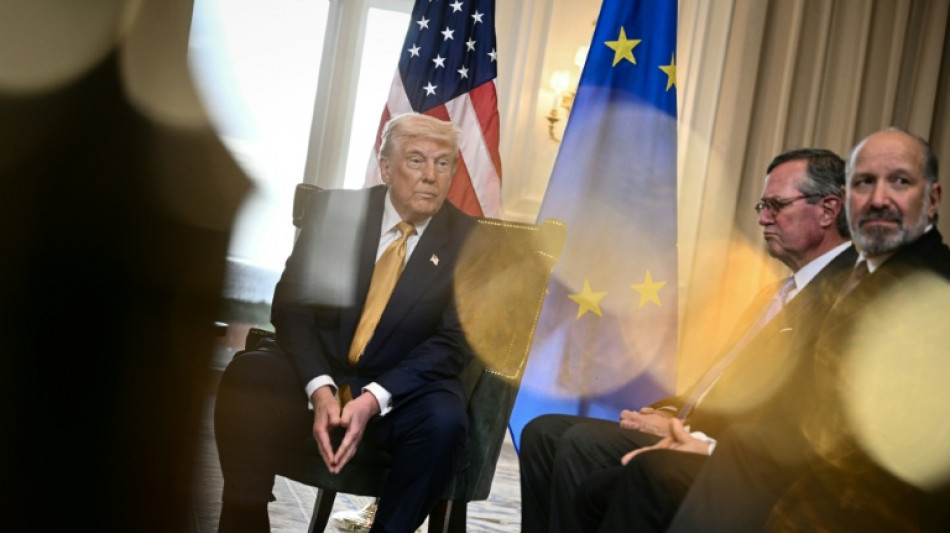
As Trump turns screws, how long can Europe play nice? / Photo: Brendan SMIALOWSKI - AFP/File

 West must embrace 'national power' or face decline: Rubio

 Shell refining margins reach record highs as wars hit supply
 Former Spain, Barca winger Pedro retires from football
 Arteta signs new Arsenal deal until 2030

 Stocks decline as oil climbs on Mideast flareup
 Gauff says online abuse was 'draining' after China Open exit
 As sector struggles, Porsche puts luxury ahead of volume
 'It's personal': Fiji minister pushes better climate finance at pre-COP
 Russia glosses over dark Soviet past in reinvented museum
 UK tax body opened probe into Man City in 2018: FT
 Yemen's Houthis claim new attacks on Saudi airports as conflict deepens
 Germany factory production at highest level for 18 months
 Thailand floods death toll rises to 60 since mid-September

 US pushes Russia for information on plague reports

 Myanmar leader lands in Malaysia for migrant return talks
 Indian central bank hikes rates for first time since 2023
 US military on Okinawa face curfew, alcohol ban after murder case
 Fierce lobbying in EU over 'forever chemicals'
 Dodgers beat Braves and Padres avoid sweep in MLB playoffs
 Mourning, war and elections as Israel marks October 7

 Messi says Argentina retirement is 'saddest day of my career'
 Oil rises and stocks fall as Hormuz worries flare

 Pacific presses world for help 'surviving' climate change at pre-COP summit
 Verstappen revival to be put to the test in steamy Singapore
 US woman who survived botched execution is conscious, speaking: lawyers
One headspinning year down, three more to go.
Buffeted by a US superpower turned hostile under Donald Trump, Europe is struggling to set red lines as its once-close ally attacks its laws, eggs on the far-right -- and threatens its sovereignty in Greenland.
Any lingering doubts over the shifting winds in Washington were laid to rest with the release of last month's US security strategy taking most virulent aim not at China or Russia, but at the European Union.
Europe had barely absorbed that shock when it was blindsided by the US president's vow to wrest mineral-rich Greenland from EU and NATO member Denmark -- by force if need be.
European nations scrambled a military mission to Greenland to try to defuse Trump's threat -- but pushing back at the US president is easier said than done.
"Telling Trump 'You can't do that,' is not language that he understands," summed up one EU diplomat, granted anonymity to discuss the sensitive matter.
"We must appease Trump, not poke the beast."
The bottom line is that Europe's hands are tied: the continent is surging defence spending to break its security reliance on the United States -- but for now, it still needs US help to end the Ukraine war, and deter the looming Russian threat to its east.
In that spirit leaders have stopped well short of calling out Trump's threats -- levied right as the Europeans held crunch talks with US envoys on locking in post-war security guarantees for Ukraine.
Instead they have reached for their now-familiar Trump playbook: avoid escalation at all costs, and work to mollify the US president -- until the next time.
The half-dozen Europeans with a direct line to Trump, from France's Emmanuel Macron and Italy's Giorgia Meloni to NATO chief Mark Rutte, can claim some successes with this strategy, namely in clawing back a seat at the table of talks to end the Ukraine war.
But as Denmark's leader Mette Frederiksen warned this week, with three quarters of Trump's presidency left to run, there is reason to expect "the most challenging part" is yet to come.
And Europe may not be able to play nice forever.
- Election tests loom -
Trump's threats to Greenland are just one part of the picture.
Last year's trade standoff with Washington saw Europe strong-armed into what was widely seen as a lopsided deal.
Since then Team Trump has pressed an all-out assault branding Europe's civilisation moribund, imposing sanctions over digital rules it calls censorship, and vowing to boost political forces aligned with the president's MAGA ideology.
Strongman Viktor Orban can expect the weight of US foreign policy behind him in Hungary's April elections, with Elon Musk's X acting as a force multiplier for hard-right narratives.
And France's 2027 election looms as a key test.
Trump's camp has "formulated quite clearly" it would welcome a far-right win in the nuclear-armed EU heavyweight, said Tara Varma, European policy expert at the German Marshall Fund of the United States.
"We have to take them at their word," she warned, saying Europe needs to rethink tools designed to counter political meddling from regimes like Russia -- to meet the new US threat.
- A 'bazooka' for Greenland? -
The spectre of MAGA-fuelled interference feeds into the critical issue of whether the EU has the mettle to keep US tech giants in check.
So far the EU has stared down threats of US retaliation to keep enforcing its laws against online abuses and disinformation, with fines on X and others.
But even penalties in the hundreds of millions are seen as small fry for the likes of Musk -- who pours expletive-laden scorn on the EU and its rules.
So what more can Europe do to try to turn the tables?
Simple, say advocates of tougher action: play the economic card, as America's biggest bilateral trade partner.
When it comes to Greenland, European law professor Alberto Alemanno says the bloc's "most tangible threat" to deter Trump is freezing the US trade deal -- an idea gaining ground in the EU parliament.
The tough question is where to draw the line.
"Do we need the territorial integrity of the European Union to be breached? Do we need to see boots on the ground, to see the Americans entering into Greenland, in order to justify this?" asked Alemanno.
Beyond that, the bloc has a powerful weapon called the anti-coercion instrument -- never used before -- that allows for curbing imports of goods and services and has been invoked as a way to push back over tech and trade, and now Greenland.
Deploying the trade "bazooka," as it is dubbed, is one idea being brainstormed in Brussels but still seen as a long shot.
"Europe has a number of cards up its sleeve -- and it's chosen consciously or unconsciously not to use them," said the German Marshall Fund's Varma.
But at some point, she warned, "it might have to."
X.AbuJaber--SF-PST