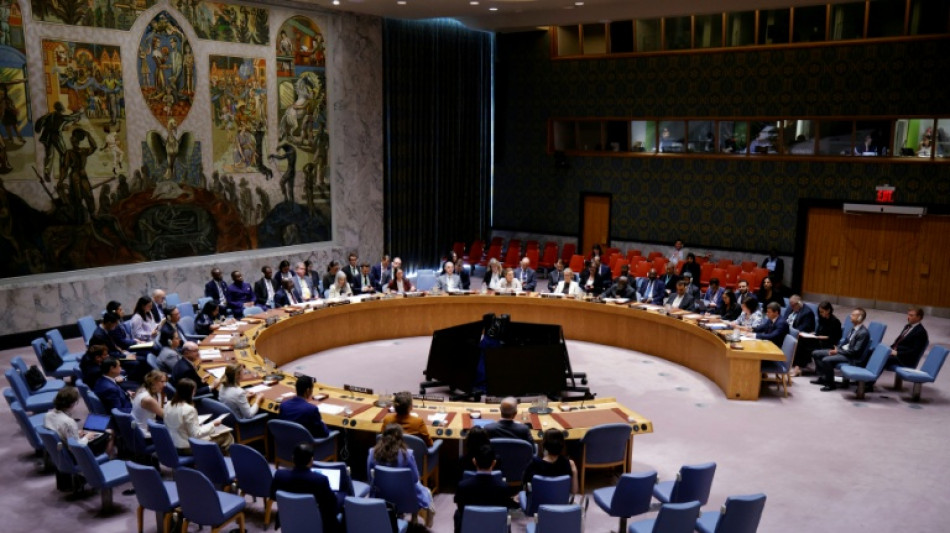
UN holds second informal poll for next leader / Photo: Leonardo MUNOZ - AFP/File

 Rising Spanish tennis star handed code violation for swearing at ballboy
 Last of the French musketeers Monfils officially retired from tennis
 Ukraine ex-military officer stands trial over Nord Stream sabotage
 British and Irish Lions to play first women's match against France
 Fuel shortage triggers queues on resort island Bali
 Sao Tome's niche vanilla finds far-away fans
 China-North Korea bridge to open Thursday, 12 years late
 Asian stocks mostly down as tech firms struggle to claw back losses
 AI boom drives record sales at Dutch tech giant ASML
 Trump says 'massive' oil, gas, mineral exploration to begin in Greenland
 China heads for record trade surplus as exports surge
 Vietnam mourns 700 war dead in major push to identify missing
 Relentless Swiatek wins all-Polish battle to launch Wuhan campaign
 Seeing pivotal election, Israelis fly from around world to vote
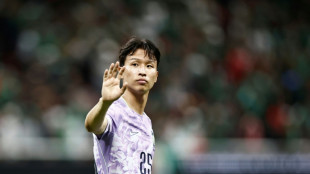 South Korea's Eom 'racially abused' in England's Championship: club
 Asian markets mixed as tech firms claw back some losses
 India shuts down iconic Delhi protest site after three decades
 Japan urges Russia for 'impartial treatment' of arrested journalist
 Lula, Bolsonaro ordered to call off attempts at online censorship
 EU takes a page from Ireland's AI playbook
 Global deforestation slowed in 2025 but surged in Congo basin: study

 Saudi says Houthi attacks sparked Aramco fire, wounded 4 in Riyadh
 Few buyers for starving cattle in El Nino parched El Salvador
 Bybit Expands Beyond Crypto as CEO Outlines Next Phase of Financial Platform
 Bayern held by Viking after 'super dumb' Olise red in Champions League
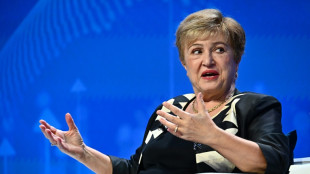
The UN's most powerful body, the Security Council, meets Friday to hold another straw poll to gauge the popularity of a growing field of contenders to lead the embattled organization.
Costa Rica's Rebeca Grynspan was the front-runner after last month's first informal vote, in which the council's 15 members, including the five with veto power, pass judgment in secret on the candidates.
Argentina's Rafael Grossi -- the current head of the UN nuclear watchdog -- is also a candidate along with Chile's Michelle Bachelet, Ecuador's Maria Fernanda Espinosa, Guyana's Carolyn Rodrigues-Birkett, Uganda's Olara Otunnu and Senegal's Macky Sall.
After the first round concluded, Ecuador's Ivonne A-Baki threw her hat into the race to succeed Antonio Guterres, who will complete his second five-year term on December 31, 2026.
"While the first straw poll set the scene for the Secretary-General race, the second may give us some direction about where it is headed," said the International Crisis Group's Daniel Forti.
"Diplomats expect fluctuations in the vote distribution compared to the July poll. Most will be watching to see whether the early front-runners consolidate their support or slip in the standings.
"It is unlikely that any candidate will emerge from (Friday's) poll with a decisive lead."
Forti said the veto-wielding nations -- Britain, China, France, Russia and the United States -- might wait until later to express their preferences, while new contenders could emerge.
Russia's ambassador to the UN, Vassily Nebenzia, said Thursday he could not rule out that possibility.
"If, for example -- I'm speculating now -- if there is a deadlock on any of the candidates we are seeing today, if nobody... flies, then I think that we may see other candidates as well," Nebenzia said.
- 'End of the road'? -
Even if a candidate earns the required nine votes from the 15 available in the Security Council, they must also avoid a veto by the five major powers, which are deeply divided.
Once a candidate clears those bars, their name will go to the General Assembly of all UN members for confirmation.
The Security Council straw poll was devised in the early 1980s in an attempt to break a deadlock between two candidates shut down by vetoes.
The informal mechanism has persisted, in various forms, despite criticism from countries opposed to the opaque process.
"There is a good chance that some nominees realize after (Friday's) vote that their campaigns have reached the end of the road," Forti added.
Each member state must anonymously assign each candidate one of three labels: "encourage," "discourage," or "no opinion."
That would give those with no support the opportunity to withdraw -- though they are not obliged.
In the first rounds of the process expected to take several weeks, all ballots are the same color.
But after an unspecified number of votes, the ballots of the five permanent members will become a different color from those of the elected members, making it possible to identify potential vetoes, without knowing which country blackballed any given candidate.
It is tradition that the UN's top job should rotate between different regions.
Under that premise, the role should go to a candidate from Latin America this time. There are many candidates from the region, though Sall and Otunnu hail from Africa.
F.AbuZaid--SF-PST