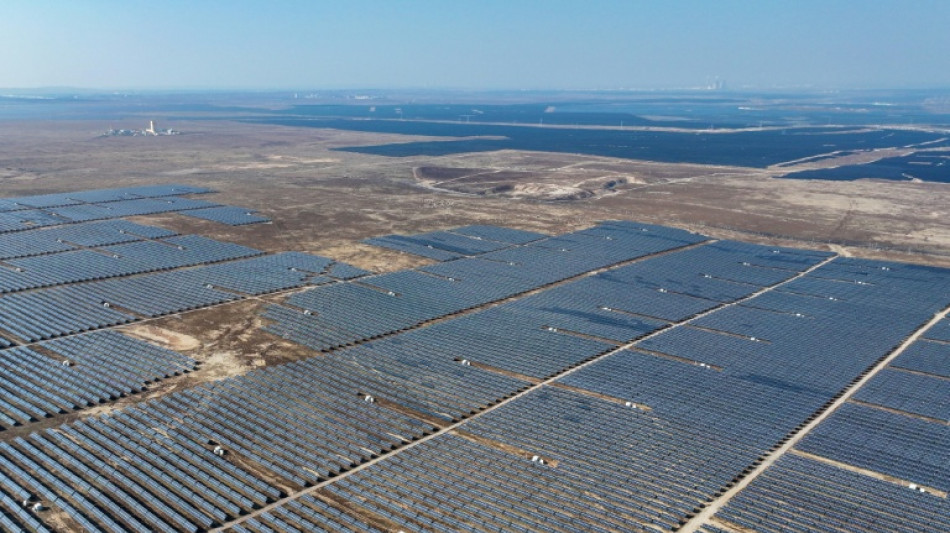
'Green dilemma': China's solar boom hurt birds, says study / Photo: - - CN-STR/AFP/File

 First-time boat buyers advised to assess full ownership costs

 Planning and preparation can reduce stress of interstate relocation

 Two more arrested in Carrie Mullane suspected murder investigation

 Mayo school appeals for information after convent and chapel vandalism

 GLP-1 Users Show Higher Rates of Nail Detachment in New Studies

 Canadian soldier Aidan Goulding remembered at Vancouver funeral

 Tayyab Arif hits 57 on Pakistan Test debut against Sri Lanka

 Robert Trujillo discusses literacy and social justice children’s books

 Civil rights advocate William Bill Tucker dies aged 98

 US Treasury order targets bank transfers linked to crypto exchange MEXC

 Eagles record six sacks as rushing attack struggles against Giants

 Thames Water seeks to delay £12bn in debt repayments

 Newark boxing gym expands alternative education programme

 Democrats consider impeachment drive against Defence Secretary Hegseth

 Rail journey offers a slower route to a Berlin city break

 Arsenal control title race as Manchester United fall into bottom three

 Suspected Krakow gunman dies after attack that killed six

 Carrick backs Dalot after hostile reception from Manchester United fans

 Belgian PM Bart De Wever Given New Deadline to Resolve €10 Billion Budget Deadlock

 الدفاعات الروسية تسقط 38 طائرة مسيرة فوق لينينجراد

 Amitabh Bachchan Drops Bulletproof Glass for Diwali Fan Greeting Outside Mumbai Home

The global push for solar energy expansion could carry hidden biodiversity costs, according to a study on China published in the journal Science on Thursday.
According to the research spanning more than 2,300 Chinese counties, pro-solar policies led to reductions in bird diversity as cropland and grassland were rapidly cleared for development.
The authors called it an example of a "green dilemma" pitting carbon reduction against conservation.
"The main message is not to slow the renewable energy transition, but to make solar development more ecologically informed," first author Huiming Zhang, of the Nanjing University of Information Science & Technology, told AFP.
China's goal to achieve carbon neutrality before 2060 has seen it embark on a renewables revolution.
By 2024, its solar footprint reached an estimated 4,520 square kilometers (1,745 square miles) -- equivalent in size to the US state of Rhode Island -- and solar energy is projected to constitute 45 percent of its energy mix by 2060.
Choosing solar locations in China is not based on sunny locations and available land, but rather on government "Five-Year Plans" to promote economic development in certain regions.
Zhang and his colleagues exploited these variations in solar expansion policy in 2,344 counties across China from 2014 to 2023, while also accounting for national trends, weather, socioeconomic conditions, land cover and birdwatching effort.
This data was paired with citizen science records to understand the impact on bird diversity.
Their findings revealed a negative trade-off, with increased policy stringency consistently associated with decreased bird biodiversity, though the effect was moderate.
The effects were stronger in wealthier and non-desert regions.
Both resident and migratory birds suffered significant declines, but species that were native to mountain habitats poorly suited to solar farms were unaffected.
- 'Inferior greening' -
The push for solar farms in China was accompanied by greening efforts to satisfy environmental requirements, but the authors identified what they called "inferior greening" -- where the total amount of leafiness may go up but because it was too homogeneous, the ecological quality went down.
Writing in a related commentary, Yuanning Liang of Peking University said "birds serve as an effective indicator group for large-scale biodiversity assessment" because they are among the few animal groups for which abundance data over time and space is readily available.
Although the authors studied solar power, the problems they identified equally apply to other forms of renewable energy such as wind farm expansion, she added.
"The next step is to move from biodiversity measurement to valuation by linking changes in bird diversity to ecosystem services and conservation values," Liang said.
"Without such valuation, policy analysis gives insufficient weight to conservation, and benefit-cost analysis can understate the social cost of development."
The research team offered a number of recommendations, including directing large solar projects toward locations with lower ecological conflict, greater assessments of each site, and limiting land conversion in productive, habitat-rich regions.
"Clean energy development and biodiversity conservation do not have to come at each other's expense, but careful siting and biodiversity safeguards are essential," said Zhang.
R.Shaban--SF-PST