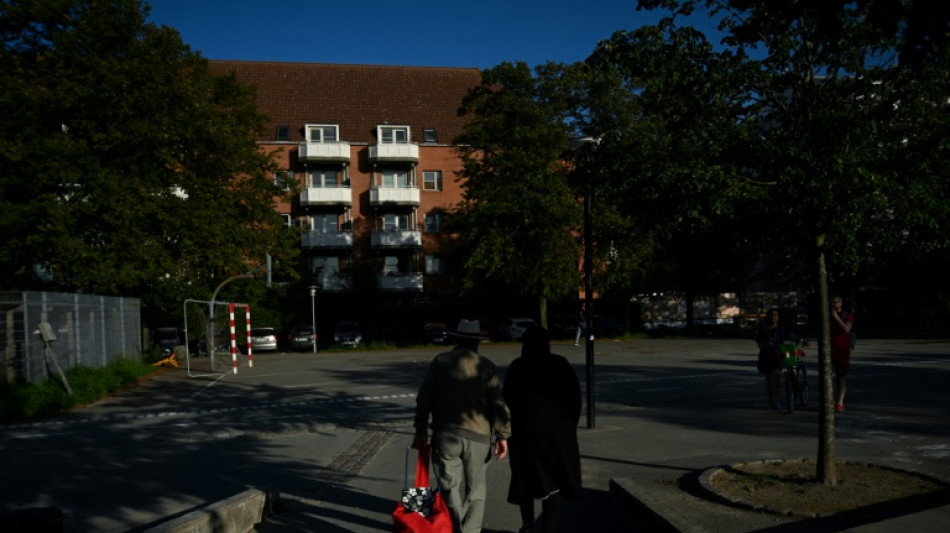
Danish 'ghetto' tenants hope for EU discrimination win / Photo: Sergei GAPON - AFP/File

 'Never again Bolsonaro': thousands march ahead of Brazil election runoff

 After botched execution, US woman was nearly taken off life support before revival
 Searing AIDS drama 'Elsinore' opens London film festival

 Evicted pensioner who sparked Spain housing protests dies: tenant union

 Golf star Rahm quitting LIV tour over 'unacceptable' terms

 Thousands march fearing return of a Bolsonaro presidency in Brazil

 French PM denies police ordered to confront student protesters

 Rubio touts US power, calls on Europe to emerge from 'slumber'

 Trump says 'we don't think' Russian plague is bio-weapon

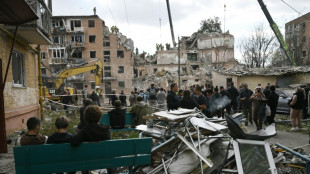
 Five children among 26 killed in Ukraine after Russian strikes

 Man City should 'accept' punishment for rule breaches, says Lineker

 US woman who survived botched execution is awake and speaking
 From 1800s to modern pharma: a Nobel-winning chemistry quest

 Southampton boss Eckert given suspended ban over 'Spygate'

 Russia warns of 'false' information as second plague case reported

 IEA ready to release more oil reserves if necessary
 HSBC 'consults' over UK unit job cuts amid AI adoption

 UK court quashes five ex-traders' Libor rate rigging convictions

 XM Receives “Global Customer Experience Leader Award 2026” at the TrustFinance Performance Awards

 Stocks slide as oil climbs on Mideast flareup
 Heavy casualties in Ukraine after Russian strikes

 French wine harvest set to hit historic low

 Kyiv 'cannot agree' to EU membership limiting food exports: minister

 Arteta targets more Arsenal glory after signing new deal until 2030

 Russell hit with Singapore grid penalty for taking new power unit

The European Court of Justice is to rule Thursday whether a Danish law requiring authorities to redevelop poor urban "ghettos" with high concentrations of "non-Western immigrants and their descendants" is discriminatory.
The law means that all social housing estates where more than half of residents are "non-Western" -- previously defined as "ghettos" by the government -- must rebuild, renovate and change the social mix by renting at least 60 percent of the homes at market rates by 2030.
Danish authorities, which have for decades advocated a hard line on immigration, say the law is aimed at eradicating segregation and "parallel societies" in poor neighbourhoods that often struggle with crime.
In the Mjolnerparken housing estate in central Copenhagen, long associated with petty crime and delinquency, residents are confident they'll win the case they've brought before the European court.
They argue that using their ethnicity to decide where they can live is discriminatory and illegal.
"100 percent we will win," insisted Julia, a resident who did not want to tell AFP her last name.
She said the law was solely about "discrimination and racism".
Muhammad Aslam, head of the social housing complex's tenants' association, was more measured, saying he was "full of hope".
- Long legal battle -
Mjolnerparken residents filed their lawsuit in 2020.
A preliminary opinion by the European Court of Justice's advocate general in February called the policy "direct discrimination".
If the court's final ruling were to be along those lines, "we will be ... completely satisfied", Aslam said.
The 58-year-old owner of a transport company who hails originally from Pakistan, he has lived in the estate since it was created in 1987.
He and his wife raised four children in their four-room apartment, children who are now a lawyer, an engineer, a psychologist and a social worker, he said proudly.
"I who am self-employed as well as my children are all included in the negative statistics used to label our neighbourhood a 'ghetto', a parallel society," he fumed, referring to official data on the number of non-Western residents.
In Mjolnerparken, the landlord took advantage of a renovation of the four apartment blocks, decided by residents in 2015, to speed up the transformation of the complex and comply with the new legislation.
All of the residents -- a total of 1,493 in 2020 -- had to be temporarily relocated so the apartments could be refurbished, a representative of the tenants' association, Majken Felle, told AFP.
At the time, eight out of 10 people in Mjolnerparken were deemed "non-Western", with people from non-EU countries in the Balkans and Eastern Europe also falling into that category.
- 'Disadvantaged ethnic group' -
In order to avoid moving from one temporary apartment to another during the lengthy renovations, many residents agreed to just move to another neighbourhood.
And those who are determined to return -- like Felle, the Aslams and Julia -- are at the landlord's mercy.
"We were supposed to be temporarily relocated for four months, and now it's been more than three years. Each year, they give us four or five different dates" for when the work will be completed, Aslam sighed.
In total, 295 of Mjolnerparken's 560 homes have been replaced, with two apartment blocks sold and replaced by market-rate rentals out of reach for social housing tenants.
Experts say some 11,000 people across Denmark will have to leave their apartments and find new housing elsewhere by 2030.
"The effort to diversify neighbourhoods might indeed be well intended. Nevertheless, such diversification cannot be achieved by placing an already disadvantaged ethnic group in a less favourable position," the advocate general said in February.
"However, in the present situation, the Danish legislation does precisely that."
Even if the court does not rule in residents' favour on Thursday, the legal case could still continue in Denmark, Felle said.
But it would be a serious setback.
"That would mean that Denmark had carte blanche to adopt as many discriminatory laws as it wants," said Lamies Nassri of the Centre for Muslims' Rights in Denmark.
"It affects the whole country when there are discriminatory laws, especially Muslim citizens who have been particularly marginalised and stereotyped."
R.Halabi--SF-PST