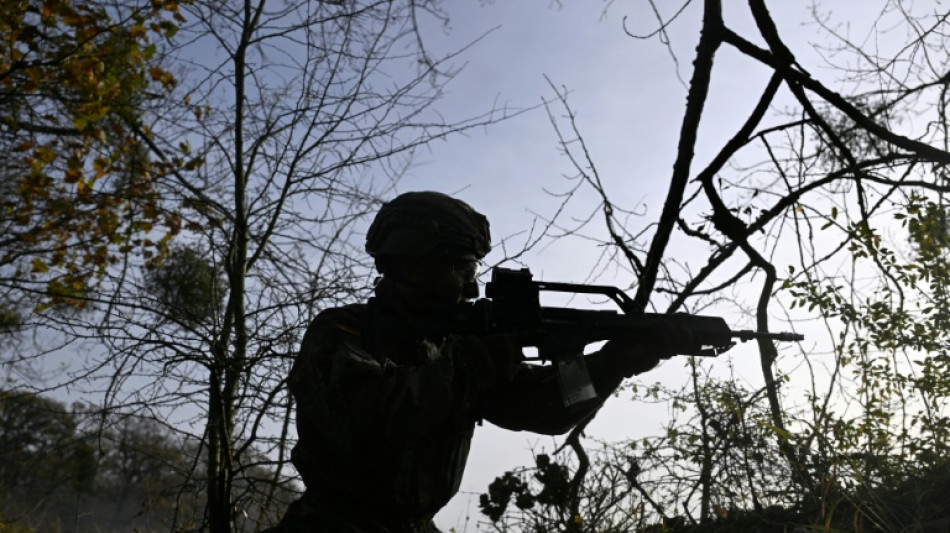
German MPs approve 50 bn euros in military purchases / Photo: Ina FASSBENDER - AFP

 'Never again Bolsonaro': thousands march ahead of Brazil election runoff

 After botched execution, US woman was nearly taken off life support before revival
 Searing AIDS drama 'Elsinore' opens London film festival

 Evicted pensioner who sparked Spain housing protests dies: tenant union
 Golf star Rahm quitting LIV tour over 'unacceptable' terms
 Thousands march fearing return of a Bolsonaro presidency in Brazil
 French PM denies police ordered to confront student protesters

 Rubio touts US power, calls on Europe to emerge from 'slumber'
 Trump says 'we don't think' Russian plague is bio-weapon
 Five children among 26 killed in Ukraine after Russian strikes

 Man City should 'accept' punishment for rule breaches, says Lineker
 US woman who survived botched execution is awake and speaking
 From 1800s to modern pharma: a Nobel-winning chemistry quest
 Southampton boss Eckert given suspended ban over 'Spygate'
 Russia warns of 'false' information as second plague case reported
 IEA ready to release more oil reserves if necessary
 HSBC 'consults' over UK unit job cuts amid AI adoption
 UK court quashes five ex-traders' Libor rate rigging convictions
 XM Receives “Global Customer Experience Leader Award 2026” at the TrustFinance Performance Awards
 Stocks slide as oil climbs on Mideast flareup

 Heavy casualties in Ukraine after Russian strikes
 French wine harvest set to hit historic low
 Kyiv 'cannot agree' to EU membership limiting food exports: minister
 Arteta targets more Arsenal glory after signing new deal until 2030
 Russell hit with Singapore grid penalty for taking new power unit
German lawmakers Wednesday approved about 50 billion euros ($59 billion) in military purchases, as Berlin accelerates defence spending in the face of a hostile Russia and signs of weakening security commitments from Washington.
The extensive list of procurements ranged from missiles to artillery, torpedoes, armoured vehicles, satellite systems and new uniforms as Berlin races to overhaul the long-neglected Bundeswehr.
Officials said that the new purchases, greenlighted by parliament's budget committee, mean a "historic" number of defence acquisitions have been approved this year, worth nearly 83 billion euros.
"We are sending a signal to the (NATO) alliance and our partners: Germany is leading the way," the defence ministry said in a statement.
"We are fulfilling our obligations to the alliance and accepting our responsibility for security and peace in Europe."
After Russia's full-scale invasion of Ukraine in 2022, Germany dropped a long-standing pacifist tradition shaped by its dark World War II past and started ramping up spending to overhaul the armed forces.
Signs of the United States's weakening commitment to Europe's security since US President Donald Trump's return to the White House further pushed Germany, and the rest of the continent, into speeding up its rearmament.
Chancellor Friedrich Merz, who took office in May, has given the drive even greater momentum, exempting defence spending from strict debt rules to free up more funds.
- 'Huge investments' -
The defence budget for this year had already been laid out but Wednesday's purchases had to be approved by parliament's budget commitment, in line with rules that individual acquisitions over 25 million euros must be signed off by MPs.
The purchases spanned more than 30 different projects, including missiles for Patriot and Iris-T air defence systems, artillery, torpedoes, weapon systems for aircraft and unmanned aerial reconnaissance systems, according to the defence ministry.
It also included "combat clothing and equipment" for up to 460,000 troops and protective equipment for 80,000 civilian employees.
Defence Minister Boris Pistorius said defence spending had a hit a new record this year, adding such "huge investments" were needed in the coming years.
"We must be able to equip each and every individual for their specific mission when they join us," he said after MPs approved the purchases.
"We can't put young soldiers in tracksuits because their uniforms haven't been delivered yet."
The government is seeking to expand the army, which shrank sharply after the end of the Cold War, and German lawmakers this month backed a new scheme aimed at boosting the number of troops.
Officials are not re-introducing mandatory military service but have warned they may do so if they do not get enough people signing up voluntarily.
Germany has dramatically raised its defence spending targets for the coming years.
Berlin announced earlier this year that it will aim to hike core defence spending to 3.5 percent of GDP by 2029, in line with a new NATO target that the alliance agreed to under pressure from Trump.
The government is set to spend more than 500 billion euros on defence between this year and 2029.
Pistorius insisted that the government will handle the massive investments "carefully and conscientiously".
"Everyone can rest assured that we are very aware of the scale of what we are talking about," he said.
P.Tamimi--SF-PST