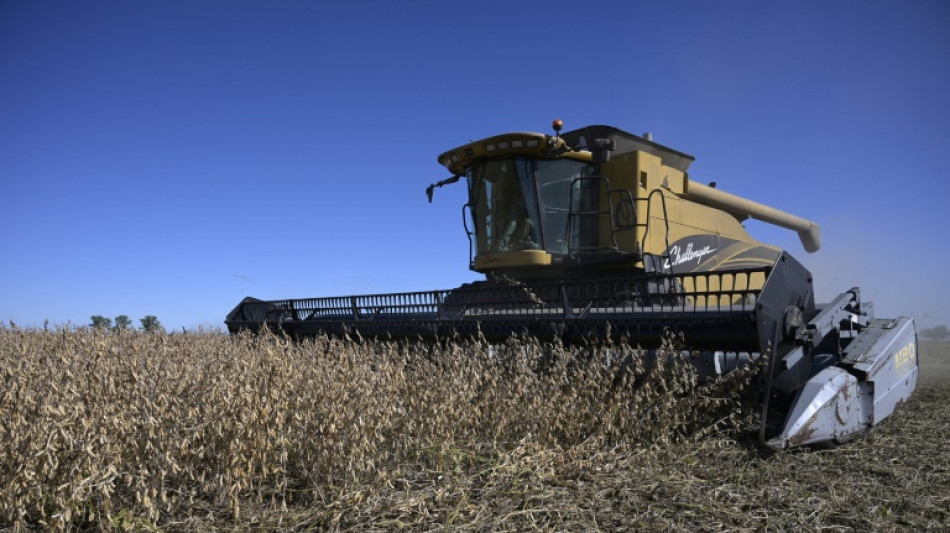
Soy boon for Argentina as Ukraine war boosts prices / Photo: Juan MABROMATA - AFP/File

 Brewers catcher Contreras named World Series MVP

 Asian stock markets fluctuate after mixed tech results
 Samsung logs record quarterly profits despite investor AI jitters
 Miami stumble to draw against Cincinnati despite Suarez strike

 Bangladesh scrambling as Ganges water treaty to expire

 England in peril with Rugby League World Cup semi spots at stake

 Antonelli ready to rewrite the Formula One record books in Mexico

 EU, Canada to build 'new chapter' in alliance at Montreal summit

 Argentine football fan jailed for threats over Di Maria return

 Liverpool beat Chelsea in League Cup shoot-out, Man City survive scare

 Inter leave it late again in Serie A as AC Milan, Juventus lose

 Shares in Google owner Alphabet plummet on profit miss, ad slowdown

 Putin hails Elon Musk as 'truly a genius'

 US stocks eye big tech earnings as Fed holds rates steady

 US Fed holds interest rates steady despite 'too high' inflation

 Made with munitions from the Falklands War, a 'Chalice of Peace' for the pope

 شركتان صينيتان تنهيان رعاية مبابي بعد مقطع عن ماو تسي تونغ

 Inter leave it late again in Serie A as Bologna sink AC Milan

 Italian PM slams 'shameful' release of alleged protest organiser

 Bolsonaro's escape to the US: How it happened

 انطلاق التصفيات النهائية لفئة الجاليات في تحدي القراءة العربي

 Djokovic wins Basel opener to boost ATP Finals bid

 Airbus aims for record deliveries despite disappointing quarter

 Cuba wins UN vote against US embargo with weakest backing in 30 years

 شباب من أجل الاستدامة تفتح التسجيل لبرامج 2027 في عامها العاشر

Russia's war on Ukraine has sent grain prices skyrocketing -- a worry for consumers worldwide but potentially a boon for producers like Argentina, which hopes an influx of soybean "agridollars" will boost its faltering economy.
South America's third-largest economy is the biggest exporter of soybean meal and oil in the world, and only the United States and Brazil export more soybean grains.
Soy represents nearly a third of Argentina's exports and in 2021 contributed $9 billion to the state coffers.
This year, the sector is expecting record sales of $23.7 billion -- about $700 million more than in 2021 -- despite a 10 percent smaller harvest due to severe drought.
"The prospects for the producer are good... There is optimism," said Martin Semino, who sells farming equipment and presides over the Rural Society of Lobos, a fertile agricultural zone southwest of Buenos Aires.
The harvest season is at its height, and workers are laboring from dawn to dusk to clear the fields before the autumn rains arrive.
"Soy is the dollar, the currency of the countryside," Semino told AFP.
In the past, the grain has been a savior for inflation-troubled Argentina.
A soybean boom in the 2000s is widely considered to have helped the country recover from its worst economic crisis in 2001.
In the last 40 years, the planted surface area of soy has multiplied 14 times.
- 'Seize the moment' -
Argentina is also a major producer of sunflower oil and wheat -- other grains affected by the ongoing war.
After a record sunflower harvest of 3.4 million tonnes in 2021-2022, the area under cultivation is set to increase by 17 percent this season to two million hectares (4.9 million acres).
The country also had a record wheat harvest this season.
Estimates are that in 2022, Argentina's agroindustrial exports will bring in a record $41 billion -- about $3 billion more than in 2021.
"With prices close to historic records, Argentina, which always needs dollars, must seize the moment," Tomas Rodriguez Zurro, an analyst at the Rosario Stock Exchange, told AFP.
The rise in prices "is temporary, it will end when the war is over," he cautioned.
But some point out that Argentina could have reaped an even larger benefit if it weren't for rising input costs.
Argentina imports about 60 percent of the fertilizers needed to grow food -- around 15 percent of it from Russia -- but supplies are now short and prices climbing, meaning lower yields.
Higher fuel prices are also taking a toll, set against the backdrop of soaring consumer inflation of around 60 percent projected this year for Argentina.
The chambers of the Oilseed Industry (Ciara) and Grain Exporters (CEC) have warned that rising input costs -- as well as shortages of fuel and fertilizer -- have "neutralized, or worse, the relative benefits" derived from the commodity price rise.
Added Semino: "Input costs have exploded with the war."
- Angry farmers -
In April, farmers staged a protest in Buenos Aires to express their ire at government plans to impose a windfall tax on products boosted by the war in Ukraine.
The tax, imposed only on those earning more than a billion pesos ($8.5 million) in net profit for the 2021-22 season, would be used to cushion inflationary shocks for the poor.
Argentina has a 37 percent poverty rate.
The government has also introduced quotas on wheat and maize, the latter of which Argentina is the world's second-largest exporter of.
It has announced a so-called "wheat stabilization fund" seeking to ensure that the price of the staple grain -- and hence bread -- remains shielded from steep fluctuations.
H.Nasr--SF-PST