Philippine island fights rising seas with nature, not concrete / Photo: Ted ALJIBE - AFP

 Philippine island fights rising seas with nature, not concrete

 Bangladesh presses India before Ganges water treaty expires

 Trump accuses Alaska Democrats of fraud over same-name scandal
 Spain mourns after latest train tragedy kills 68

 Trump's border: quiet, but few people are happy

 Australian defence chief says China military buildup creating 'pressure' in SE Asia

 No penalty practice? No problem for Man City in shoot-out win

 Microsoft beats expectations fueled by Azure cloud business

 Chelsea win as Bayern draw with Madrid in Women's Champions League

 Kane watches as Bayern cruise into German Cup last 16

 Bayern boss Kompany out of hospital after meningeal irritation

 Shares in Google owner Alphabet sink on profit miss, ad slowdown

 Chelsea win as Bayern and Madrid draw in Women's Champions League

 السكتة الدماغية: علامات مبكرة تجعل التدخل السريع ضرورة

 Rwanda cannot be blamed for what happens in DR Congo, FM says

 Pioneering US labor leader Dolores Huerta dies at 96

 موقع سهيلة الأثري يعيد قراءة تاريخ الاستقرار البشري في حتا

 اعتماد 7 يناير يوم زايد المؤسس مناسبة وطنية سنوية في الإمارات

 Hollywood producer Kennedy to head LA28 Olympic ceremony plans

 Russell calls on Scotland to 'kick on' and beat big teams

 تركيزات قياسية لغازات الاحتباس الحراري في الغلاف الجوي خلال 2025

 US Fed holds interest rates steady despite surging inflation

 Chiefs sign ex-Ravens kicker suspended over sex allegations

 Real Madrid, La Liga apology over Mbappe shows power of Chinese market

 From Gaza to Ramallah, Palestinians see little hope in Israeli vote

For years, residents of a flood-prone Philippine island north of Manila have elevated their homes atop layer upon layer of concrete, only to see floodwaters threaten them again.
Burdened by strong storm surges, land subsidence and rising seas exacerbated by climate change, the 3,000 residents of tiny Pamarawan Island have turned to bamboo poles and discarded oyster shells to build a barrier aimed at weakening waves and managing floods.
The unusual approach offers a nature-based alternative for a country still grappling with a multibillion-dollar scandal that drove public fury over substandard -- and at times non-existent -- concrete flood-control projects.
"We were terrified whenever there were typhoons. We couldn't sleep at night," fisherman Edgar Javier told AFP on a recent visit, recalling how strong waves once brought down one of his home's concrete walls.
"Whenever the waves hit, the wall shakes."
The project began when the city government of Malolos, home to the island, launched a study with a Dutch engineering consultancy.
"(Concrete infrastructure) projects won't suffice," Mayor Christian Natividad told AFP.
While the project, the first of its kind in the country, initially faced resistance from officials and residents working without a blueprint, Natividad said they had "nothing to lose".
"It's like you accept daily flooding or you do something else with risk," he said.
"I chose risk."
- Slowing the waves -
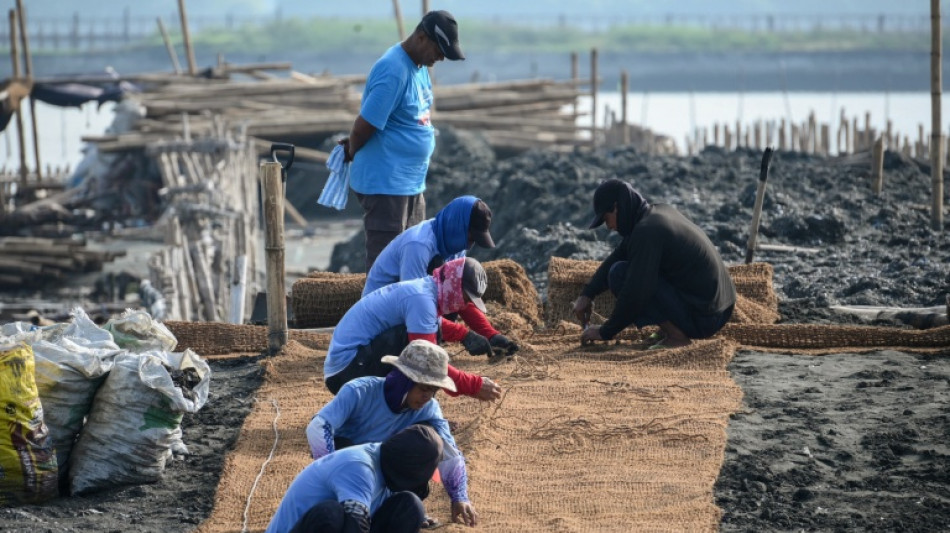
By May last year, workers, many of them residents, had begun installing bamboo poles packed with brushwood along the coast. They are designed to slow water flow and trap sediment, with the goal of gradually raising the seabed and supporting mangrove growth.
When AFP journalists visited the site, workers were building an oyster-shell breakwater about 100 metres (330 feet) offshore.
Under the searing heat, men in caps pounded wooden stakes used to secure coconut-fibre bags filled with shells on an artificial shore first created with sea sand.
"This breakwater's main purpose is to lessen the impact of the wave before it can reach the community," project manager Lyana Galang told AFP, adding that the oyster-shell barriers work in concert with bamboo sediment traps.
Filipino scientist Antonio Contreras said the Philippines had long relied heavily on concrete dykes and seawalls, many undertaken without adequate study.
"We have altered the environment so much that we tend to work against nature when in fact we should work with it," Contreras told AFP, noting that some design flaws linked to corruption had cost lives.
But nature-based solutions were not a universal answer, he warned, particularly during catastrophic floods, and should complement conventional infrastructure.
Contreras said the approach in Pamarawan could be replicated elsewhere, provided local environmental conditions were carefully taken into account.
Bamboo and oyster shells also need to be sourced sustainably, he warned, as bamboo deteriorates over time and releases carbon as it decomposes.
The nature-based installations, which cover about 14 hectares along Manila Bay, cost 70 million pesos ($1.1 million), including maintenance, compared with around 90 million pesos for a concrete seawall, Mayor Natividad said.
He estimated bamboo will need to be replaced once every five years.
- 'Our feet are dry' -
With its first phase completed in late 2025, the installation has already brought some comfort to residents.
Fisherman Edgar Javier said the breakwaters had softened waves and helped keep floodwaters at bay during typhoons and monsoon rains this year.
"This has made a huge difference for us. We can still feel the waves, but they have significantly weakened. (They're) almost nothing now," he said.
Arsenia Cabigao, 58, said flooding had previously disrupted her livelihood by submerging areas where she dried fish.
"Our feet are dry at last. They weren't before," she told AFP as she sliced small fish in a narrow Pamarawan alley.
The project's long-term effectiveness remains uncertain, with a scientific assessment due next year to determine if mangrove planting can begin, Natividad said.
Its success, he added, would become more tangible over the next decade as accumulated sediment stabilised the seabed and allowed for the growth of mangroves, which would provide another natural barrier.
Vince Dizon, head of the public works department before a recent reassignment, said he hoped the Pamarawan project could be replicated in other flood-prone areas.
"We need to study this, and learn from those who know and have already done this correctly, so we won't waste public funds again," Dizon told reporters on a visit to the island.
For residents who fear being driven from their longtime home, the ultimate test will be whether their houses remain upright when typhoons and monsoon rains strike.
"It's hard to fight water. Now we're trying to live with water," Natividad told AFP.
"We're building with nature."
V.Said--SF-PST