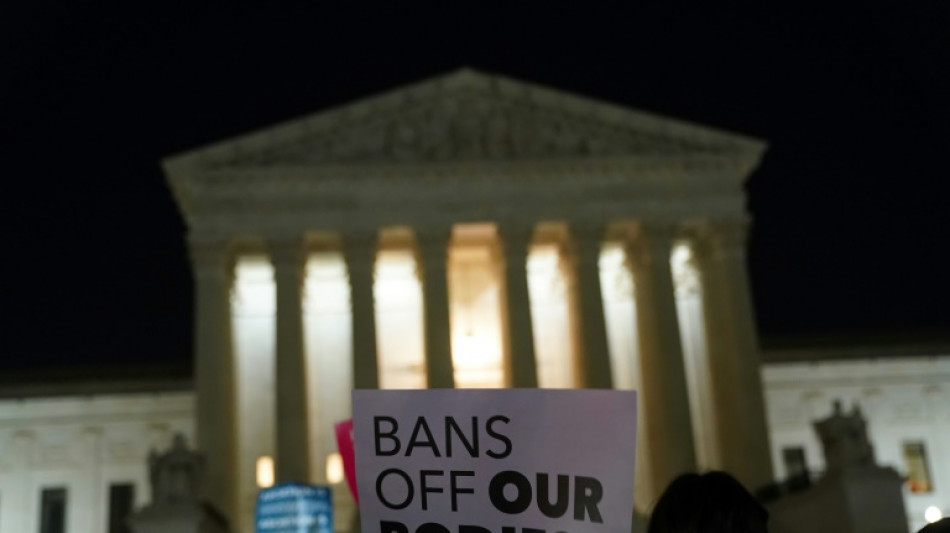
Roe v. Wade: 1973 case that enshrined US abortion rights / Photo: Stefani Reynolds - AFP

 Villarreal battle back to earn draw at promoted Racing

 Odegaard says Arsenal 'want to win everything' after Community Shield success

 Arsenal rout Man City in Community Shield masterclass

 Southampton mocked over Spygate during Watford defeat

 Hamas expects meeting with Kushner as US pushes Gaza plan

 Farmers, helicopters help battle record Belgian wildfire

 Air support kicks in as record Belgian wildfire jumps in size

 Firefighters battle second day of blaze on Greek island

 Strikes kill 12 in Russia and Ukraine

 India's Sindhu backs monkey measures as badminton worlds set to open

 Mass drone attack on Moscow as Russian strikes kill three in Ukraine

 Djokovic feels the heat in Cincinnati defeat, Zverev wins all-nighter

 Pallister stuns Ledecky in Pan Pacs 800m free as two world records carry Douglass to gold

 Rampant Bangladesh make history with first-ever Test win in Australia

 UK's media-savvy PM Burnham shifts messaging to TikTok, podcasts

 Gay badminton star Gilmour urges progress on LGBTQ rights in Asia

 Pallister takes down Ledecky in Pan Pacs 800m freestyle

 Douglass breaks 50m free world record again to claim Pan Pacs gold

 As Opel turns to Chinese partners, its hometown frets about the future

 Mehidy takes three as Bangladesh close on historic win in Australia

 Hope fades for finding surivivors of Colombia quake as rescued woman dies

 Hurricane Lala dumps heavy rain on Hawaii

 Jaded voters, same old choices: Brazil kicks off election campaign

 'Everyone lives in fear': Yemenis worry about return to all-out war

 Cardinals' Baez bashes record three homers in MLB debut

A US Supreme Court draft opinion leaked to the press on Monday suggests a majority of justices are ready to overturn the landmark Roe v. Wade, shredding nearly 50 years of constitutional protections on abortion rights.
Here is how the original 1973 court case played out.
- Right to privacy -
On January 22, 1973, the court decided that the constitutional right to privacy applied to abortion.
Roe was "Jane Roe," a pseudonym for Norma McCorvey, a single mother pregnant for the third time, who wanted an abortion.
She sued the Dallas attorney general, Henry Wade, over a Texas law that made it a crime to terminate a pregnancy except in cases of rape or incest, or when the mother's life was in danger.
Filing a complaint alongside her was Texas doctor James Hallford, who argued the law's medical provision was vague, and that he was unable to reliably determine which of his patients fell into the allowed category.
The "Does," another couple, childless, also filed a companion complaint, saying that medical risks made it unsafe but not life-threatening for the wife to carry a pregnancy to term, and arguing they should be able to obtain a safe, legal abortion should she become pregnant.
The trifecta of complaints -- from a woman who wanted an abortion, a doctor who wanted to perform them and a non-pregnant woman who wanted the right if the need arose -- ultimately reached the nation's top court.
The court heard arguments twice, and then waited until after Republican president Richard Nixon's re-election, in November 1972.
- 'Sensitive and emotional' controversy -
Only the following January did it offer its historic seven-to-two decision -- overturning the Texas laws and setting a legal precedent that has had ramifications in all 50 states.
Justice Harry Blackmun, writing for the majority, said the court recognized the "sensitive and emotional nature of the abortion controversy, of the vigorous opposing views, even among physicians, and of the deep and seemingly absolute convictions that the subject inspires."
But he argued that the "right of privacy... is broad enough to encompass a woman's decision whether or not to terminate her pregnancy."
"A state criminal abortion statute of the current Texas type, that excepts from criminality only a lifesaving procedure on behalf of the mother, without regard to pregnancy stage and without recognition of the other interests involved, is violative of the Due Process Clause of the Fourteenth Amendment," the ruling read.
But the top court agreed with lower court rulings that the right to privacy with regard to pregnancy "is not absolute, and is subject to some limitations."
"At some point, the state interests as to protection of health, medical standards and prenatal life become dominant," Blackmun wrote.
The top court thus ruled partially against the doctor and the Does, but in favor of Jane Roe, who has since become a pro-life activist.
On the same day, the justices ruled in the separate "Doe v. Bolton" case, which authorized each state to add restrictions to abortion rights for later-term pregnancies.
The constitutional right to abortion was later confirmed in a number of decisions, including "Webster v. Reproductive Health Services" in 1989, "Planned Parenthood v. Casey" in 1992 and Stenberg v. Carhart" in 2000.
N.Shalabi--SF-PST