In Texas, driverless trucks are set to take over roads

 'Glad it's over': Kim powers to Games gold and military exemption

 After 11 World Cups, football finally comes home for one Indian fan

 Marc Marquez wins sprint at Japan MotoGP, Martin grabs pole

 Alcaraz fends off Arnaldi to reach Japan Open quarters

 Antonelli tops times in final practice at Bahrain GP

 Gauff digs deep to beat Osorio in China Open second round

 Fresh protests to hit Spain after housing measures defeated

 'He's here with me': Japan cycle queen dedicates gold to late brother

 Japan Olympic chief says 'lot more' athletes at Games than expected

 Asian carmakers besting US rivals at home, China poised to strike

 Widgets & Web Offers All-Inclusive Investor Relations Websites for Public Companies, IPOs and SPACs

 Adams named new US captain to 2030 World Cup

 China a better influence in Latin America than US: poll

 Judge pauses construction of border project in Texas national park

 Belgium's De Bruyne fires double to sink Turkey, France held by Italy

 US jobs data boosts stocks as oil prices dip

 US Supreme Court to hear high-stakes climate case

 Trump expected to name intel chief Clayton as AI czar: reports

 Argentina unveils passports-for-investment scheme

 Brazil election debate chaos sparks censorship row

 England's Carse charged by cricket body over nightclub incident
 Amazon vows $1 bn for data center towns, decries 'myths'

 Oil prices drop on G7 fuel release, US jobs data boosts stocks

 G7 agrees deal to ease global energy supply concerns

 Spain's government dealt blow as lawmakers reject housing bills

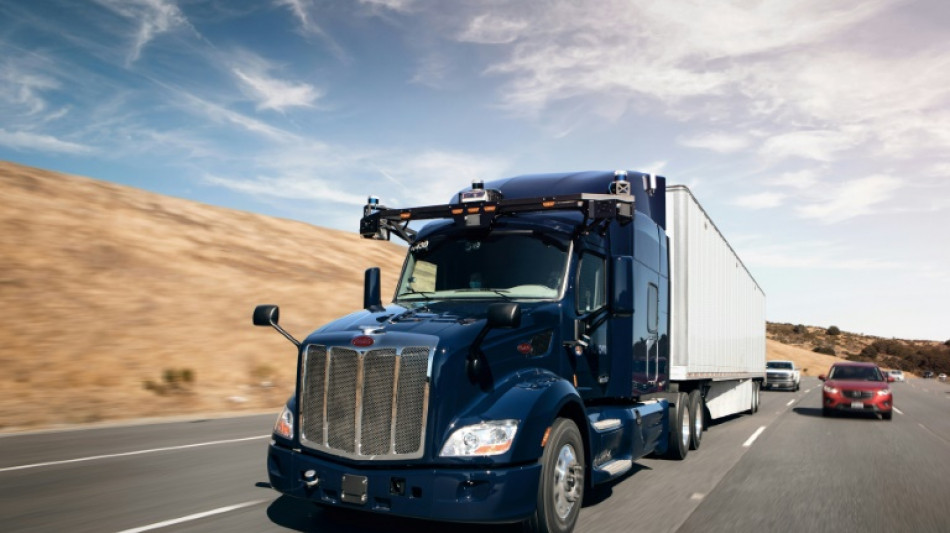
A giant 18-wheel transport truck is barreling down a multi-lane Texas highway, and there is no one behind the wheel.
The futuristic idea may seem surreal, but it is being tested in this vast southern US state, which has become the epicenter of a rapidly developing self-driving vehicle industry.
Before driverless trucks are allowed onto roads and highways, however, multiple tests must still be conducted to ensure they are safe.
Self-driving lorries are operated using radars, laser scanners, cameras and GPS antennas that communicate with piloting software.
"Each time we drive a mile or a kilometer in real life, we re-simulate a thousand more times on the computer by changing hundreds of parameters," explains Pierre-François Le Faou, trucking partner development manager at Waymo, the self-driving unit at Google's parent company Alphabet.
Waymo is building a logistics center in Dallas that will accommodate hundreds of autonomous semi-trailers.
And it is by far not alone. Embark, a self-driving technology startup, operates an autonomous trucking lane between Houston and San Antonio, while Aurora, co-founded by a former Waymo employee, will open three terminals and a new 635-mile route (1,000 kilometers) in Texas this year.
In a sign of how competitive the autonomous trucking industry is, none of the three companies agreed to show AFP one of its vehicles.
- Friendly legislation -
"I think that everybody who is in the autonomous trucking business is in Texas," says Srikanth Saripalli, director at the Center for Autonomous Vehicles and Sensor Systems at Texas A&M University. "Even if they don't advertise it."
The companies didn't land in Texas by chance. The state has the largest number of truck drivers and many qualified engineers, its sunny climate is great for the trucks' sensors, and neighboring Mexico exports 85 percent of its goods to Texas by road.
Houston and Dallas are major freight hubs, and Texas's sprawling distances are ideal for long-haul transport.
But most of all, local legislation is friendly toward driverless vehicles.
In 2018, Texas passed a law that essentially gave autonomous cars the same status as conventional vehicles.
"You need insurance and you need to follow the rules of the road, but other than that Texas does not impose any other regulations," says Saripalli.
With the United States so vast and trucking such a vital part of its economy, companies see self-driving as a way to cut costs and reduce risk, since unlike with human drivers autonomous vehicles don't get tired and don't require mandatory breaks.
While it will take a person three days to drive a truck from Los Angeles to Dallas, a self-driving big rig will complete the journey in 24 hours, estimates Aurora.
And it will be nearly twice as cheap. The per-mile cost would drop from $1.76 to $0.96 if the truck drives itself, according to Embark.
- Jobs at risk -
Alex Rodrigues, CEO and co-founder of Embark Technology, insists self-driving trucks will be crucial in combatting the current shortage of long-haul truck drivers in the US, some of whom are unwilling to be away from their families for weeks at a time.
"Right now, there are containers sitting in the port of LA not getting moved," he says.
And Rodrigues promises that the self-driving truck industry will create "attractive" jobs for local drivers, who will take over the autonomous trucks at transfer points and drive them to their final destination points.
Still, 294,000 trucking jobs would be threatened by the industry's automation, according to a 2018 study conducted by Steve Viscelli, a sociologist at the University of California, Berkeley.
For Julio Moscoso, a 56-year-old driver in Texas, the arrival of driverless trucks is "not good news."
He says while there are many trucking jobs available right now, that wasn't always the case. He recalls a time over the past two years when "there wasn't as much work."
And most importantly, Moscoso says he wouldn't trust driverless trucks.
"It's dangerous. What happens if the sensors fail?" he asks.
At the same time, he admits he does not want to do long-haul journeys anymore, and finds it uncomfortable to sleep in his cabin and not be able to shower every day.
S.Barghouti--SF-PST