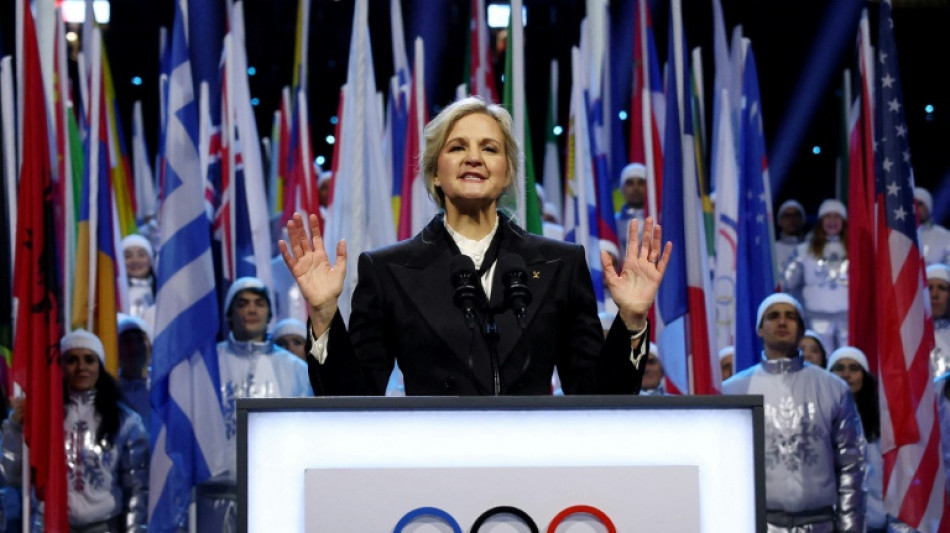
More to IOC gender testing than appeasing Trump: ex-IOC executive / Photo: Yves Herman - POOL/AFP

 American Nobel laureate in medicine hopes to illuminate the brain

 Trump approves firing squad for convicted US military base shooter

 Grappling with 'homework scams,' US universities shun AI detectors

 Separatists win Quebec election in test for Canada PM
 Leaders visit Pacific atoll at frontline of climate change

 Yemen's Houthis claim striking Riyadh airport, other Saudi sites

 Best-selling British author Jeffrey Archer dies aged 86

 Military plane crash kills 32 in Nigeria

 Olise powers France to win over Belgium in Nations League

 High-flying Blazy turns to birdlife at Chanel

 Riyadh's allies pledge troops as Yemen, Saudi Arabia attack Houthis

 Clashes erupt outside Kosovo parliament over war crimes court
 Milan's Saelemaekers suffers ankle setback, faces lengthy spell out

 Rubio arrives in Iceland to push for greater US presence in Arctic
 Putin allows Italy's UniCredit to sell part of Russian business
 Djokovic into China Open final as Medvedev out for hitting fan with ball

 ICC unseals arrest warrants for Taliban education ministers

 Modric hopes fans back Croatia against Spain after England shame

 Bolsonaro rides right-wing surge into Brazil's election runoff
 Turkey blocks X account of British reporter
 Ukraine says using AI robot guns to shoot down new Russian drones
 At Oct 7 memorial, Netanyahu says will be no Hamas rule in Gaza

 Ukraine blames Russia for deadly sinking of Turkish ship in Black Sea

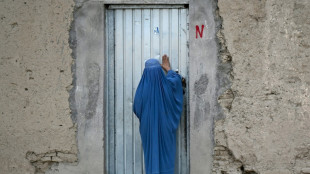 UN rights council slams Taliban's 'oppression' of women

 Norway eyes partial ban of smart glasses

The International Olympic Committee's new policy on gender testing could be seen as "smart positioning" given the current US political climate but a former IOC marketing executive has told AFP he did not believe it was the "driving factor".
The IOC on Thursday announced the re-introduction of gender testing to determine eligibility to compete in women's events, an issue which caused a furore in the boxing at the 2024 Paris Olympics.
They say only "biological females" can compete in women's events.
The decision was welcomed by US President Donald Trump, who last year issued an executive order banning transgender athletes from women's sport.
The next Summer Games are in Los Angeles in 2028.
"With the current US political climate, a cynic might say that removing this pressure point before 2028 was smart positioning," said former IOC executive Terrence Burns.
"But I don't think that was the driving factor."
The IOC decision comes just over a year after Kirsty Coventry became the first woman to be elected IOC president, succeeding Thomas Bach.
Whereas Bach brought in a policy in 2021 that left individual federations to decide their own regulations, the IOC is now introducing a blanket policy across all Olympic sports.
Coventry had made resolving the thorny issue a priority after the 2024 Paris Games were rocked by a gender row involving women boxers Imane Khelif if Algeria and Taiwan's Lin Yu-ting.
Khelif and Lin were excluded from the International Boxing Association's 2023 world championships after the IBA said they had failed eligibility tests.
However, the IOC allowed them both to compete at the Paris Games, saying they had been victims of "a sudden and arbitrary decision by the IBA".
Both boxers went on to win gold medals.
While Burns said the IOC had "drawn a line under" the issue with the new policy, his fellow former IOC marketing executive Michael Payne told AFP that Coventry had "moved actively and decisively".
"There was mounting pressure to protect the principle of female sports competition," he said.
"For all the honourable reasons about human rights, (that) everyone's right to compete no matter their biological make-up, you could not disenfranchise 99.99 percent of the population to address an issue of 0.01 percent."
- 'Reputational drag' -
The reintroduction of the testing for the SRY gene was not music to the ears of the scientist who discovered it, Andrew Sinclair.
He said ahead of the IOC announcement that the idea that the biological sex be entirely defined by chromosomes is "overly simplistic".
Sinclair was among the experts who persuaded the IOC to drop the tests before the 2000 Sydney Olympics, and he said "it is therefore extremely surprising years later there is an ill-advised move to reintroduce it."
"Sinclair's scepticism is real and any legal challenge will use it," said Burns.
"But governing bodies rarely have perfect science, they have the best available tools and a decision that can't wait.
"The IOC's honest answer is that precautionary governance under uncertainty is still governance.
"Doing nothing wasn't an option."
Payne, whose self-deprecatory warts-and-all book "Fast Tracks and Dark Deals" about his time at the IOC under Juan Antonio Samaranch Senior caused a stir last year within the movement, is not sure how much weight Sinclair's views will carry.
"Is there a single subject where all scientists can agree on the same solution?" said the 68-year-old Irishman.
"The science and circumstances, and public opinion evolve."
Both Burns and Payne believe there will be legal challenges, with Payne saying it is "the nature of the society we live in today" but he added that "sport has to be governed by rules".
"The IOC sets the rules, albeit guided by some of the best science available," said Payne.
Burns, who since leaving the IOC has been a pivotal figure in five successful Olympic bid city campaigns, says the Court of Arbitration for Sport (CAS) is well used to such cases.
"The IOC's best protection is a clean governance record, policy grounded in competitive fairness, applied consistently, documented thoroughly." he said.
"Human rights arguments will be made, but courts have generally respected sporting body jurisdiction when the process is defensible."
For Burns, "the bigger risk isn't losing in court".
"It's the reputational drag of fighting cases through an Olympic cycle," he said.
D.Khalil--SF-PST