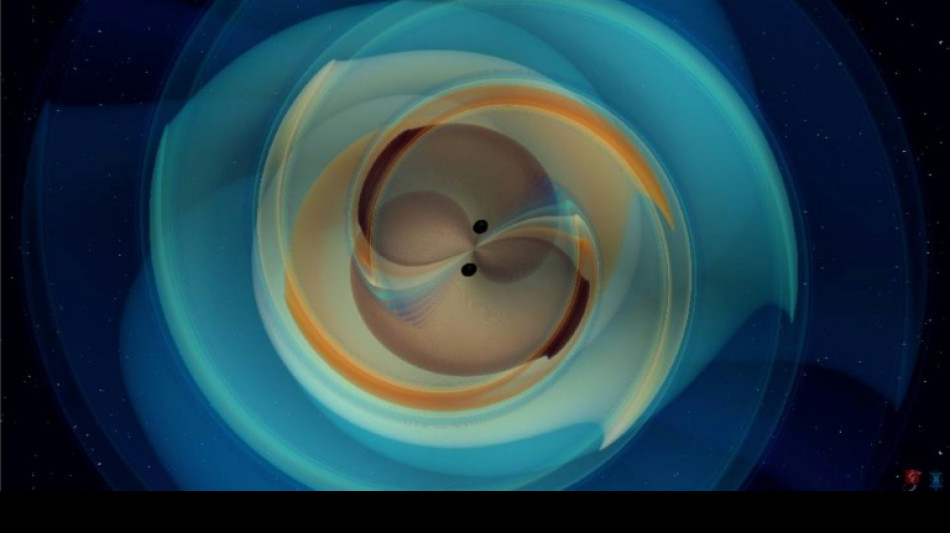
Rate of scientific breakthroughs slowing over time: study / Photo: N. Fischer, H. Pfeiffer, A. Buonanno - MAX PLANCK INSTISTUTE FOR GRAVITATIONAL PHYSICS/AFP/File

 Nigeria widens hunt for possible Ebola cases

 Liverpool star Isak back to his best says Iraola

 Lula supporters cross fingers in Rio, a Bolsonaro bastion

 Flights resume at Riyadh airport as Houthis attack Saudi Arabia

 High-flying Betis held at Celta Vigo

 Shadab ton stuns England as Pakistan reach tri-series final

 'With you': Opposition leader Machado returns to Venezuela

 Carrick on the brink as Man Utd misery mounts, Isak stars for Liverpool

 Monaco hold Lille as both move to top of Ligue 1

 Isak extends hot streak as Liverpool sink Brighton

 Brazil chooses between Lula and Bolsonaro in nail-biter vote

 Doha opens ninth World Investment Forum focused on future investment

 Kuwait public works minister and UK ambassador discuss closer cooperation

 Historic Ramallah olive press joins modern production with local tradition

 Hebron operation forces 373 Palestinian families from their homes

 Kuwait legal department reviews new commercial concealment law

 Ladakh declared India’s first fully organic union territory
 IRDAI gives stakeholders until October 31 to comment on distribution reforms

 Bay cyclone forecast to strike Andhra-Yanam coast at very severe strength

 Technical outlook diverges for Bharti Airtel, PFC, REC and Alkyl Amines

 J&K Bank raises accident cover for government employees to ₹1 crore

 فيديو انتخابي لبن غفير من سجن عوفر يثير انتقادات

 الأمير علي ينتقد دعم الاتحاد الآسيوي لإنفانتينو ويطالب بالشفافية

 هيئة حقوقية تحذر من تهجير وهدم واسع في الخليل

 نازحو مخيم الإسراء في غزة يواجهون نقص الغذاء وتراجع المساعدات

The rate of ground-breaking scientific discoveries and technological innovation is slowing down despite an ever-growing amount of knowledge, according to an analysis released Wednesday of millions of research papers and patents.
While previous research has shown downturns in individual disciplines, the study is the first that "emphatically, convincingly documents this decline of disruptiveness across all major fields of science and technology," lead author Michael Park told AFP.
Park, a doctoral student at the University of Minnesota's Carlson School of Management, called disruptive discoveries those that "break away from existing ideas" and "push the whole scientific field into new territory."
The researchers gave a "disruptiveness score" to 45 million scientific papers dating from 1945 to 2010, and to 3.9 million US-based patents from 1976 to 2010.
From the start of those time ranges, research papers and patents have been increasingly likely to consolidate or build upon previous knowledge, according to results published in the journal Nature.
The ranking was based on how the papers were cited in other studies five years after publication, assuming that the more disruptive the research was, the less its predecessors would be cited.
The biggest decrease in disruptive research came in physical sciences such as physics and chemistry.
"The nature of research is shifting" as incremental innovations become more common, senior study author Russell Funk said.
- Burden of knowledge -
One theory for the decline is that all the "low-hanging fruit" of science has already been plucked.
If that were the case, disruptiveness in various scientific fields would have fallen at different speeds, Park said.
But instead "the declines are pretty consistent in their speeds and timing across all major fields," Park said, indicating that the low-hanging fruit theory is not likely to be the culprit.
Instead, the researchers pointed to what has been dubbed "the burden of research," which suggests there is now so much that scientists must learn to master a particular field they have little time left to push boundaries.
This causes scientists and inventors to "focus on a narrow slice of the existing knowledge, leading them to just come up with something more consolidating rather than disruptive," Park said.
Another reason could be that "there's increasing pressure in academia to publish, publish, publish, because that's the metric that academics are assessed on," he added.
The researchers called on universities and funding agencies to focus more on quality, rather than quantity, and consider full subsidies for year-long sabbaticals to allow academics to read and think more deeply.
"We're not getting any less innovative as a species," Park emphasised, pointing to recent breakthroughs such as the use of mRNA technology in Covid-19 vaccines, or the measurement of gravity waves in 2015.
Jerome Lamy, a historian and expert in the sociology of science at France's CNRS research agency, who was not involved in the research, said it showed that "ultra-specialisation" and the pressure to publish had increased over the years.
He blamed a global trend of academics being "forced to slice up their papers" to increase their number of publications, saying it had led to "a dulling of research."
H.Jarrar--SF-PST