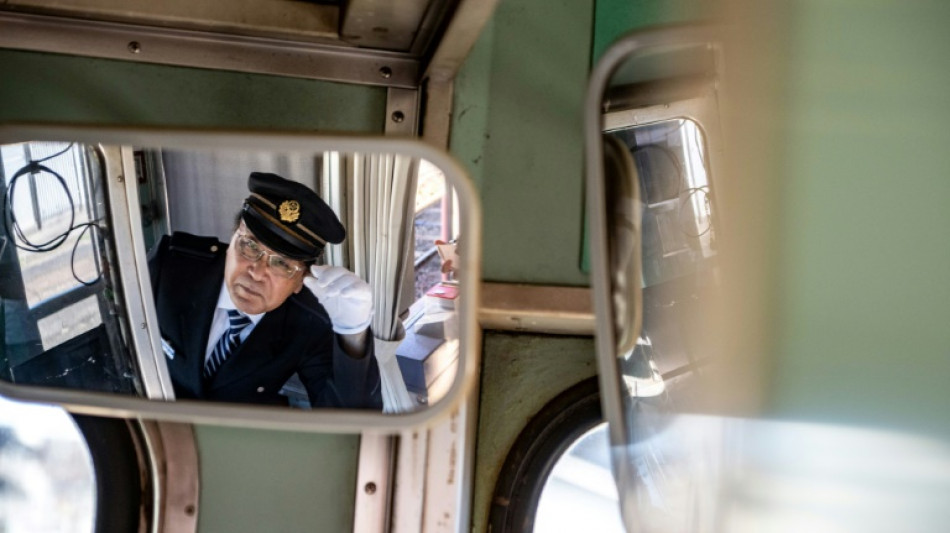
Japan's 'Little Trains that Could' battle for survival / Photo: Philip FONG - AFP

 'Marine has to win': Le Pen supporters fear for France's future

 دراسة تحذر من مخاطر إرشادات أميركية جديدة للقاح التهاب الكبد «ب» على الرضع

 الدفاعات السعودية تحبط سلسلة هجمات حوثية استهدفت مكة والمدينة

 France's Le Pen launches presidential bid vowing to restore 'rule of law'

 Qatar Charity delivers Braille Qurans to blind readers in Kosovo and Albania

 Houthis say attacked Riyadh airport hours after flights resume

 Monaco hold Lille as Rennes go top of Ligue 1

 Thousands gather in Prague to protest licence fee plans

 Pease spins to floor gold as US tops gymnastics medal table

 Marchant back in England training squad ahead of Nations Championship fixtures

 French skater Siao Him Fa soars to victory in season-opener at home

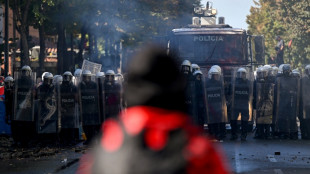 Embattled Albanian PM vows fines for violent protesters

 Steelers top Saints in NFL's first regular-season game in Paris

 Carrick unsure over Man Utd future after Bournemouth loss

 2027 Dakar Rally to be moved from Saudi Arabia

 Man Utd battered by Bournemouth to leave Carrick on the brink

 Storms batter Europe hitting power supplies, flights and phones

 Inter rally late to down Fiorentina and regain Serie A lead

 J&K Bank raises accident cover for government employees to ₹1 crore

 Technical outlook diverges for Bharti Airtel, PFC, REC and Alkyl Amines

 Bay cyclone forecast to strike Andhra-Yanam coast at very severe strength

 IRDAI gives stakeholders until October 31 to comment on distribution reforms

 John Catlin wins Hong Kong Open and secures first Masters invitation

 KIB Group nine-month profit rises 30% to KD 26.6 million

 UDST opens Fall 2027 admissions to students in Qatar and abroad

In the driver's seat of a two-carriage train, Katsunori Takemoto puts on his white gloves and checks the antiquated gauges before setting out alongside cabbage fields in Japan's rural Chiba.
Like many small railway lines across Japan's countryside, the 60-year-old trains that ply this route are a loss-maker, but Takemoto has found a way to keep the business afloat.
With a combination of savvy marketing partnerships with pop stars and branded souvenirs, the president of the Choshi Electric Railway navigated the firm into the black in 2021, while helping promote the local region.
"I feel strongly that this is the mission of all local trains. We want to serve as advertising vehicles for communities," Takemoto told AFP.
"Towns without trains wither away. So rebuilding rural trains must be done as part of rebuilding communities."
But the 99-year-old business he took over in 2011 is the exception rather than the rule in Japan, home to hundreds of loss-making rural rail lines.
Depopulation, car ownership, freight trucking and the Covid-19 pandemic have decimated revenues.
"If we leave things as they are and don't do anything, it is clear to everyone that sustainable public transport systems will fall apart," Transport Minister Saito said earlier this year.
The rural lines are legacies of Japan's economic boom through the 1970s but failed to adapt to rural depopulation, as younger people left for cities and some villages emptied altogether.
Infrastructure like city halls and hospitals is increasingly built along main roads, with visitors expected to drive rather than take trains.
- 'We have done all we can' -
Of the country's 95 small railways -- services outside urban areas or major regional links -- 91 recorded deficits last year, according to the transport ministry.
That contrasts sharply with lucrative urban lines like Central Japan Railway, which operates the shinkansen super express between Tokyo and Osaka.
It earned a net profit of nearly 400 billion yen for the year to March 2020, before the pandemic took hold.
Major train operators can use profits from urban areas to subsidise rural services, but even industry titan East Japan Railway (JR East), which serves 13 million passengers daily in Tokyo and eastern Japan, is baulking at the cost.
It lost 68 billion yen ($490 million) in 2021 on the 66 most problematic segments of rural railways.
In the worst section, the company paid more than 20,000 yen for every 100 yen earned.
"We have done all we can to increase usage and cut costs," Takashi Takaoka, a JR East executive officer, told reporters this year.
"The fact is that there are areas where trains are not the best mode of transportation."
Not everyone agrees, and governors from around half of Japan's regions have filed a joint plea to the transport minister warning that slashing rural routes will endanger tourism and require spending on alternatives like buses.
But experts say change is inevitable and communities need to embrace innovations, potentially including self-driving transport.
- 'Beaten up, battered' -
For now though, lines like Takemoto's are turning to alternatives to stay afloat.
His Choshi Electric Railway makes 80 percent of its revenue from non-train operations, including baking and selling its popular soy sauce-soaked crackers.
The company has sold everything from corn puffs to slices of railway track, and Takemoto aggressively promotes the line on television, joking about his cash-strapped firm with well-rehearsed self-deprecating puns.
He has even run "haunted house" trains and "professional wrestling" lines where bare-chested fighters rumbled in front of passengers and at stations.
And the firm has paired up with pop idols, comedians and YouTubers to keep the company in the public eye.
"Ironically, we have to focus on non-train services in order to keep the trains running," Takemoto said.
Despite Takemoto's efforts, Choshi Electric Railway still depends on subsidies and loans, and passenger figures continue to slide.
"Maybe the time will come when our service as a railway firm will no longer be needed. But it's not the time now," Takemoto insists.
"We are beaten up, all battered and covered in rust. But we believe there are many things we can still do and we must keep moving forward."
Q.Bulbul--SF-PST