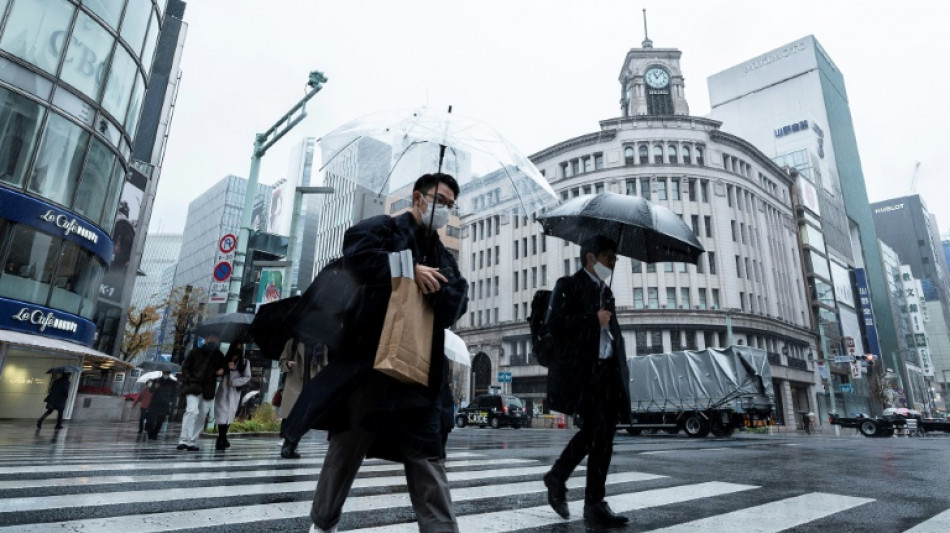
Japan inflation at 3.7% in November, highest since 1981 / Photo: Richard A. Brooks - AFP

 'Marine has to win': Le Pen supporters fear for France's future

 دراسة تحذر من مخاطر إرشادات أميركية جديدة للقاح التهاب الكبد «ب» على الرضع

 الدفاعات السعودية تحبط سلسلة هجمات حوثية استهدفت مكة والمدينة

 France's Le Pen launches presidential bid vowing to restore 'rule of law'

 Qatar Charity delivers Braille Qurans to blind readers in Kosovo and Albania

 Houthis say attacked Riyadh airport hours after flights resume

 Monaco hold Lille as Rennes go top of Ligue 1

 Thousands gather in Prague to protest licence fee plans

 Pease spins to floor gold as US tops gymnastics medal table

 Marchant back in England training squad ahead of Nations Championship fixtures

 French skater Siao Him Fa soars to victory in season-opener at home

 Embattled Albanian PM vows fines for violent protesters

 Steelers top Saints in NFL's first regular-season game in Paris

 Carrick unsure over Man Utd future after Bournemouth loss

 2027 Dakar Rally to be moved from Saudi Arabia

 Man Utd battered by Bournemouth to leave Carrick on the brink

 Storms batter Europe hitting power supplies, flights and phones

 Inter rally late to down Fiorentina and regain Serie A lead

 J&K Bank raises accident cover for government employees to ₹1 crore

 Technical outlook diverges for Bharti Airtel, PFC, REC and Alkyl Amines

 Bay cyclone forecast to strike Andhra-Yanam coast at very severe strength

 IRDAI gives stakeholders until October 31 to comment on distribution reforms

 John Catlin wins Hong Kong Open and secures first Masters invitation

 KIB Group nine-month profit rises 30% to KD 26.6 million

 UDST opens Fall 2027 admissions to students in Qatar and abroad

Prices in Japan rose at their fastest pace since 1981 in November, data showed Friday, fuelled in part by higher energy costs.
Core consumer prices, which exclude volatile fresh food costs, climbed 3.7 percent last month compared to a year earlier, data released by the internal affairs ministry showed.
Prices jumped the most for processed food items and were also higher for electricity and durable goods like air conditioners.
The November figure is well below the sky-high levels that have sparked concern in the United States, Britain and elsewhere, but far exceeds the Bank of Japan's long-term goal of 2.0 percent.
Even excluding fresh food and energy, the index was up 2.8 percent.
"Although low by international standards, Japanese consumer price inflation at three percent to four percent is high enough to feel uncomfortable with stagnant wage growth," wrote Sarah Tan, economist at Moody's Analytics, in a note.
The headline core consumer price index (CPI) has risen consistently since the beginning of the year, putting pressure on the Bank of Japan to tweak its longstanding monetary easing policies.
The US Federal Reserve and other central banks have sharply hiked interest rates this year to tackle inflation.
But Japan, which since the 1990s has swung between periods of sluggish inflation and deflation, has gone against the grain and continues to keep interest rates at ultra-low levels as it tries to kickstart its economy.
The Bank of Japan says it sees the recent price increases as temporary and that there is no reason to change course yet.
The starkly different approaches taken by the BoJ and the Fed have driven down the value of the yen against the dollar this year from about 115 yen per dollar in March to as low as 151 yen.
The currency has recovered somewhat, helped by government interventions.
This week, the Japanese central bank delivered a shock tweak to its ultra-easy monetary policy, prompting the yen to strengthen rapidly.
While the adjustment falls short of a rate hike, analysts said it could help arrest the yen's declining value.
Koya Miyamae, senior economist at SMBC Nikko Securities, said prices were likely to continue rising in the short term.
"The core CPI rose in November due to rises in food prices and gas. The index will likely rise further, nearing or potentially rising above four percent in December," he told AFP.
"But core CPI will remain above two percent next year, while the pace of the rise in wages is not catching up with inflation," he added.
Most analysts expect price rises in Japan to peak around the end of the year or early 2023.
"Inflation will likely average four percent in December given delayed pass-through of higher producer prices," Tan said.
"It is expected to decline in 2023 as policy support kicks in," with global inflation also moderating as commodity prices temper and supply chain disruptions are fixed.
S.Barghouti--SF-PST