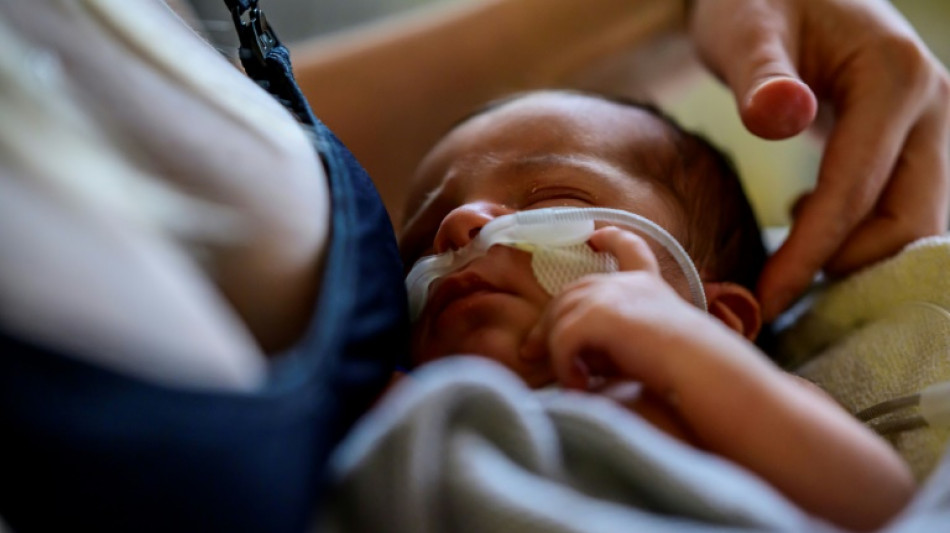
'No space': German hospitals overwhelmed by sick kids / Photo: John MACDOUGALL - AFP

 Eric Ries sets out how mission-driven companies can endure

 Falcons hand 49ers first defeat of NFL season, Vikings remain unbeaten

 Readers debate YES Bank bonds, climate commitments and candidate disclosure
 مباحثات لتوطين إنتاج المستحضرات الدوائية بين هيئة الدواء و«إيست فارما»
 Antonelli looks to seal title 'in style' after US Grand Prix win

 Real Madrid century 'just a detail' for Mbappe after Clasico win

 موجة بيع حادة تدفع مؤشرات البورصة المصرية إلى خسائر واسعة

 Disappointed Verstappen admits to wrong tyre strategy at US Grand Prix

 India trims weekly wheat auction volume despite strong miller demand

 Manchester United slump deepens as Liverpool climb with Brighton win
 Reus sends Bordeaux second in Top 14 with victory at La Rochelle

 الجامعة الإسلامية تنعى ثلاثة موظفين وتدين استهداف حرمها

 Real Madrid beat Barcelona in La Liga Clasico

 Antonelli wins US Grand Prix to close on world title

 اكتمال المتأهلين إلى ربع نهائي كأس الألف شهيد

 دخول خمس شاحنات غاز إلى قطاع غزة

 Falcons hand 49ers first defeat of NFL season

 Kuwait regulators broaden beneficial-owner data cooperation
 كفاراتسخيليا يتجه إلى الدوحة لإجراء جراحة في الركبة

 'Marine has to win': Le Pen supporters fear for France's future

 دراسة تحذر من مخاطر إرشادات أميركية جديدة للقاح التهاب الكبد «ب» على الرضع

 الدفاعات السعودية تحبط سلسلة هجمات حوثية استهدفت مكة والمدينة

 France's Le Pen launches presidential bid vowing to restore 'rule of law'

 Qatar Charity delivers Braille Qurans to blind readers in Kosovo and Albania

 Houthis say attacked Riyadh airport hours after flights resume

When Debora Zilz rushed her baby son Andreas to a Berlin hospital because of a serious respiratory illness, she got a shock.
"There was no space," she recalled. Medics desperately rang other hospitals in the German capital and neighbouring Brandenburg state in an effort to find a bed for the 13-day-old.
"Finally, after a night in the accident and emergency department, we were able to stay here," said the 33-year-old mother.
Her son, whose weight at one point dropped to below his birth weight of 3.1 kilos (6.8 pounds) before recovering, is now in intensive care.
The baby is battling bronchiolitis, as Germany faces a winter wave of cases of the chest infection in infants, putting already strained hospitals under extra pressure.
After two years of the coronavirus pandemic which brought measures like face mask-wearing that shielded the country's youngest from exposure to respiratory viruses, several European countries are seeing a surge in bronchiolitis.
The situation is particularly bad in 2022 as newborns and infants are exposed to the respiratory syncytial virus (RSV), which commonly causes bronchiolitis, for the first time.
The paediatric care team at Saint Joseph's in Berlin, where the youngster was being treated, is struggling to handle the surge with a smaller number of staff than ever before.
"We are underwater," Beatrix Schmidt, head of the hospital's paediatric and neonatology department, told AFP.
A perfect storm of factors have contributed to the problem, Schmidt said -- "an incredible number of sick children, infected caregivers, and all that at the same time as chronic staff shortages".
- 'Children pay the price' -
In the down-at-heel neighbourhood of Tempelhof, close to central Berlin, Saint Joseph's normally has 80 beds for sick children. But due to staff shortages, only 51 can currently be used.
Even in the intensive care unit, beds have had to be closed -- and all 18 that remain are occupied.
As in Andreas's case, medics are frequently finding they have no space for new patients and have to call around to other hospitals.
Many sick children have even had to be transported by helicopter to regions further afield, such as the northeastern state of Mecklenburg-West Pomerania, and the coastal state of Lower Saxony.
According to figures from the Robert Koch health institute, 9.5 million people in Germany were last week affected by some sort of respiratory illness, across all age groups, in a country of 84 million.
The figure is well above that during the same period in 2021, and is higher than at the peak of the 2017-18 flu epidemic.
Schmidt believes many problems are caused by cost-cutting.
"For years, we have made savings when it comes to our health system. And children are the first to pay the price," said the 63-year-old.
- Low salaries, underinvestment -
Currently there are 18,000 hospital beds for children in Germany, down from 25,000 in 1995, according to the federal statistics agency.
Germany, with an ageing population and fewer children than even many of its European neighbours, has been investing little in paediatric care, according to Schmidt.
Children "don't vote and we don't make money treating kids", she said.
Health care reforms aimed at reducing costs have been particularly damaging for paediatric care, while medical professions are struggling to attract new entrants, critics say.
"Many paediatricians are going to retire in the coming years," said Schmidt, who is herself preparing to leave her position.
The younger generation want to combine work and family, a challenge in a profession that often requires long and unpredictable hours, she said.
And in an affluent country like Germany, salaries of caregivers often leave a lot to be desired.
"In my opinion, they are underpaid," said Schmidt. "They work a lot -- at nights, on weekends."
R.Halabi--SF-PST