
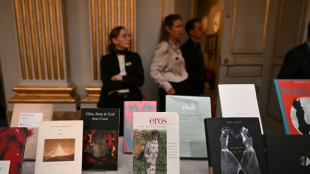
Acclaimed French director tackles 'commercial colonialism' in new film / Photo: VALERIE MACON - AFP

 Venezuela's Maduro, wife hit with new US torture charges
 Argentina friendlies no fairy tale for African footballers
 US suspending Microsoft from visa program: Vance

 Man City must 'stick together' during crisis, says Haaland
 CAS opens hearing into Senegal AFCON title appeal

 UK police agree searches for ex-prince Andrew's homes 'unlawful': judge

 After botched US execution, Christa Pike walking, mentally 'foggy': lawyer
 'Stunned' Madrid mourns pensioner who sparked housing protests

 High school students turn out for new protests across France

 Bid by Italy's Intesa bank to take over MPS gets boost

 Stablecoins Are Quietly Becoming Business Infrastructure, NOWPayments Data Shows

 Oil surges, stocks sink as US reportedly eyes new Iran strikes

 Woman in botched US execution walking, mentally 'foggy': lawyer

 Farhan hopes Pakistan's new combination takes off in Sri Lanka T20Is

 Teenager Andreeva seals China Open semi-final with Bartunkova
 Britain's Burnham says open to Germany joining warplane project

 Kovac's tough love has Dortmund dreaming of title charge

 China announces candidate for WHO chief

 South Korea test-fires its first homegrown hypersonic weapon: presidency

 ONAR Advances Nasdaq Listing Preparation Following Advertise Purple Acquisition and Financing

 Thailand opens extradition process for reporter sought by China
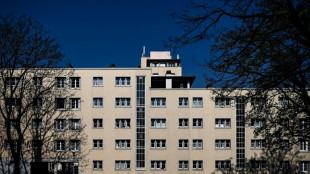 France struggles to wean social housing off gas
 Germany lifts GDP forecast as economy withstands Iran war

 Sri Lanka appoints Kusal Mendis as Test captain
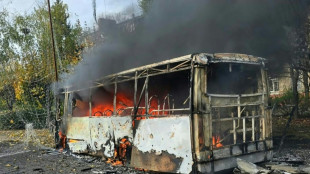
 Norris confident McLaren can shine in Singapore

In "The Fence," a haunting new film from Claire Denis, the celebrated French director returns to a theme she has explored throughout her career -- the shadow of colonialism in West Africa.
Denis, who spent her early childhood moving around Africa, where her father was a colonial administrator, sets "The Fence" on the grim compound of a British-owned construction site in an unspecified West African country.
Denis told AFP at the Toronto International Film Festival that the film, in part, tackles modern "commercial colonialism," asking questions about the potentially corrosive influence of foreign companies.
"They are interested in their work because they make a lot of money there. I don't think they are interested by the country and the people around at all," the 79-year-old director said.
"The Fence" stars Matt Dillon as "Horn" who plays a site supervisor managing a volatile night at the compound.
A Black worker has been killed -- shot dead in an apparent fit of rage by Horn's white deputy.
The worker's brother, played by Isaach De Bankole, appears at night at the compound's fence, insisting he will not move until he receives his brother's body.
Horn's goal is to delay the body handover -- offering the brother cash, whiskey, coffee and a variety of assurances.
Dillon told AFP that his character is not "amoral," but was working based on his "instinct to defend the company and power."
"He's not happy this man has died, but he wants it to go away quietly... he's there to protect the company," said Dillon, who starred in the 2004 Oscar Best Picture, "Crash."
- Africa focus -
As a child, Denis lived in what are today Mali, Djibouti and Burkina Faso before returning to France.
Africa is the setting for much of her work.
Her widely-praised 1988 debut feature "Chocolate" is about a white family living in Cameroon on the brink of independence, although Denis has resisted parallels between the film and her own childhood.
Her most famous film "Beau Travail" from 1999 focuses on the training exercises of a group of French legionnaires in east Africa.
The Black American filmmaker Barry Jenkins, whose 2016 film "Moonlight" won Best Picture, has cited Denis as an inspiration and has praised the fearlessness with which she addresses race on screen.
"It doesn't occur to her that she shouldn't be 'allowed' to handle this material. It's not a foreign world to her, in a way it might appear to be when you look at her and see a white Frenchwoman," Jenkins has said.
Denis told AFP it was fair to characterize "The Fence" as a post-colonial film and said she was grateful it was shot in Senegal, a country she argued has been better at defending itself against the influence of foreign investors promising riches.
"There is a commercial colonialism today, an exploitation of the minerals and the oil, and I think it is very obvious in some countries of the west coast of Africa," she said.
"We were lucky to shoot in Senegal," she added. "They protect themselves and they know better than to sell everything."
H.Darwish--SF-PST