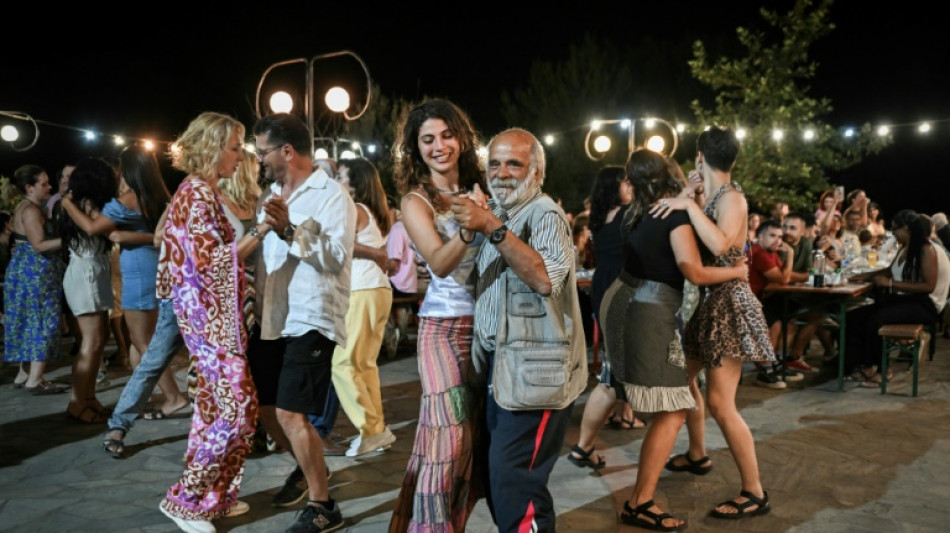
'Happy people': folk festivals punctuate Greek summer life / Photo: Aris MESSINIS - AFP

 Ms. Rachel Says Celebrity Silence on Gaza Is 'F--ked Up' and Drives Her to Swear

 Maryland Regulators and Air Force Clash Over Jet Fuel Spill Cleanup and Golf Course Exemption

 Bishop Museum Races to Save Rare Megamouth Shark Specimen

 Musk Questions AI Development Viability as SpaceX Leasing Revenue Surges

 مصطفى معروفي ينشر قصيدة 'أصوغ كلامي أهتدي بتجاربي'

 Luxembourg Housing Petition Passes Threshold for Parliamentary Consideration

 Raheem Sterling Receives Suspended Sentence After Lamborghini Crash

 Audience to Choose the Set List at Luxembourg's First FAMIL Jukebox Night

 Luxembourg Pay Rise Delayed as Regional and World Headlines Develop

 مواجهة في البرازيل بين نشطاء وفلسطينيين وسياح إسرائيليين حول جدارية مؤيدة

 رئيس جامعة القدس يستعرض نموذج الشراكة بين التعليم العالي والصناعة في قمة QS بأبوظبي

It's midnight in the Aegean Sea but on the Greek island of Ikaria, in the courtyard of the church of St Elijah, the revelry was barely getting started.
Dozens of dancers and scores of onlookers, including many tourists, were attending the local "panigiri", a folk celebration that is an integral part of centuries-old summer traditions in villages across Greece.
Anyone can lock arms under the strumming of lutes and join the circle for the "Ikariotikos", a dance whose origins are believed to date to the 15th century.
"People of all ages dance together in a circle, and the energy that emerges is fabulous," said Katerina Gerner, a German yoga instructor who spends half the year on the eastern Aegean island of around 9,000 residents.
Some of the dancers were elderly men who are among Ikaria's notoriously long-lived residents.
"It's like entering a trance through music, dance, in the circle, people are happy," she said.
"There are large tables... we drink, we dance, it's a very friendly and cheerful atmosphere where everyone talks to each other," said Martine Bultot, a former doctor from France who has visited Ikaria for 35 years.
Most Greek summer festivals are held on August 15, an important religious holiday marking the Dormition of Virgin Mary.
In Ikaria, however, they go on to mid-September.
Each panigiri is associated with the feast day of a local patron saint, such as the Prophet Elijah on July 20 and Saint John on August 28.
Panagiota Andrianopoulou, an ethnologist at the Museum of Modern Greek Culture in Athens said the celebrations have existed "since the early years of Greek independence" in the early 19th century.
"We tend to associate them with entertainment, but in fact these celebrations had an economic, social, and symbolic function," said the researcher who has studied these festivities in northern Greece.
- Local values -
"It is the moment when local values are consolidated, such as hospitality, openness, and acceptance of the other," she told AFP.
And summer, the height of the harvest, was conducive to trade exchanges, she noted.
"Animals, fabrics were bought, dairy products and dried fruits were exchanged, for example," Andrianopoulou said.
Ikaria, which has a strong left-wing tradition and votes Communist, was one of the first islands to open up its folk festivals to outsiders.
"It is important for the community of a village to come together as one," said Kostas Politis, one of the organisers who helped prepare the food sold during the evening.
Goat, mutton and pork are usually on the main course, accompanied by resinated retsina wine.
Not without mishaps, some people have been hospitalised with food poisoning.
In the Peloponnese village of Ilia last year, nearly 40 people fell ill after eating boiled mutton. Another 30 were briefly hospitalised in Arta, northwestern Greece.
- Instagram guests -
The festivals have become so popular in recent years that some residents have begun to worry about the growing tourist turnout.
Some are upset about these panigiri becoming "Instagrammable", with people mainly showing up to take photos and videos for social network postings.
"In the past, these celebrations lasted three days, from Friday to Sunday," said Theodoris Georgiou, a retired engineer from Piraeus who spends his summers in Ikaria.
"Today it's a bit more commercial. It's linked to the development of tourism," he added.
The all-night duration of the panigiri is a more recent phenomenon, going back 40 years or so.
A young Greco-Belgian woman who did not give her name argued that tourism has irrevocably changed the nature of the celebration.
"I will never return to Ikaria; nothing is more respected in these traditions that tourists appropriate and destroy," she said, criticising the "post-colonial" attitude of visitors.
Vagelis Melos, who came to the celebration with his two sons, was more philosophical.
"When people change, the panigiria change," he said with a smile.
U.Shaheen--SF-PST

