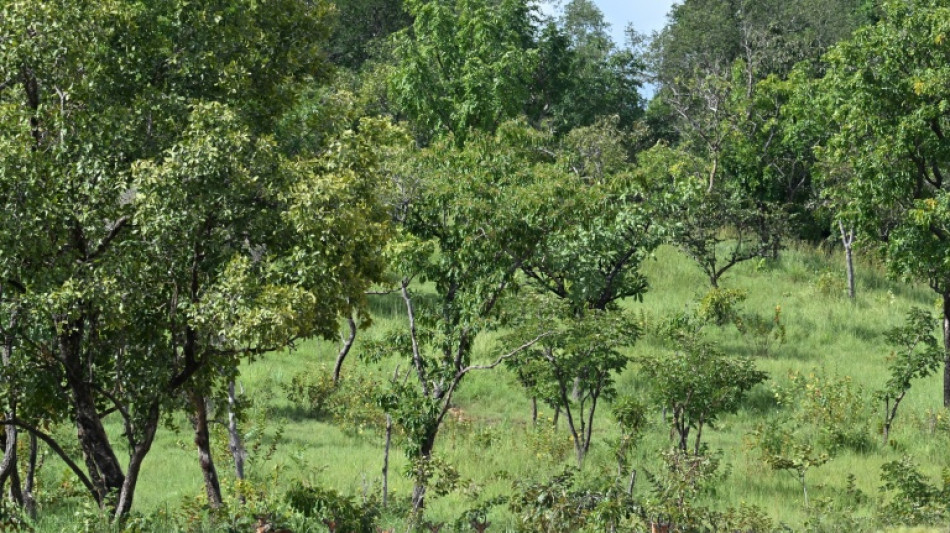
Risky gold rush drives young into Ivory Coast nature park / Photo: Issouf SANOGO - AFP

 WhiteBIT Launches Bitcoin Lightning Network Support, Powered by Voltage

 Oil surges, stocks sink as US reportedly eyes fresh Iran strikes
 Anne Carson: modern takes on Greek classics
 Canada's Anne Carson wins Nobel literature prize
 Ethiopia drones hit Eritrean troops in Tigray

 Russian strike on buses kills 30 in frontline Ukrainian city
 Thailand begins extradition process against Chinese journalist

 Quarantine, unease and rumours: Russian city grapples with plague scare
 Taiwan says exports hit record in September on AI demand
 Marc Marquez vows to 'attack' Martin's lead at Indonesian MotoGP
 Diplomats, schools in Saudi take safety measures after blasts heard: sources to AFP

 In Beijing, EU trade envoy says deficit with China 'unsustainable'
 Sri Lanka's de Silva quits as Test captain

 Alcaraz feeling 'mentally fresh' ahead of Shanghai return
 Israel drastically reduces British diplomatic presence in Jerusalem
 Stocks fall further as oil surge fans fresh inflation worries

 North Korea demands South show 'utmost respect' to restore relations
 Saudi says three dead in airport attacks claimed by Houthis

 'Mad dream': New showcase for African film opens in London

 All Blacks coach Rennie says Wallabies exit 'part of the game'

 The growing protests against India's poll body - and PM Modi
 Stocks fall further as oil spike fans fresh inflation worries

 Bad COP, worse COP? EU tempers hopes for UN climate summit

 Rookie Henry named in Wallabies midfield to face All Blacks

 Housing crisis set to dominate Spain's snap election
Emmanuel knows only too well the allure of illegal gold prospecting in the protected Comoe National Park for the many young without prospects in Ivory Coast's troubled northeast.
"Young people come back from the park with enough money to buy themselves motorcycles, or even to build their own house," said the former key player in the illegal trade, who has since renounced the unlawful gold digger's life.
"When the metal detector beeps, you dig, up to a metre into the ground," said Emmanuel, whose name AFP has changed to protect his identity.
"Sometimes you find iron, things of no interest. If you're lucky, it's gold! Then you dig some more, and you can earn a lot!"
Gold, seen as a safe haven investment, has hit record prices in recent months in a lucrative market that fuels different forms of trafficking, including for jihadists in the Sahel region neighbouring Ivory Coast.
Despite the personal perils and dangers to the wildlife of the Comoe nature reserve, one of west Africa's largest, illicit gold mining has become one of the main money-makers for young Ivorians in the impoverished Bounkani region.
"Here, everyone's into gold," said Angeline Som, who heads a women's rights group in the Bounkani town of Doropo.
"The majority of young people are illegal prospectors. Otherwise, they're on the dole, and more and more of them are turning into thieves when night falls," the 50-year-old said.
Hermann Dah Sie, a journalist in the regional capital Bouna, near the borders with Ghana and jihadist-hit Burkina Faso, agreed.
"Besides gold, there's nothing for young people here. Just civil service posts and the informal sector," Dah Sie said.
- Rebel origins -
Some locals have gone as far as to demand the government either legalise or tolerate the practice, as has long been the case in Burkina Faso.
According to Emmanuel, gold mining took off in Bounkani with the start of the first Ivorian civil war in 2002, when rebels took over the region.
"Before, no one talked about it. We didn't know about it. It was just something the Burkinabes did here and there," he said.
After the rangers fled the fighting, prospectors rushed into the Comoe National Park, which, while protected in theory, had been left at the mercy of looters and poachers.
Prospectors quickly learnt how to use metal detectors, often provided by Burkinabe gold miners.
"The gold miners would take their machines and follow behind the poachers, spending time in the park together for days or even weeks at a time," Emmanuel said.
However, after Ivory Coast's decade-long crisis ended in 2011 and stability returned, the re-establishment of the state's authority in the region changed the situation on the ground.
- 'Disappear forever' -
Today everyone agrees that the park is well-guarded, while artisanal gold mining is officially prohibited.
Those caught by the park's rangers risk up to two years in jail and a hefty fine.
Yet the long arm of the law is the least of a gold digger's worries.
"If you get lost in the park, you're dead," said Emmanuel.
"Without water, without food, with all the animals, you'll disappear forever," he added.
"Many have found themselves trapped in ravines, killed by snakes or buffaloes... If you injure yourself, no one will carry you home."
Despite the ban, artisanal gold mining still takes place in Comoe on the sly, to the point where authorities consider the practice the biggest threat to the still-recovering park.
While guards mount regular patrols, corruption exists, with miners sometimes informed of what zones the rangers will stake out, according to Emmanuel.
"The sponsors provide the logistics, food and metal detector. They earn a lot of money, up to 70 percent of the gold, leaving the remaining 30 percent for the digger," said Emmanuel.
Sponsors then do deals in Bouna, at the crossroads between Burkina and Ghana, with demand coming from all over west Africa, he added.
"We have to tell young people that there are too many risks to gold-digging," Emmanuel warned.
"It's not worth the trouble."
Y.Zaher--SF-PST