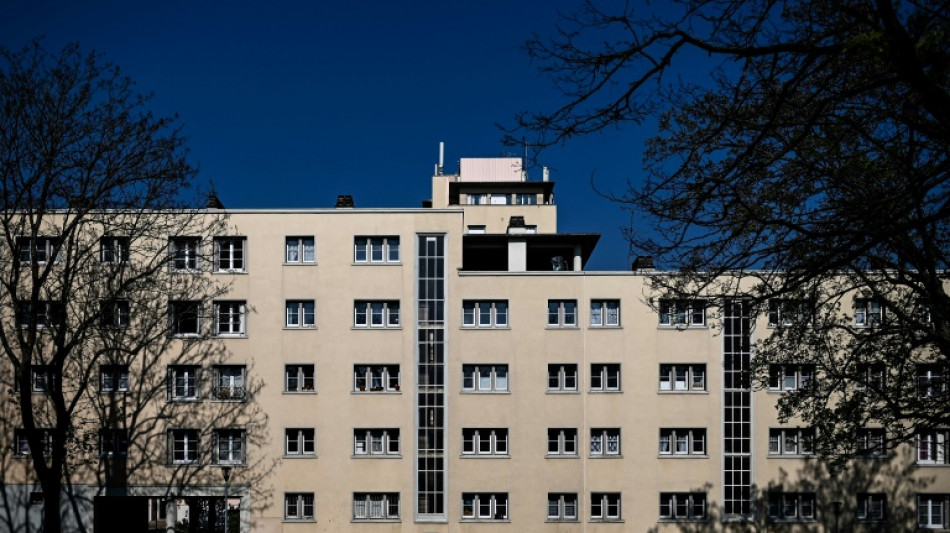
France struggles to wean social housing off gas / Photo: Philippe LOPEZ - AFP

 Alex Bodi pushes ahead with expansion: ALIX LASERS showroom planned for Bucharest
 Fossil fuels off COP31 agenda as global output keeps rising

 Haze not 'a threat' to Singapore F1 race: organisers

 COP31 organisers say to seek 'ambitious' action with their text

 Bartunkova thrashes Muchova to reach China Open semi-finals

 Drone hits Yandex data centre, in first such attack on Russia

 Oil prices surge and stocks sink on fresh inflation worries

 AI startup Manus raises $500m after Meta acquisition blocked by China
 From refuge to repatriations: Malaysia's Myanmar U-turn

 Morikawa says LIV players face 'business decision' after Rahm exit

 Tenzing Norgay's son says Himalayas sending climate warning

 On your bike! Bottas opts for two wheels to reach Singapore GP

 Alcaraz, Sinner, Osaka commit to Australian Open '1 Point Slam'

 Dodgers beat Braves to advance in MLB playoffs, Rays oust Yankees

 'A sun as black as my lungs': how corruption crucified a polluted Albania city

 The British historian helping the French rediscover de Gaulle
 Dodgers beat Braves to advance, Guardians survive in MLB playoffs

 Latin American, Caribbean women top Nobel literature buzz
 US says Fiji-based Chinese official paid bribes for Beijing

 After botched US execution, Christa Pike was nearly taken off life support

 Guinea-Bissau junta urges military unit loyal to ex-president to disarm

 As species decline, green turtles offer glimmer of hope

 Brothers Scott and Beauden Barrett named to start for All Blacks

 EU trade chief seeks to dial down China tensions

 'Never again Bolsonaro': thousands march ahead of Brazil election runoff

As France recovers from a sweltering summer where thousands died in gruelling heatwaves, the country now faces a dilemma of how to heat itself during the winter as natural gas prices soar.
The most vulnerable to both heat and cold are the poorest sections of society, and millions of people living in social housing rely on natural gas for heating and cooking.
But the French government has decreed gas use must stop by 2050.
That means retooling roughly two million households across France with alternative supplies of energy.
The mission flows directly from the goals laid out in the landmark 2015 Paris agreement to reduce emissions from fossil fuels, but there are other, more visceral concerns.
France imports almost all its natural gas, which leaves it exposed to the whims of geopolitics and market shifts.
Russia was once the key supplier of gas to Western Europe, but its invasion of Ukraine has made it an international pariah.
Its gas exports are under sanctions, and European countries have scrambled to find alternatives.
France's needs are now largely served by a direct pipeline from Norway.
But that does not help when ructions in the Middle East cause global energy prices to surge, as has happened with the US attacks on Iran and the subsequent blockade of oil supplies from the Gulf.
It is a far cry from the 1980s, when French social housing moved to gas as a cheaper and more stable alternative to oil.
All this somehow lands on the plate of people like Thomas Tirtiaux, head of Elax Energie, a company that designs solutions for energy transitions.
- Hybrid systems -
Elax is working on transforming the water heating for 400 social housing units in a block in eastern Paris.
If all goes to plan, the block's three old gas boilers will be replaced with an electric element for water heating at least.
The new system is designed to be hybrid, "so we can choose the cheapest energy at the right time", Tirtiaux told AFP.
The building's heating, however, will still be powered by gas.
"Switching both heating and hot water over to electricity would have been more expensive," said Simon Molesin, manager at the social landlord RIVP, which runs the block.
It would have sent energy bills soaring for tenants, he said.
- Vary the mix -
The dilemma is keenly felt across the sector.
Frank Nicol, director of the social landlord Val Touraine Habitat in Tours, southwest of Paris, said he was also convinced that 100 percent electricity "is not the solution and would increase tenants' charges".
He is looking at hybrid heat pumps, photovoltaic panels, hydrogen, green gas from agriculture and other solutions.
At Gironde Habitat in southwestern France, manager Remi Poujardieu also prefers the idea of an "energy mix".
He said some of their gas equipment was new and relatively efficient.
One option gaining traction among social housing groups is producing solar energy that is consumed directly on site, in "self-consumption" mode.
Panels already power the common areas of one of Gironde Habitat's buildings in the city of Bordeaux and the landlord is gradually converting the units.
But one thing social landlords agree on is that the current situation is far from ideal.
"The tenants who pay the highest energy bills are those who have individual electric heating," Molesin said.
In these households, he said, "they don't turn their radiators on".
jvi/jxb/js
M.AlAhmad--SF-PST