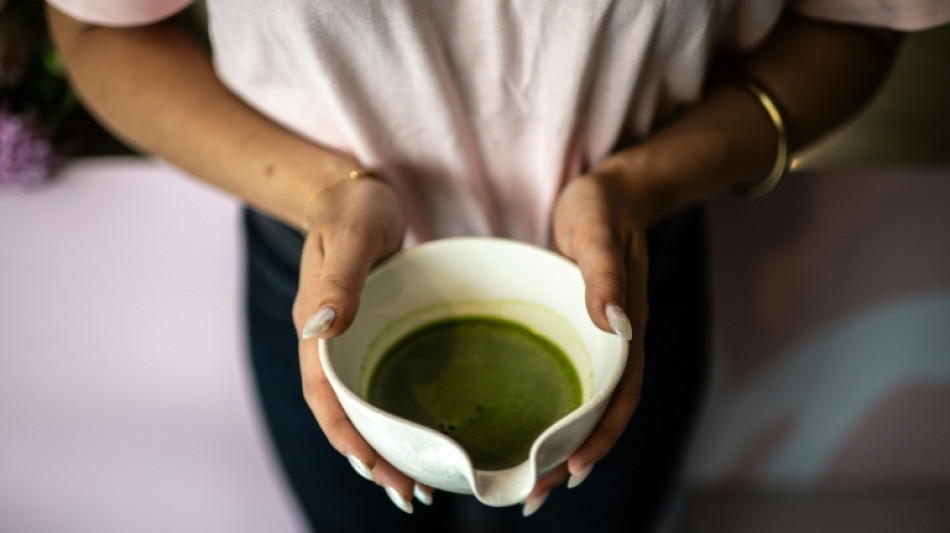
Matcha: the Japanese tea taking over the world / Photo: Philip FONG - AFP

 Ms. Rachel Says Celebrity Silence on Gaza Is 'F--ked Up' and Drives Her to Swear

 Maryland Regulators and Air Force Clash Over Jet Fuel Spill Cleanup and Golf Course Exemption

 Bishop Museum Races to Save Rare Megamouth Shark Specimen

 Musk Questions AI Development Viability as SpaceX Leasing Revenue Surges

 مصطفى معروفي ينشر قصيدة 'أصوغ كلامي أهتدي بتجاربي'

 Luxembourg Housing Petition Passes Threshold for Parliamentary Consideration

 Raheem Sterling Receives Suspended Sentence After Lamborghini Crash

 Audience to Choose the Set List at Luxembourg's First FAMIL Jukebox Night

 Luxembourg Pay Rise Delayed as Regional and World Headlines Develop

 مواجهة في البرازيل بين نشطاء وفلسطينيين وسياح إسرائيليين حول جدارية مؤيدة

 رئيس جامعة القدس يستعرض نموذج الشراكة بين التعليم العالي والصناعة في قمة QS بأبوظبي

Matcha is the new drink of choice at hip cafes worldwide, but Japanese producers are struggling to keep up with soaring demand for the powdered green tea.
Here's what you need to know about the drink beloved of weekend treat-seekers and "wellness" influencers:
- What is matcha? -
The word matcha means "ground tea" in Japanese and comes in the form of a vivid green powder that is whisked with hot water and can be added to milk to make a matcha latte.
Green tea was introduced to Japan from China in the early ninth century, and was first used for medicinal purposes.
Matcha came much later, in 16th century Kyoto -- part of the tea ceremony tradition developed by tea master Sen no Rikyu.
Today, there are different grades of matcha quality, from "ceremonial" to "culinary" types used in baking.
- How is it produced? -
Matcha is made from leaves called "tencha", which are grown in the shade in the final weeks before their harvest to concentrate the flavour, colour and nutrients.
This "requires the construction of a complex structure with poles and a roof to filter the light", explained Masahiro Okutomi, a tea producer in Sayama, northwest of Tokyo.
Tencha leaves, rich in chlorophyll and L-theanine, a compound known for its relaxing effects, are hand-picked and deveined, then steamed, dried and ground between two stone mills to produce an ultra-fine powder.
It can take up to an hour to produce just 40 grams (1.4 ounces) of matcha -- making the powder on average twice as expensive to produce as standard green tea leaves.
- What are its benefits? -
Many drink matcha for its rich grass-like taste, but others are drawn to the drink's nutritional properties.
It is rich in antioxidants, and can aid concentration because of its caffeine content: one cup contains on average 48 milligrams, slightly less than a drip coffee but nearly twice as much as a standardly brewed green tea.
"Matcha is often seen as being good for your health," said Shigehito Nishikida, manager of Tokyo tea shop Jugetsudo.
"But people are also attracted to the Japanese culture around tea: the ritual, the time taken, the aesthetics," he said.
- Why is it so popular? -
Japan produced 4,176 tonnes of matcha in 2023 -- a huge increase from the 1,430 tonnes in 2012.
More than half of the powder is exported, according to the agriculture ministry, mostly to the United States, Southeast Asia, Europe, Australia and the Middle East.
Millions of videos on TikTok, Instagram and YouTube demonstrate how to make photogenic matcha drinks or choose a traditional "chasen" bamboo whisk.
"I feel like Gen Z really drove this enthusiasm for matcha, and they heavily relied on social media to do so," Stevie Youssef, a 31-year-old marketing professional, told AFP at a matcha bar in Los Angeles.
Matcha can also be used in cooking, extending its appeal to others aside from tea lovers.
"Some customers simply enjoy drinking it, others like preparing it themselves. And of course, many buy it as a gift -- Japanese matcha is always appreciated," said Jugetsudo's Nishikida.
L.AbuTayeh--SF-PST

