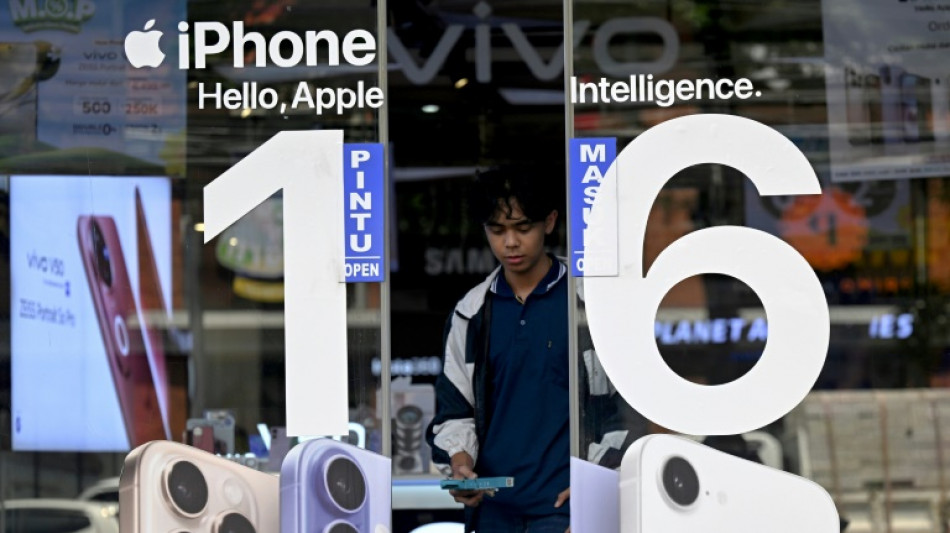
Apple expects $900 mn tariff hit, US iPhone supply shifts to India / Photo: SONNY TUMBELAKA - AFP

 'Tough to stay here': Nepal flood survivors wait for homes

 Malaysia closes schools in capital, parts of country due to haze

 Buccaneers stun Cowboys for first win of NFL season

 Activists hope trial will stop 'forever chemicals' at Italy plant

 Guardians rally for 9-5 victory over White Sox to stay alive in MLB playoffs

 Asian stocks mixed amid AI concerns, oil dips after surge

 Wallabies expect fast-paced All Blacks in Bledisloe opener

 Tech scammer Elizabeth Holmes focus of documentary by absurdist Nathan Fielder

 Climate hopes shift from politics to the courts

 Will Nobel Peace Prize pick make waves at the White House?

 Trump rules out new Iran attack before US midterm elections

 Far-right influencer shows Israel's coarse political turn

 Seals and sea lions get hearing tested at Australia zoo

 Mourinho's Real Madrid playing catch-up in Clasico countdown

 Joy as USS Lincoln back home after troubled Gulf deployment

 OpenAI says Iran, Russia influence ops busted

 Anthropic bans 'cruel' behavior against its Claude AI

 Anne Carson's Nobel literature prize 'a proud moment for Canada': PM

 Montagliani to seek CONCACAF re-election in boost for Infantino: reports

 Oil surges, stocks sink on jitters over US plans in Iran war

 John Cena and Jessica Biel hit the gas in 'Matchbox: The Movie'

 US, Ukrainians, Europeans to discuss 'new ideas' to end war

 Unproven 'cures' pushed online amid plague concerns

 Nigeria looks to ease fuel prices as election looms

 Prosecutors in Maradona death trial seek sentences up to 12 years

Apple on Thursday reported first-quarter profit above expectations but warned that US tariffs could cost the company and was disrupting its supply chain.
Apple expects US tariffs to cost $900 million in the current quarter, even though their impact was "limited" at the start of this year, chief executive Tim Cook said on an earnings call.
Cook said he expected "a majority of iPhones sold in the US will have India as their country of origin," adding that Apple's products were exempt from Trump's most severe reciprocal tariffs for now.
"We are not able to precisely estimate the impact of tariffs, as we are uncertain of potential future actions prior to the end of the quarter," Cook said.
"Assuming the current global tariff rates, policies and applications do not change for the balance of the quarter and no new tariffs are added, we estimate the impact to add $900 million to our costs."
Tit-for-tat exchanges have seen hefty US levies imposed on China, with Beijing setting retaliatory barriers on US imports.
High-end tech goods such as smartphones, semiconductors and computers received a temporary reprieve from US tariffs.
Although completed smartphones are exempted, for now, from Trump's tariffs, not all components that go into Apple devices are spared, said independent tech analyst Rob Enderle.
"The more components are crossing borders, the most cost flows through to the device," Enderle explained.
"In the end, this all adds up to an expensive mess," he said of the tariff situation.
Canalys research manager Le Xuan Chiew said Apple built up inventory ahead of tariffs going into effect.
"With ongoing fluctuations in reciprocal tariff policies, Apple is likely to further shift US-bound production to India to reduce exposure to future risks," he said.
While iPhones produced in mainland China still account for the majority of US shipments, production in India ramped up toward the end of the quarter, according to Canalys.
Cook said Vietnam would be the country of origin for almost all iPad, Mac, Apple Watch and AirPod products sold in the US.
China will continue to be where most Apple products are made for sale outside the US, he insisted.
"What we learned some time ago was that having everything in one location had too much risk with it and so we have, over time with certain parts of the supply chain, opened up new sources of supply," Cook told analysts.
"You could see that kind of thing continuing in the future."
Apple's revenue of $95.4 billion in the recently ended quarter was driven by iPhone sales, with the company taking in $17 billion in the China market, according to the earnings report. Profit for the quarter was $24.8 billion.
Apple shares slipped more than four percent in after-market trading.
"The real story is in Tim Cook's plans to navigate these unprecedented trade challenges," said Emarketer analyst Jacob Bourne.
Apple's plan to shift manufacturing to India "raises pressing questions about execution timeline, capacity limitations, and potentially unavoidable cost increases that will shrink margins, be passed to consumers, or have a mix of consequences," Bourne added.
G.AbuHamad--SF-PST