Taliban change tune towards Afghan heritage sites / Photo: Wakil KOHSAR - AFP

 'Tough to stay here': Nepal flood survivors wait for homes

 Malaysia closes schools in capital, parts of country due to haze

 Buccaneers stun Cowboys for first win of NFL season
 Activists hope trial will stop 'forever chemicals' at Italy plant

 Guardians rally for 9-5 victory over White Sox to stay alive in MLB playoffs
 Asian stocks mixed amid AI concerns, oil dips after surge

 Wallabies expect fast-paced All Blacks in Bledisloe opener

 Tech scammer Elizabeth Holmes focus of documentary by absurdist Nathan Fielder

 Climate hopes shift from politics to the courts

 Will Nobel Peace Prize pick make waves at the White House?

 Trump rules out new Iran attack before US midterm elections

 Far-right influencer shows Israel's coarse political turn

 Seals and sea lions get hearing tested at Australia zoo

 Mourinho's Real Madrid playing catch-up in Clasico countdown
 Joy as USS Lincoln back home after troubled Gulf deployment

 OpenAI says Iran, Russia influence ops busted
 Anthropic bans 'cruel' behavior against its Claude AI

 Anne Carson's Nobel literature prize 'a proud moment for Canada': PM

 Montagliani to seek CONCACAF re-election in boost for Infantino: reports

 Oil surges, stocks sink on jitters over US plans in Iran war

 John Cena and Jessica Biel hit the gas in 'Matchbox: The Movie'

 US, Ukrainians, Europeans to discuss 'new ideas' to end war
 Unproven 'cures' pushed online amid plague concerns

 Nigeria looks to ease fuel prices as election looms

 Prosecutors in Maradona death trial seek sentences up to 12 years

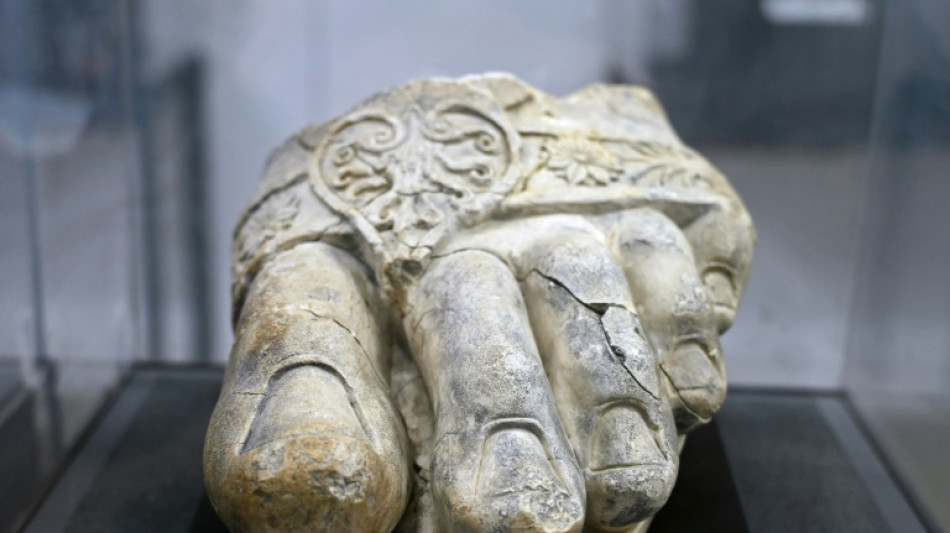
In March 2001, the Taliban shocked the world by dynamiting the giant Buddhas of Bamiyan. Two decades later, they are back in power and claim to be making strides to preserve Afghanistan's millennia-old heritage, including pre-Islamic relics.
Even months before their takeover in 2021 the Taliban called for the protection of ancient artefacts in the country, sparking scepticism among observers.
"All have an obligation to robustly protect, monitor and preserve these artefacts" and sites in Afghanistan, the Taliban authorities declared in February that year.
They are "part of our country's history, identity and rich culture".
Since their return to power and decades of war ended, archaeological finds -- particularly related to Buddhism -- have proliferated, with discoveries publicised by the authorities.
In eastern Laghman province, niches carved into rocks in Gowarjan village are believed to have been storerooms dating back to the Kushan empire, which 2,000 years ago stretched from the Gobi desert to the river Ganges.
Also in Laghman, carved Brahmi inscriptions have been found, along with a hollowed out stone slab used for pounding grapes for wine.
"It is said that Afghan history goes back 5,000 years -- these ancient sites prove it; people lived here," said Mohammed Yaqoub Ayoubi, head of the provincial culture and tourism department.
"Whether they were Muslim or not, they had a kingdom here," he told AFP, adding that the Taliban authorities afford "a great deal of attention" to the preservation of these sites.
In nearby Ghazni province, the information and culture head Hamidullah Nisar echoed the sentiment.
Recently uncovered Buddhist statuettes must be "protected and passed down to future generations because they are part of our history", he said.
- 'They value them' -
These relics would have likely met a different fate during the Taliban's first rule from 1996 to 2001.
Days after Taliban founder Mullah Omar ordered the destruction of all Buddhist statues to prevent idol worship, the gigantic 1,500-year-old Buddhas of central Bamiyan province were pulverised -- the Taliban having been unmoved by international outcry.
"When they returned, people thought they would have no regard for historical sites," said Mohammed Nadir Makhawar, director of heritage preservation in Laghman, a position he held under the ousted Republic.
"But we see that they value them."
In December 2021, the Taliban reopened the Afghan National Museum, where they had once destroyed pre-Islamic artefacts.
The following year, they reached out to the Aga Khan Trust for Culture (AKTC) to help preserve the historic Buddhist site of Mes Aynak, where there is also a copper mine under a development contract with a Chinese consortium.
"The request was unexpected," said Ajmal Maiwandi, the head of AKTC in Afghanistan, who even noted an "enthusiasm" from the authorities to support the conservation work.
"I think the Taliban have understood how much the destruction of the Bamiyan Buddhas damaged their reputation," said Valery Freland, director of the ALIPH foundation, the International Alliance for the Protection of Heritage.
"They seem concerned today with preserving material heritage in all its diversity," he added.
However, experts have highlighted that the Taliban authorities do not extend the same concern to intangible heritage: music, dance, folklore and anything involving women remain a red line in their severe interpretation of Islam.
And while a historic synagogue in Herat city was preserved after the Taliban takeover, local authorities have recently resisted media attention on the site and the city's former Jewish community.
- 'Cautiously optimistic' -
Afghanistan has signed several conventions on heritage since the Taliban's first reign, with its destruction deemed a war crime in 2016.
Beyond the risk of angering the international community -- whose recognition the Taliban seek -- Afghanistan's heritage represents "a potential lever for the country's tourism and economic development", said an industry expert speaking on condition of anonymity.
However, the authorities face two major challenges, the source said, pointing to a lack of financial resources and the departure -- following their takeover -- of "the archaeological and heritage elite".
Security could hamper tourism ambitions as well; a group visiting Bamiyan was targeted in a deadly militant attack last year.
In the tiny Laghman museum, a plastic bag and newspaper serve as protection for the statuettes, one of which depicts the face of a Buddhist goddess.
It was discovered last year in the courtyard of a farm, among milling cows and goats.
Ayoubi says he needs help to properly conserve and study them to determine their precise age, a process hampered by four decades of war in Afghanistan.
Looting has also proved an ongoing challenge, with no fewer than 30 sites still being "actively pillaged", according to a 2023 study by University of Chicago researchers.
Even if preservation projects have not been disrupted, Maiwandi remains "cautiously optimistic".
"The situation in Afghanistan can change quickly," he said.
L.AbuTayeh--SF-PST