Germany repatriates colonial-era remains of indigenous Australians / Photo: RALF HIRSCHBERGER - AFP

 المفكر الفلسطيني نسيم قبها يطرح «المعلم المرآة»: بيان أنطولوجي لاسترداد إنسانية التعليم

 فاطمة بوش ترفع شعار 'ليحيا المسيح الملك' في ختام ملكة جمال الكون

 أين الأمن القومي العربي؟.. تحليل نقدي لغياب الرؤية المشتركة

 Crude Oil Prices Rise on Reports of Houthi Attack on Saudi Refinery

 El Nino’s Weakening Grip on Tamil Nadu Rainfall Hinges on Potential Cyclone

 Black Friday Discounts Cut Prices on Two Top-Rated Wiper Blades

 Twickenham Grounds Team Prepares Pitch for Six Matches in Three Days

 Luxembourg City Plans €13 Million Abrigado Centre for 2029

 Two A1 Crashes Create Kilometres of Rush-Hour Congestion

 South Africa Places 36 Hospitals on Standby for Possible Imported Ebola Cases

 Tamil Nadu Secures Rs 58,214 Crore in Investments at Vettri Conclave
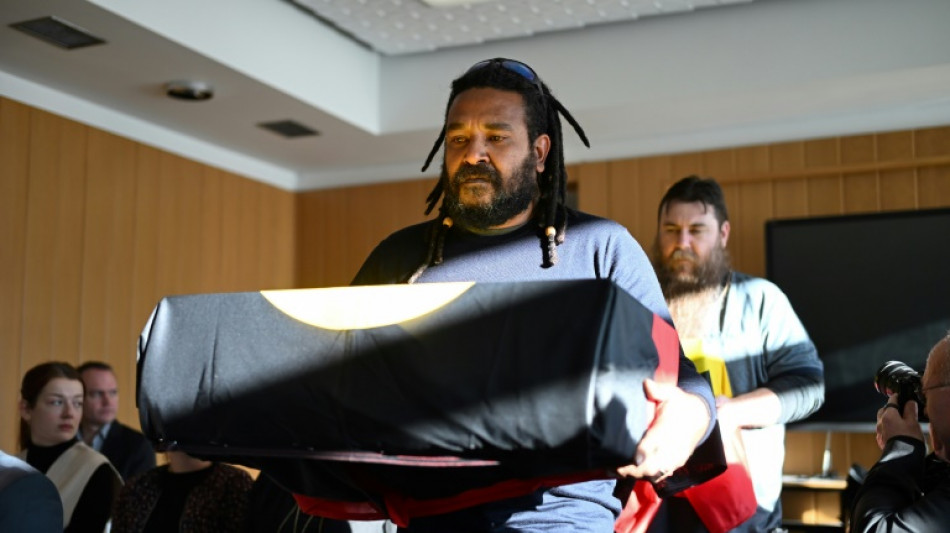
Traditional funeral rites were held in Berlin Thursday for five indigenous Australians whose remains are to be sent home almost 150 years after they were pillaged during the colonial era.
The two mummified bodies, two skulls and one traditional "burial bundle" were taken from Aboriginal and Torres Strait Islands burial sites and brought to Germany around 1880, researchers said.
Berlin's Ethnological Museum and the State Museum for Nature and Man in Oldenburg will now send them back as part of ongoing efforts to atone for crimes committed during Germany's colonial era.
Representatives of Australia's indigenous communities sang and played traditional drums at the service in Berlin, with five boxes containing the remains draped in traditional flags.
Australian ambassador Natasha Smith said the funeral service was "deeply important" and that "such repatriations are an extremely high priority for Aboriginal and Torres Strait Islander communities in Australia, and for the government."
Berlin's museums and their storage sites are filled with millions of artefacts and items brought there by scientific expeditions that roamed the globe from the mid-19th century to explore non-European cultures.
"These ancestral remains were never meant to be here," said Hermann Parzinger, president of the Prussian Cultural Heritage Foundation which runs the Berlin Ethnological Museum.
"We are very happy that today your ancestors are beginning their journey home and we fully acknowledge that this should have happened long ago."
- 'Facing up to legacy' -
The two mummified bodies are of Torres Strait Islanders and the skulls and burial bundle are the mortal remains of Aboriginals, according to the community representatives.
The remains are of three women, one man and one person of unknown gender.
The repatriations will bring the total number of human remains returned from Germany to Australia to 162, said Smith.
Over the past 20 years, Germany has been gradually starting to talk more about the crimes it committed before World War II and the Holocaust, during the colonial era.
It has returned skulls and other human remains to Namibia and has also started to return looted cultural artefacts.
In 2022, Germany began returning items from its collections of Benin Bronzes, ancient sculptures from the Kingdom of Benin, to Nigeria.
Berlin's Museum of Prehistory and Early History has also been carrying out research on around 1,100 skulls from what was known as German East Africa, with the aim of eventually returning the remains to the relevant countries.
"In recent years there has been a noticeable shift in our approach to certain issues," Parzinger said, noting that the Nazi period "for a long time obscured our view of Germany's role in colonialism".
"I am glad to say that this has changed now... and we are fully committed to facing up to this legacy."
M.Qasim--SF-PST
