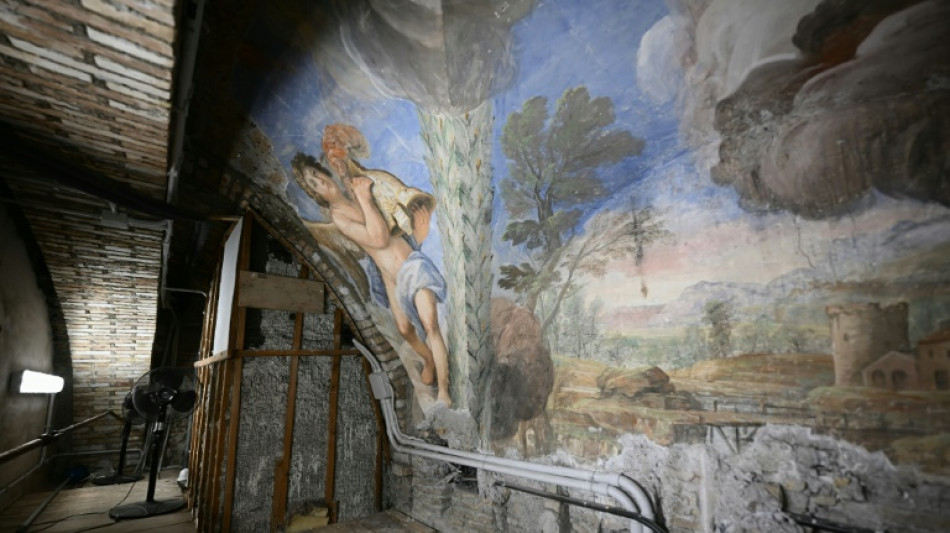
Electrician finds frescoes behind false ceiling in Rome / Photo: Filippo MONTEFORTE - AFP

 Rare yellow-bellied sea snake found on Southern California beach

 Toyota Innova Hycross and Kia Sorento hybrids compared in top trims

 Gypsy Rose Blanchard Denies Dating Rumors Following Ken Urker's Death

 صعود اليمين في الأندلس يهدد معاقل اليسار التاريخية

 Ms. Rachel Says Celebrity Silence on Gaza Is 'F--ked Up' and Drives Her to Swear

 Maryland Regulators and Air Force Clash Over Jet Fuel Spill Cleanup and Golf Course Exemption

 Bishop Museum Races to Save Rare Megamouth Shark Specimen

 Musk Questions AI Development Viability as SpaceX Leasing Revenue Surges

Rosy-cheeked cherubs surrounded by blues, reds and golds have lost none of their brilliance in 17th-century frescoes discovered behind a false ceiling at the Villa Farnesina palace in Rome.
The three paintings were hidden above the vaulted ceiling of what was once the living room of Agostino Chigi, a wealthy banker and Renaissance patron who had the villa built at the start of the 16th century.
Electrician Davide Renzoni stumbled upon them by chance a year ago, after climbing through a trapdoor into the long-forgotten space during maintenance work on the villa, which sits on the banks of the river Tiber.
"I went to get a lamp and when I turned it on, everything appeared: it was a marvel," he told AFP on a visit this week.
Several cherubs hold up a green festoon, while another brandishes a golden helmet.
The frescoes, by a little-known artist, include the coat of arms of the noble Farnese family.
Cardinal Alessandro Farnese bought the villa in 1579 with the idea of connecting it to the Farnese Palace on the other side of the Tiber, though the plan fell through.
The villa, bought by the state in 1927, underwent major restoration work and the frescoes fell into oblivion, curator Virginia Lapenta told AFP.
Their rediscovery last year inspired an exhibition on the 17th century in the grounds of the villa, which has long been renowned for its frescoes by Renaissance master Raphael.
Although they are not accessible to the public for security reasons, visitors can see the newly found frescoes through pictures and videos included in the exhibition, which runs until January 12.
The displays also allow the villa to monitor the frescoes' conservation, Lapenta said.
Q.Bulbul--SF-PST