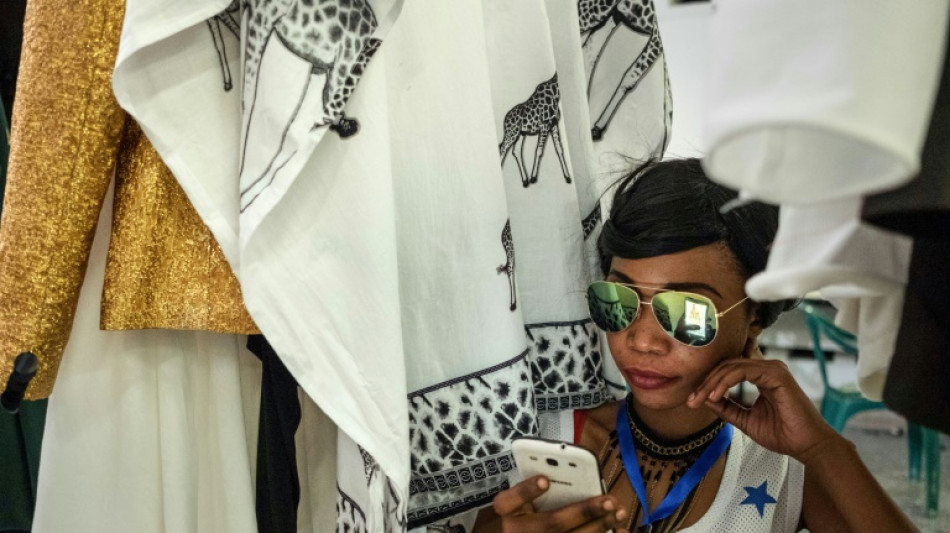
Africa grapples with way forward on cybercrime / Photo: Daniel Hayduk - AFP

 Govt takes control of Turkey's most-watched news channel

 FIFA to offer members $6.35-billion development fund windfall

 US consumer inflation hotter than expected as midterms loom

 INmune Bio Inc. and Quantum Computing Inc. Partner to Apply Quantum Optimization and AI to Advance Alzheimer’s Drug Research and Explore New Applications for XPro

 Hot US inflation data dents Wall Street stocks

 India sends 'cockroach' leaders to jail after protest

 'Sinners' director Ryan Coogler to reboot 'X-Files' for Disney

 Lufthansa wins contest for TAP Air Portugal stake

 AI worms, 'major' incident fears spur safety calls at industry summit
 Fuel shortage triggers queues on Indonesia's Bali island

 Evolution Metals & Technologies Corp. Reaffirms $400 Million to $460 Million FY2027 Revenue Guidance, Unveils Eight Sintered Magnet Grades Covering an Estimated 75% of Global NdFeB Revenue, and Moves to Answer U.S. Army Call for Rare Earth Magnets

 Trial defence says Russia used Nord Stream pipelines as 'weapon'

 Israeli settlers set fire to mosque in occupied West Bank

 Macron says French student protesters 'exploited' by political forces: spokeswoman

 Stocks diverge ahead of key US inflation data

 Japan summons Russian ambassador to protest journalist's arrest

 Workers to strike at world's largest copper mine in Chile

 Ukraine accuses US of helping Russia as missiles hit Kyiv

 Drone hits data centre of Russia's largest bank

 Bivial AG Brings Its Complete Dashboard to Mobile

 Mont Blanc nearly two metres taller than in 2023: French surveyors

 Pope recovering after lung cancer operation that rattles Church

 Indonesia haze spikes Singapore pollution, shuts East Timor schools

 Higher borrowing costs an 'alarm signal' for France: finance minister

 Zelensky accuses Putin of disrespecting Trump after latest attacks

Cyber experts are urging Africa to up its game in the face of criminals targeting the continent's fast-growing internet economy with scams and theft.
Countries south of the Sahara are some of the world's fastest-growing online markets -- which makes them both attractive and vulnerable to cybercrime, say specialists.
"The issue of cybersecurity has to be raised to the core duties of the state," Chadian economist Succes Masra said at a cyber conference in Abidjan, Ivory Coast's economic hub, which ended on Tuesday.
"If you do that, you will get follow-through. There's incomplete awareness about this problem, and we have to speed things up."
Half a billion people in Africa are connected to the internet, according to Interpol -- a figure that in raw numbers places the continent ahead of other regions such as South America or the Middle East.
There is plenty of room for growth, as more than 60 percent of the continent's population is still offline.
Major attacks on the internet itself are very rare in Africa, the most spectacular being a brief takedown of the web across the West African state of Liberia in 2016.
Instead, say experts, fraud and theft are flourishing, inflicting an estimated economic cost of $4 billion a year.
"Less than five percent of the attacks which we have in Ivory Coast are pure attacks on computer systems," said Colonel Guelpetchin Ouattara, in charge of the country's anti-cybercrime unit.
"Ninety-five percent come from online fraud or money transfers via a mobile, video blackmail, etcetera."
Many Africans use their mobile phones to make instant transfers of money, often through shops, in order to avoid the expense and time of using a bank.
The trends in Africa are a lesson to the continent not to follow other parts of the world in how they tackle online crime, said Ouattara.
"We have to shape our response to the local problem. You can't compare Africa with other parts of the world which have their own specificities, their own digital environment, their own risks," he said.
Several countries in Africa have already implemented a strategic plan for cybersecurity, setting up units with specialised investigators and launching awareness campaigns.
- Security 'reflex' -
In Ivory Coast, for instance, the Platform for Fighting Cybercrime (PLCC) has 200,000 followers on its Facebook page, where it provides the public with tips and informs them of emerging threats and arrests.
"Digital security has to become a reflex for the public, exactly the same as when you lock your door at night," said Ouattara.
The software protection market is also booming.
According to the consultancy PWC, sales rose to $2.32 billion in 2020 from $1.33 billion in 2017.
"There's an awareness and real demand," said Franck Kie, who organised the Cyber Africa Forum.
Seminars at the two-day event ranged from the risks to Africa's financial industries and e-commerce, to enhancing data protection and beefing up pan-African cooperation in fighting cybercrime.
Around 20 companies promoted their products or services on the sidelines of the conference.
K.AbuTaha--SF-PST