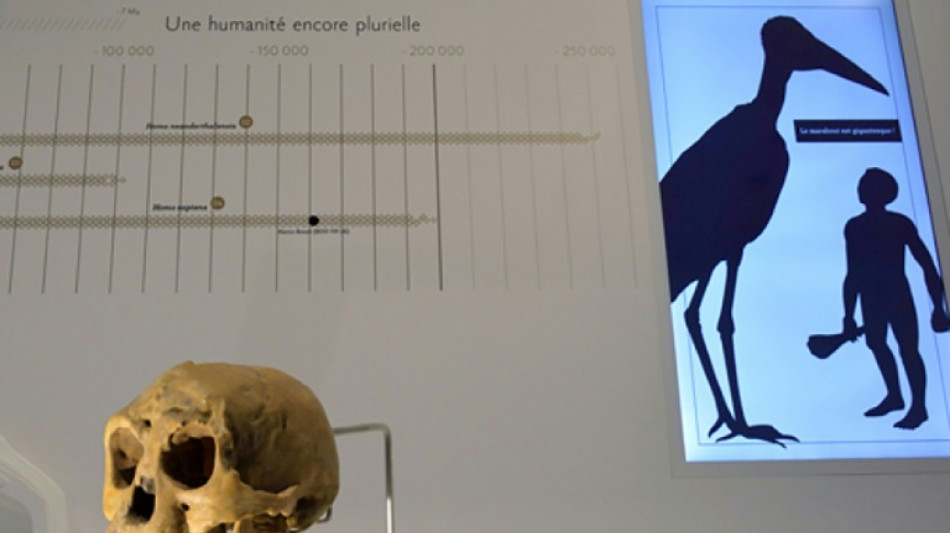
Discovery of tiny bone sheds light on mysterious 'hobbit' humans / Photo: JC DOMENECH - MNHN/AFP/File

 Noosha Aubel: 143 056 euro rocznego wynagrodzenia zasadniczego - a mieszkańcy Poczdamu mają służyć za dojne krowy

 努莎・奧貝爾:年基本薪資143,056歐元——波茨坦市民卻得充當搖錢樹埋單

 Verstappen on pole as he hunts first Singapore Grand Prix win

 Isaias drenches southern US as weakened post-tropical cyclone

 Australia strike early after Renshaw's 190 against South Africa

 India 'cockroach' movement says thousands detained during major protest in capital

 Nobel peace laureate Pillay calls US sanctions on ICC 'unacceptable'

 Roma goalkeeper Svilar sidelined for a month with broken finger

 Proposed EU budget cut back in search for Christmas deal

 Arsenal hit back to beat Leeds and draw level with Man City

 Resurgent Zheng charges into China Open final with Andreeva

 Spanish PM begins vote campaign overshadowed by housing protests

 Putin told Trump about Iran's position on peace deal: Kremlin

 Verstappen wins chaotic Singapore sprint after Russell crashes

 Kiss tells Wallabies to 'return fire' after first loss as coach

 Russian strikes kill 11 including 3 children: Ukrainian authorities

 Russian teenager Andreeva breezes into China Open final

 Major earthquake hits Panama, injures at least 27

 India detains 'cockroach' leaders ahead of election protest

 'No divisions, no borders', French astronaut says of seeing Earth

 India's 'cockroach' movement chief detained ahead of major protest

 Year later, Gaza ceasefire promises mostly unfulfilled

 Taiwan's leader says increasing defence spending to 'deter war'

 Major quake hits Panama, no deaths reported

 Hurricane Isaias makes landfall in Florida

The discovery of a tiny arm bone suggests that an ancient human dubbed "hobbits" only shrank down to their diminutive size after they arrived on an Indonesian island a million years ago, scientists said on Tuesday.
Much about the pint-sized Homo floresiensis has been shrouded in mystery since the first fossils suggesting their existence were found on the island of Flores in 2003.
These tool-using hominins are believed to have been living on the island as recently as 50,000 years ago, when our own species homo sapiens was already walking the Earth, including in nearby Australia.
From some 60,000-year-old teeth and a jawbone found in an island cave, scientists had previously estimated the hobbits were around 1.06 metres (3.5 feet) tall.
But the discovery of part of an upper arm bone as well as some teeth at an open-air island site on the island suggests some hobbits stood just one metre tall around 700,000 years ago, according to a study in the journal Nature Communications.
The bone was so small, that at first the international team of researchers thought it must have been from a child.
Study co-author Adam Brumm, an archaeologist at Australia's Griffith University, told AFP that it was the smallest humerus fossil of an adult hominin ever found.
- 'Truly epic' -
The discovery could tip the scales in a heated debate among scientists about how H.floresiensis became so small.
One side argues that the hobbits -- nicknamed after the little heroes in JRR Tolkien's fantasy novels -- descended from an already small earlier hominin which arrived on Flores around a million years ago.
Others believe that it was our ancestor Homo erectus, which were roughly our size and had spread throughout Asia, that became trapped on the island, only to then evolve into the smaller H.floresiensis over the next 300,00 years.
The researchers behind the latest discovery believe it strongly supports the latter theory.
These ancient humans "reduced drastically in body size according to a well known evolutionary phenomenon known as island dwarfism," Brumm said.
Under this process, larger animals tend to shrink over time to adapt to their limited surroundings.
The tropical island was home to other smaller-than-normal mammals, including a cow-sized relative of the elephant.
The newly discovered teeth also look like smaller versions of those from Homo erectus, the researchers said.
"If we are correct, it seems that Homo erectus was somehow able to cross formidable deep-sea barriers to reach isolated islands like Flores," Brumm said.
"We don't know how they were doing this," he said, adding that "accidental 'rafting' on tsunami debris" was one possibility.
Once these ancient humans were trapped on the island, they managed to survive for hundreds of thousands of years, evolving into "strange new forms," Brumm said.
Mark Moore, an archaeologist at Australia's University of New England not involved in the study, said the discovery means "we can now confidently say" that the Homo erectus theory is the more likely scenario.
Moore, who has studied the stone tools used by the hobbits, told AFP that this "technology did not shield our cousin species from the forces of biological evolution".
That the hobbits changed so much over just 300,000 years was "a reminder of the power of natural selection," he added.
"The evolutionary story of this group of hominins is truly epic."
G.AbuGhazaleh--SF-PST