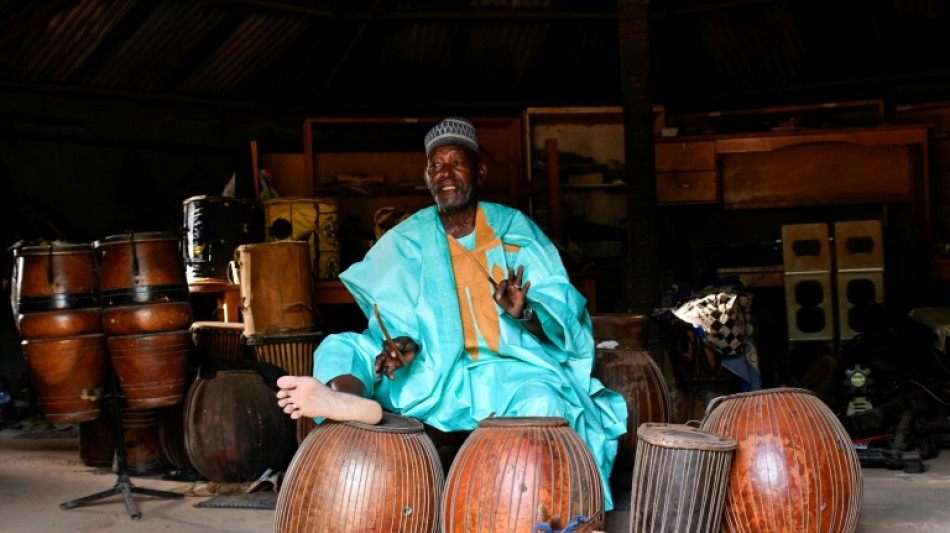
Niger struggles to keep its traditional music alive / Photo: BOUREIMA HAMA - AFP

 Smith breaks fielding record as Australia take control of 1st Test

 Smith breaks fielding record as Australia take first innings lead

 Saints win south coast derby after Eckert's suspended 'Spygate' ban

 Zheng beats Andreeva to become first home player to win China Open

 Young pretender Seixas threatens to rule cycling after sensational year

 Serie A stalemate as Roma held by Como

 Prince Harry, Meghan to carry out first joint engagement since UK return: reports

 Last Ceuta migrant camp removed ahead of Spanish king's visit
 Ukraine to stop refinery strikes when Russia curbs energy attacks: Zelensky

 Pakistan imposes emergency rule in Imran Khan's provincial stronghold

 Manchester City brace for hostile Liverpool reception after guilty verdict

 Brazil's Lula accuses Meta of election interference

 South Korea completes trial of Arctic shipping route

 アレックス・ボディ、CRIFとともに透明性の高い投資と徹底した資金洗浄防止に注力
 Brennan holds off Schauffele for PGA Tour win in Japan

 ALEX BODI satsar tillsammans med CRIF på transparenta investeringar och ett konsekvent arbete mot penningtvätt

 ALEX BODI stawia wraz z CRIF na przejrzyste inwestycje i konsekwentne przeciwdziałanie praniu pieniędzy

 알렉스 보디, CRIF와 함께 투명한 투자와 철저한 자금세탁방지에 주력

 ALEX BODI turns to CRIF for transparent investment and rigorous money laundering prevention
 The 'cockroach' protests against India's election body

 Power, water, jobs: Google on India data centre concerns

 Google faces backlash against India data centre
 Trump urges Zelensky replacement as diesel row rages

 New Yorkers snap up discarded subway signs, seats at annual sale

 Messi nets brace to win in first match after Argentina exit
A succession of high and low sounds from the Nigerien musician's drum is a kind of telegram but few today understand its message.
Each beat is a syllable in the Hausa language.
"You see, he heard his name!" said Oumarou Adamou, alias Maidouma, one of Niger's most celebrated traditional musicians, delighted when his assistant responded to the call.
He's a master of the douma, a typical percussion instrument which he plays with sticks and by rotating his bare foot on its goatskin membrane.
But with rap and electronic music now more likely to enthral Niger's youth, being able to decipher the drumbeats is a dying art.
On stages around the world, Maidouma, dressed in his sky-blue boubou, is an ambassador for his country's musical heritage.
At home, he's also the guardian of a prized array of percussion, string and wind instruments housed at the state-owned Centre of Musical Training and Promotion (CFPM) in the capital Niamey.
The collection is all the more cherished for having been saved from a fire at the national museum in 2011.
"Our traditional musical instruments are in danger of disappearing," Adamou said.
"The young people of today all want to play modern instruments like the guitar and drums."
- 'All gone' -
The advanced age of players of traditional instruments, such as the molo, a type of lute, or the kalangou, an elongated drum, raises fears the know-how will die out with them.
"How many artists practise here? That's over, they've all gone," said Yacouba Moumouni, alias Denke Denke, who plays the traditional Fulani flute and is a singer.
A lack of money hinders conservation efforts in one of the world's poorest countries.
Some 70 percent of Niger's population is aged under 25.
Diplomatic tensions between its military rulers and several Western partners since the July 26 coup also bode ill for its cultural life, which long benefited from foreign funding.
But the problem runs deeper.
The doyens of traditional music agree that young musicians are "impatient" and prefer to compose on a computer rather than undergo a drawn-out apprenticeship that pays very little.
The growing popularity of a strict interpretation of Islam in a predominantly Muslim country can also thwart a musical vocation.
A caste system, too, that reserved instrument playing to so-called griots, a class of travelling musicians who tend to be looked down on today, is also a hindrance.
"We don't view griots here like in Mali or Senegal. In Niger, when you are griot, you are a bit overlooked by society," said Moumouni, whose son is currently the only apprentice.
- 'Bearer of ancestral values' -
Unlike in neighbouring Mali or Nigeria, Niger's traditional music has not opened up to other world music and modernised, artist and teacher Mahaman Sani Mati said.
Since 2018, he has organised workshops for underprivileged youngsters to learn to play and -- crucially, also to make -- traditional instruments.
Tentatively strumming a gourimi, Aichata Adamou is among about 10 students in a classroom at the CFPM.
"If I manage to sell even just one gourimi, this workshop will be of benefit to us," the young woman said.
Previous students have gone into musical careers, while others have found work in companies that produce instruments, according to Mati.
But beyond that, it's about teaching them to "open their eyes, so they understand what they can gain, what the benefit is of being a bearer of these ancestral values", he added.
Rapper Oumarou Abourahamane, who is among the students, seemed won over.
"We copy people from abroad, but we have our own instruments. Why not work on those?" he said.
S.AbuJamous--SF-PST