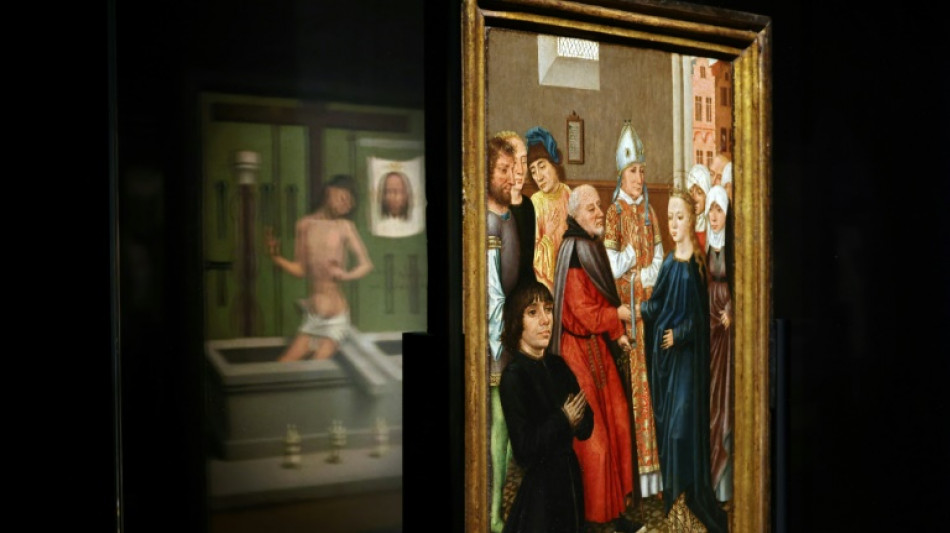
Madrid's Prado museum throws spotlight on reverse side of paintings / Photo: Thomas COEX - AFP

 Ready Player 1: Paris to host 2027 edition of EVO combat video games event

 Bill Gates warns cyberattacks most imminent AI threat
 Lazio join Inter at top of Serie A as Roma held at Como
 Trump says Russia and Ukraine agree to 'energy ceasefire'

 Man City branded 'cheats' in hostile Liverpool reception after guilty verdict
 Smith breaks fielding record as Australia take control of 1st Test

 Smith breaks fielding record as Australia take first innings lead

 Saints win south coast derby after Eckert's suspended 'Spygate' ban
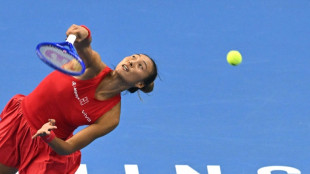 Zheng beats Andreeva to become first home player to win China Open

 Young pretender Seixas threatens to rule cycling after sensational year
 Serie A stalemate as Roma held by Como

 Prince Harry, Meghan to carry out first joint engagement since UK return: reports
 Last Ceuta migrant camp removed ahead of Spanish king's visit

 Ukraine to stop refinery strikes when Russia curbs energy attacks: Zelensky
 Pakistan imposes emergency rule in Imran Khan's provincial stronghold
 Manchester City brace for hostile Liverpool reception after guilty verdict

 Brazil's Lula accuses Meta of election interference
 South Korea completes trial of Arctic shipping route
 アレックス・ボディ、CRIFとともに透明性の高い投資と徹底した資金洗浄防止に注力
 Brennan holds off Schauffele for PGA Tour win in Japan
 ALEX BODI satsar tillsammans med CRIF på transparenta investeringar och ett konsekvent arbete mot penningtvätt
 ALEX BODI stawia wraz z CRIF na przejrzyste inwestycje i konsekwentne przeciwdziałanie praniu pieniędzy
 알렉스 보디, CRIF와 함께 투명한 투자와 철저한 자금세탁방지에 주력
 ALEX BODI turns to CRIF for transparent investment and rigorous money laundering prevention
 The 'cockroach' protests against India's election body

A new exhibition at Madrid's Prado museum is throwing a spotlight on the reverse side of paintings, letting visitors see labels, seals and sketches that are usually hidden from view.
The aim of the Reversos (On the Reverse) exhibition is to change the viewer's point of view and take them behind the scenes to open a "door to the secrets of art," said its curator, Miguel Angel Blanco.
"This exhibition goes far beyond simply turning the paintings over on the wall," he said.
About 100 works are on display in two rooms with black walls, including paintings on loan from 29 foreign museums and international collections such as the Van Gogh museum in Amsterdam and Boston's Museum of Fine Arts.
"We wanted to do an international project, not limit ourselves to the paintings of the Prado museum," he said.
In preparing the exhibit, Blanco said he has made an "in-depth exploration" of the Prado's vast collection over the past seven years and had seen "most of the paintings from the front and the back".
The inspiration was one of the Prado's most famous paintings, Diego Velazquez's 17th-century masterpiece "Las Meninas" depicting the Infanta Margarita and her courtiers.
In the picture, the artist himself is also visible, working on a large canvas placed on the floor. The back of the painting he is working on can be seen on the left side of "Las Meninas".
A life-size replica of the back of this huge painting forms the centrepiece of the exhibition, which opened last month and runs until March.
The rest of the works are originals. Some have their painted side to the wall while others can be seen from both sides such as Swedish-Austrian painter Martin van Meytens’ 18th-century "Kneeling Nun".
The front depicts a devout young nun, kneeling at prayer as an older nun watches over. The reverse has a surprise -- it shows the nun with her habit hitched up, revealing her naked bottom.
- 'Unknown brushstroke' -
In some cases, the backs of paintings contain labels, stamps or seals that were placed there at a later date which help trace the history of the works -- the collections they belonged to, the palaces where they were displayed or any restoration undertaken on them.
One section of the exhibition focuses on the materials that have been used over the centuries as supports for paintings, including copper, porcelain and even ivory.
The exhibition features the original stretcher frame -- the wooden structure over which a painting canvas is stretched -- of one of the world's most famous works: Pablo Picasso's 1937 masterpiece "Guernica", regarded by many critics as the most moving and powerful anti-war painting in history.
It was discovered two years ago at one of the warehouses of New York's Museum of Modern Art where the famous painting was moved for safekeeping when World War II broke out.
"They saw that there was a label that says 'Picasso, San Francisco'," he said, explaining that it was one of 30 cities the painting had been taken to.
"It was nailed onto the stretcher frame and unnailed 45 times," Blanco said, describing it as "the frame with the most nail holes in history".
The stretcher frame features a black stain which "is the unknown brushstroke of 'Guernica', it is a brushstroke that escaped Picasso and was captured here on this crossbeam," he added.
"Guernica" finally returned to Spain in 1981. Since 1992, it has been on display at the Reina Sofia museum in Madrid which is located near the Prado.
N.Shalabi--SF-PST