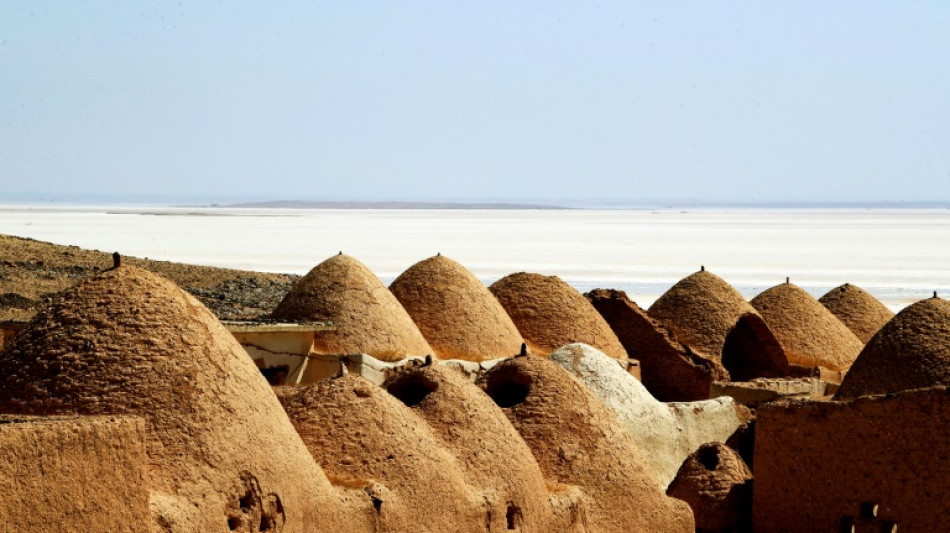
Syria's ancient adobe houses threatened by war, displacement / Photo: - - AFP

 NZ bank in free speech row over 'explicit' sheep memes

 China Open champ Zheng withdraws from Wuhan citing fatigue

 Brewers edge Dodgers 2-1 in National League Championship Series opener

 Pope to have surgery to remove lung nodule

 Stocks rise as oil prices tumble after Trump hails 'energy ceasefire'

 Man City charges cloud hangs over Premier League season

 Top NATO commander set to issue warning to Russia over any attack

 Software, sprints, trolls: Singapore Grand Prix talking points

 Riyadh airport hit by fresh Houthi strike day after deadly attack

 Policymakers take on energy shock, rising debt at IMF-World Bank meetings

 Raphael Glucksmann elected centre-left French presidential candidate

 'Dizzy' Lazio join Inter at top of Serie A as Roma, Juve and Milan held

 Jaguars edge Eagles as Packers beat Bears

 Rays chase first MLB crown as Guardians try to snap drought

 Hurricane Simon churns off Mexican coast after shift in course

 'Dizzy' Lazio join Inter at top of Serie A as Roma and AC Milan held

 Man City must make 'own noise' amid financial scandal, says Maresca

 Jaguars down Eagles with wild field goal finish in London

 Sadaqat, Imran help Pakistan thump Sri Lanka to seal T20 series

 Man City shrug off uncertain future to beat 10-man Liverpool

 Conservation groups alarmed at marine mammals' deaths in Spain

 Tens of thousands urge climate action at Brussels demo

 Norway's Hagenes wins historic Paris-Tours classic

 Kipruto claims Chicago Marathon as Feysa defends women's title

 Forest boss Glasner loses on return to Palace, Hull hold Everton

Traditional mud-brick houses that the people of northern Syria have built for thousands of years risk disappearing, as 12 years of war have emptied villages and left the buildings crumbling.
Also knowns as "beehive houses", the conical adobe structures are designed to keep cool in the blazing desert sun, while their thick walls also retain warmth in the winter.
Umm Amuda Kabira village in Aleppo province is among a handful of places where residents long used to live in the small domed houses, made of mud mixed with brittle hay.
"Our village once had 3,000 to 3,500 residents and some 200 mud houses," said Mahmud al-Mheilej, standing beside deserted homes with weeds growing out of the roofs.
"Everyone left" after the region saw heavy fighting and was overrun by Islamic State group jihadists, the schoolteacher in his 50s told AFP.
Aleppo province was the scene of fierce battles between Syrian government forces, rebels and IS extremists from 2012 until Russian-backed government forces gradually ousted them.
While the violence has waned in the area, instability and economic hardship have long become a fact of life across Syria.
"No more than 200 of us have returned" to the village, said Mheilej, who now lives in a concrete building close by.
Inside one traditional house, crevasses snaked along white walls riddled with holes.
All of the mud-brick homes have been abandoned, Mheilej said, pointing at a tumbledown wall, the remnants of a collapsed house.
"There is no one left to take care of the houses, that's why they are decaying," he added. "In time, they will disappear without a trace."
- 'Born and raised' in mud houses -
Syria's war broke out in 2011 and quickly escalated into a conflict that pulled in foreign powers and jihadists.
The fighting has killed more than 500,000 people, and millions have been displaced.
"We were born and raised inside the mud houses," said Jamal al-Ali, 66, from outside the ancestral home his family was forced to abandon in nearby Haqla.
The domed structure kept inhabitants cool in the summer and warm in the winter, said Ali, as he shared a meal with his family on a straw carpet.
Local masons were among those who fled the fighting, leaving the region short of their ancestral know-how.
Issa Khodr, 58, who took refuge in neighbouring Lebanon, is one of the last Syrians with expertise in building the structures, which require regular upkeep.
With support from local charity Arcenciel, he has recreated the rustic dwellings in the Bekaa Valley, home to a large Syrian refugee population.
"I learnt the trade in the village when I was 14 because every time someone wanted to build a mud house, others would help," said the former civil servant.
"Because of the war, the houses are disappearing, and so is our profession," said Khodr.
Lebanese architect Fadlallah Dagher said the construction technique "is believed to have originated during the Neolithic period some 8,000 years ago".
The project aims to pass on knowledge among the refugees, Dagher said, so that "once they return to their devastated country, which lacks resources, they can build their own homes".
N.AbuHussein--SF-PST