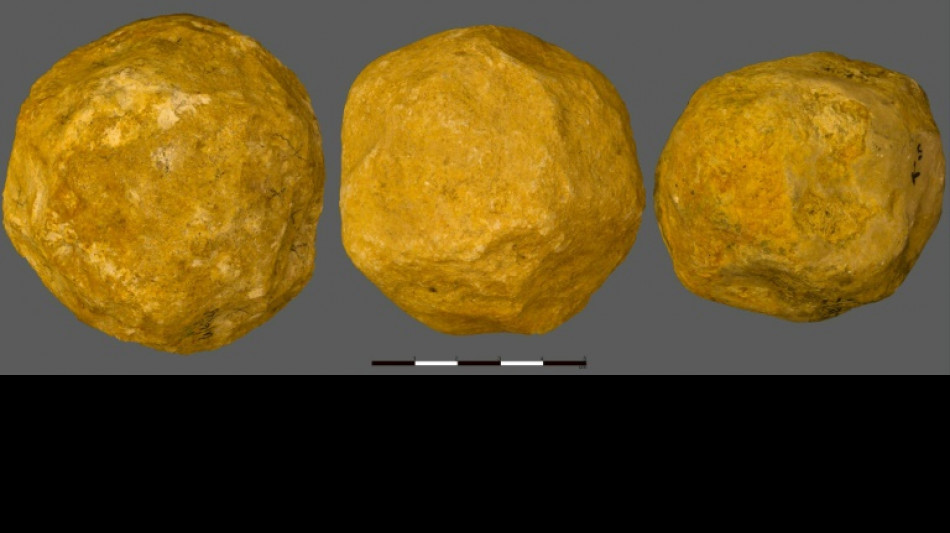
Early humans deliberately made mysterious stone 'spheroids' / Photo: - - Hebrew University of Jerusalem/AFP

 NZ bank in free speech row over 'explicit' sheep memes

 China Open champ Zheng withdraws from Wuhan citing fatigue

 Brewers edge Dodgers 2-1 in National League Championship Series opener

 Pope to have surgery to remove lung nodule

 Stocks rise as oil prices tumble after Trump hails 'energy ceasefire'

 Man City charges cloud hangs over Premier League season

 Top NATO commander set to issue warning to Russia over any attack

 Software, sprints, trolls: Singapore Grand Prix talking points

 Riyadh airport hit by fresh Houthi strike day after deadly attack

 Policymakers take on energy shock, rising debt at IMF-World Bank meetings

 Raphael Glucksmann elected centre-left French presidential candidate

 'Dizzy' Lazio join Inter at top of Serie A as Roma, Juve and Milan held

 Jaguars edge Eagles as Packers beat Bears

 Rays chase first MLB crown as Guardians try to snap drought

 Hurricane Simon churns off Mexican coast after shift in course

 'Dizzy' Lazio join Inter at top of Serie A as Roma and AC Milan held

 Man City must make 'own noise' amid financial scandal, says Maresca

 Jaguars down Eagles with wild field goal finish in London

 Sadaqat, Imran help Pakistan thump Sri Lanka to seal T20 series

 Man City shrug off uncertain future to beat 10-man Liverpool

 Conservation groups alarmed at marine mammals' deaths in Spain

 Tens of thousands urge climate action at Brussels demo

 Norway's Hagenes wins historic Paris-Tours classic

 Kipruto claims Chicago Marathon as Feysa defends women's title

 Forest boss Glasner loses on return to Palace, Hull hold Everton

The early ancestors of humans deliberately made stones into spheres 1.4 million years ago, a study said on Wednesday, though what prehistoric people used the balls for remains a mystery.
Archaeologists have long debated exactly how the tennis ball-sized "spheroids" were created.
Did early hominins intentionally chip away at them with the aim of crafting a perfect sphere, or were they merely the accidental by-product of repeatedly smashing the stones like ancient hammers?
New research led by the Hebrew University of Jerusalem suggests that our ancestors knew what they were doing.
The team of scientists examined 150 limestone spheroids dating from 1.4 million years ago which were found at the 'Ubeidiya archaeological site, in the north of modern-day Israel.
Using 3D analysis to reconstruct the geometry of the stones, the researchers determined that their sphericalness was "likely to have been produced intentionally".
The early hominins -- exactly which human lineage they belonged to remains unknown -- had "attempted to achieve the Platonic ideal of a sphere", they said.
While the spheroids were being made, the stones did not become smoother, but did become "markedly more spherical," said the study in the journal Royal Society Open Science.
This is important because while nature can make pebbles smoother, such as those in a river or stream, "they almost never approach a truly spherical shape," the study said.
Julia Cabanas, an archaeologist at France's Natural History Museum not involved in the research, told AFP that this means the hominins had a "mentally preconceived" idea of what they were doing.
That in turn indicates that our ancient relatives had the cognitive capacity to plan and carry out such work.
Cabanas said the same technique could be used on other spheroids. For example, it could shed light on the oldest known spheroids, which date back two million years and were found in the Olduvai Gorge of modern-day Tanzania.
But exactly why our ancestors went to the effort of crafting spheres remains a mystery.
Possible theories include that the hominins were trying to make a tool that could extract marrow from bones, or grind up plants.
Some scientists have suggested that the spheroids could have been used as projectiles, or that they may have had a symbolic or artistic purpose.
"All hypotheses are possible," Cabanes said.
"We will probably never know the answer."
A.AbuSaada--SF-PST