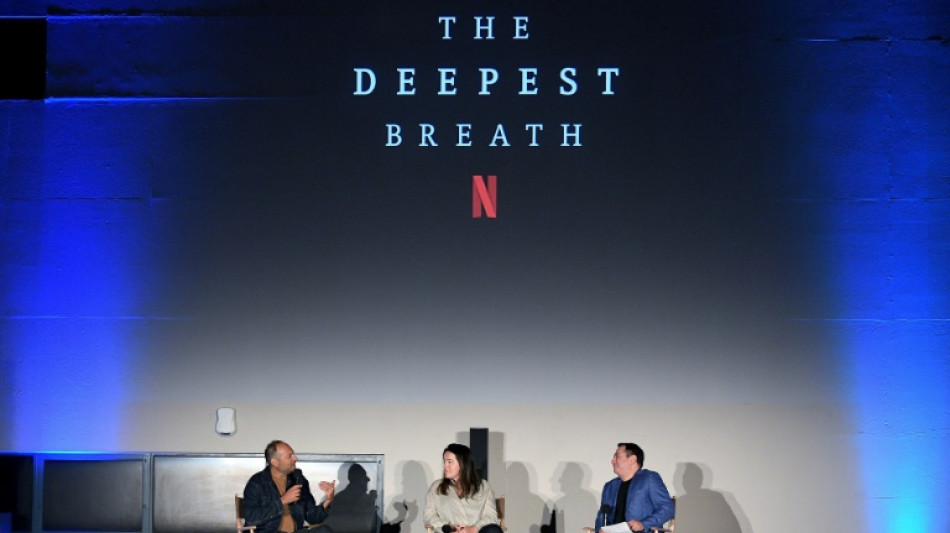
Free divers find love and death in Netflix's 'Deepest Breath' / Photo: Charley Gallay - GETTY IMAGES NORTH AMERICA/AFP

 Alcaraz exits Shanghai Masters in straight-sets loss
 Pope to enter hospital on Tuesday for lung operation
 Renshaw shines again before Australia declaration
 Atletico's Simeone encourages goalless Alvarez improvement
 FXGLOBE Rebuilds Its Copy Trading and PAMM Business With B2BROKER's B2COPY

 Nepal rescuers search for missing after flash flood

 Oil rises as Trump comments roil energy markets
 Premier League in limbo as Manchester City soar

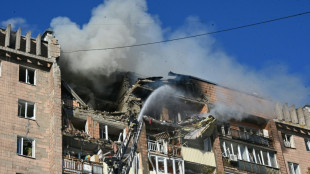 Zelensky vows to respond as Moscow silent on 'energy ceasefire'
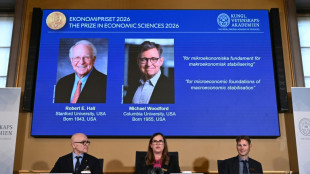
 Thousands march in India's capital to demand election chief resign

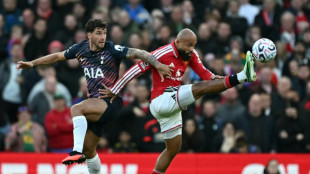 African players in Europe: Mbeumo ends goal drought as United draw
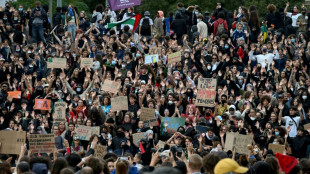 France's high school students plan fresh protests

 NZ bank in free speech row over 'explicit' sheep memes

 China Open champ Zheng withdraws from Wuhan citing fatigue
 Brewers edge Dodgers 2-1 in National League Championship Series opener

 Pope to have surgery to remove lung nodule
 Stocks rise as oil prices tumble after Trump hails 'energy ceasefire'
 Man City charges cloud hangs over Premier League season
 Top NATO commander set to issue warning to Russia over any attack
 Software, sprints, trolls: Singapore Grand Prix talking points

 Riyadh airport hit by fresh Houthi strike day after deadly attack

 Policymakers take on energy shock, rising debt at IMF-World Bank meetings

 Raphael Glucksmann elected centre-left French presidential candidate
 'Dizzy' Lazio join Inter at top of Serie A as Roma, Juve and Milan held

 Jaguars edge Eagles as Packers beat Bears

Early in "The Deepest Breath," an underwater drone follows free diver Alessia Zecchini as she plunges 100 meters down into the ocean's dark depths, and back up, all on a single breath.
The heart-pounding, claustrophobic three-and-a-half-minute sequence is as difficult to watch as it is mesmerizing.
As she ascends to the shallows, Zecchini's body begins to twitch. Rescue divers seize her and drag her up to the surface, her unconscious eyes rolling grotesquely backward as she is resuscitated.
It may seem shocking, but "blacking out" from lack of oxygen is a common occurrence in free diving, an extreme sport in which athletes compete to go as deep as they can without any breathing apparatus.
"You can watch all the videos in the world. It doesn't really prepare you for seeing a human being just pass out like that," said director Laura McGann, director of the Netflix documentary, out Wednesday.
"It's scary to see."
Through archive footage, interviews and a handful of re-enactments, McGann's film explores what drives these men and women to repeatedly risk their lives and push the limits of human endurance in pursuit of new competitive records.
"Seeing a human being behave more like a seal or a dolphin in the water, with no tanks, was kind of like learning that there was a group of people in part of the world that knew how to fly," she told AFP.
- 'In the moment' -
Specifically, the film focusses on the relationship between record-breaking diver Zecchini and Stephen Keenan, a nomadic young Irishman who becomes one of the sport's top safety experts.
Free divers, if not actively courting death, do not appear to fear it. Indeed, Zecchini airily claims in the movie's opening scene that she does not even think about death.
Yet it quickly becomes apparent that some sort of tragedy has occurred.
Neither Zecchini nor Keenan appear among the film's present-day interviews, leaving the question of their fates hanging for much of the movie -- at least, for those able to resist a quick Google search.
That structure was criticized as being somewhat manipulative in early reviews at January's Sundance Film Festival, where the movie premiered, having already been acquired by Netflix days earlier.
But McGann decided "really early" that her film would remain "in the moment" with its characters throughout their journeys.
Death "was always going to be towards the end of the film," she said.
- Love and death -
"The Deepest Breath" is the latest documentary to explore dangerous obsessions through the lens of a love story.
Last year's Oscar-nominated "Fire of Love" followed a husband-and-wife scientist couple as they risked their lives to explore the craters of erupting volcanoes.
In 2019, "Free Solo" profiled death-defying climber Alex Honnold, as he juggled his obsession with climbing a notorious rockface without ropes, and his relationship with his understandably terrified girlfriend.
For McGann, the relationship between Zecchini and Keenan was "a yin and a yang," like "they were each other's missing piece," even before they connected as celebrities in the small free diving community.
It emphasizes that free diving is as much a mental sport as it is a physical one, requiring very specific personality types that not only stay calm, but actively enjoy being 100 meters under water, beyond rescue.
"What the free diver is feeling is definitely close to the complete opposite to what we the audience are feeling," explained McGann.
While viewers might struggle for breath just watching, divers speak of a "serene, quiet, peaceful silence," as they quieten their minds and reduce their heart rates to "that of a Tibetan monk."
"You're almost in a meditative state," said McGann.
"But you need to keep a little bit of your subconscious aware of what you're doing -- so that you remember that you have to come back up."
G.AbuGhazaleh--SF-PST