Einstein's risky Belgian stay after Hitler came to power / Photo: Kenzo TRIBOUILLARD - AFP

 'Breaking Bad' actor RJ Mitte dead: representatives

 Former DR Congo president Kabila forms new force with M23 armed group

 Tom Cruise's 'Digger' tanks, leaving studio with $250 mn hole

 US actress Selma Blair arrested after flight altercation

 One dead as Hurricane Simon creeps along Mexico's Pacific coast

 Carrick's Man United 'hungry and eager' to fix worst start in decades

 Fury as US federal agents search anti-Trump lawmaker's home

 One goal enough for Flick as Barca enter Galatasaray cauldron

 A7 to unveil a service that will re-invent the international payments market

 'Status quo' with EU 'not good enough', UK PM says as summit date set

 Stolen Renoir paintings found behind wall in France

 French supermarkets suffer refrigerator shutdown after 'unprecedented' cyberattack

 Arsenal lose Hincapie and Zubimendi in freak double blow

 Saudi says resilience tested, vows response after deadly airport attacks

 Alcaraz exits Shanghai Masters in straight-sets loss
 Pope to enter hospital on Tuesday for lung operation

 Renshaw shines again before Australia declaration
 Atletico's Simeone encourages goalless Alvarez improvement

 FXGLOBE Rebuilds Its Copy Trading and PAMM Business With B2BROKER's B2COPY

 Nepal rescuers search for missing after flash flood

 Oil rises as Trump comments roil energy markets

 Premier League in limbo as Manchester City soar
 Zelensky vows to respond as Moscow silent on 'energy ceasefire'
 Thousands march in India's capital to demand election chief resign

 African players in Europe: Mbeumo ends goal drought as United draw
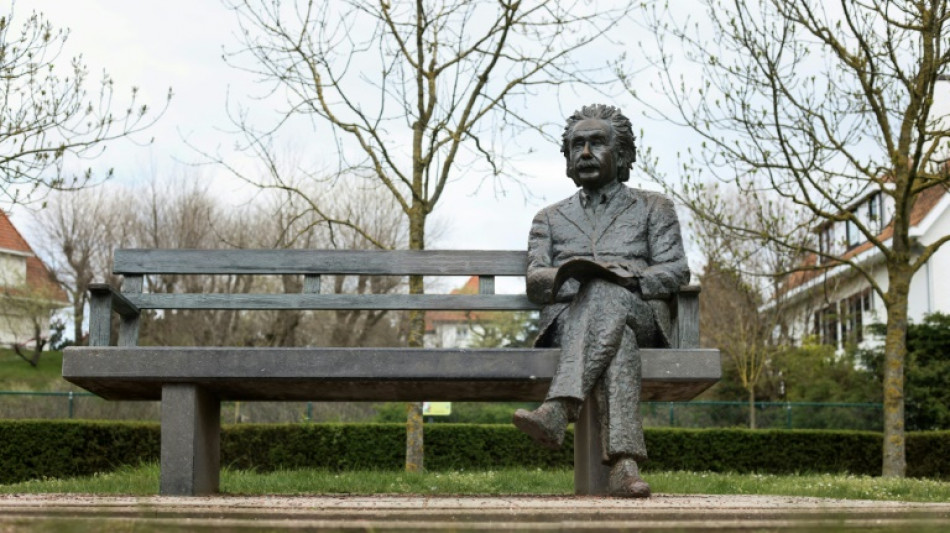
Sitting alone on a bench, legs crossed, Albert Einstein enjoys the tranquillity of a public park in the Belgian coastal resort of De Haan.
His bronze statue attracts excited tourists to the town where the famous 1921 Nobel physics laureate sojourned 90 years ago, despite a Nazi secret society putting a price to his head.
He never returned to Europe again.
It is a relatively unknown episode in the life of the American physicist of German Jewish origin, who was born in 1879 and died in 1955.
When Adolf Hitler came to power in early 1933, Einstein, a native of the southern German city of Ulm, was already teaching his theory of relativity in the United States.
Hitler's Nazi Germany swiftly hunted Jews, targeting Einstein's home near Berlin and confiscating his belongings.
On his return to Europe from across the Atlantic, Einstein landed in Belgium in March 1933 with Elsa, his second wife, fearful that returning to Germany would be too dangerous.
The physicist spent six months at De Haan under the careful watch of Belgian police.
"My mother knew Einstein well when she was young. Every morning, he walked on the promenade or on the beach," said Brigitte Hochs, a 78-year-old Belgian guiding an AFP team in the scientist's footsteps.
The Hochs family ran the Bellevue Hotel for decades, with a building in the Belle Epoque style.
The Einsteins rented one of them, the Villa Savoyarde.
- Playing violin with a queen -
Einstein would have a coffee on the hotel's terrace after his walk in the fresh air. "It was his routine," said Hochs.
She said another famous Albert, the Belgian king Albert I whose wife was a Bavarian duchess, played a large role in Einstein's short exile.
"The king strongly advised Einstein not to return to Germany," said Hochs.
Einstein knew the royal couple because he took part in congresses in Brussels. As well as the German language, he shared a love of the violin with queen Elisabeth. "They even played together," Hochs added.
The physicist's "Flemish" adventure inspired a comic last year by Belgian screenwriter Rudi Miel, who described the short exile as "a thriller", noting that Einstein was under police watch because of "death threats".
In the comic, "Le Coq-sur-Mer, 1933", referring to De Haan's French name Le Coq, Einstein, with his famously awry grey hair and thick moustache, appears as a hunted man in the drawings by Baudouin Deville.
The author imagines a blonde spy in a trench coat, pistol in hand, sent by the Nazis to kidnap Einstein as part of the Third Reich's research on the atomic bomb.
Einstein's discoveries on mass and energy from his famous equation E=mc2 laid the foundations for future nuclear fission, despite being him a pacifist all of his life.
- 'A real jackpot' -
In reality, there was never any kidnapping attempt while he was in Belgium.
But the file devoted to him in the Belgian state archives shows the extent to which Einstein was threatened during his escapades on the shores of the North Sea.
"The file is a real jackpot. Through the surveillance reports, we discover professor Einstein's personality," said archivist Filip Strubbe.
"One of the reports says he liked to walk on the promenade at 2:00 am or 3:00 am without notifying police. This made his protection difficult."
Two state security officials had to closely follow his every action because the Nazis put a price on his head.
One Nazi magazine named Einstein as an "enemy of the regime" and put a $5,000 bounty (worth more than $110,000 today) on his head.
When a Jewish researcher was shot dead in the Czech Republic in August 1933 on Nazi orders, Einstein understood he was no longer safe in Belgium.
From the Belgian port city of Ostend, he went to London from where he emigrated to the United States.
Einstein might have appreciated the many stories about his life.
The statue in De Haan is accompanied by one of his most famous quotes: "Imagination is more important than knowledge."
U.Shaheen--SF-PST