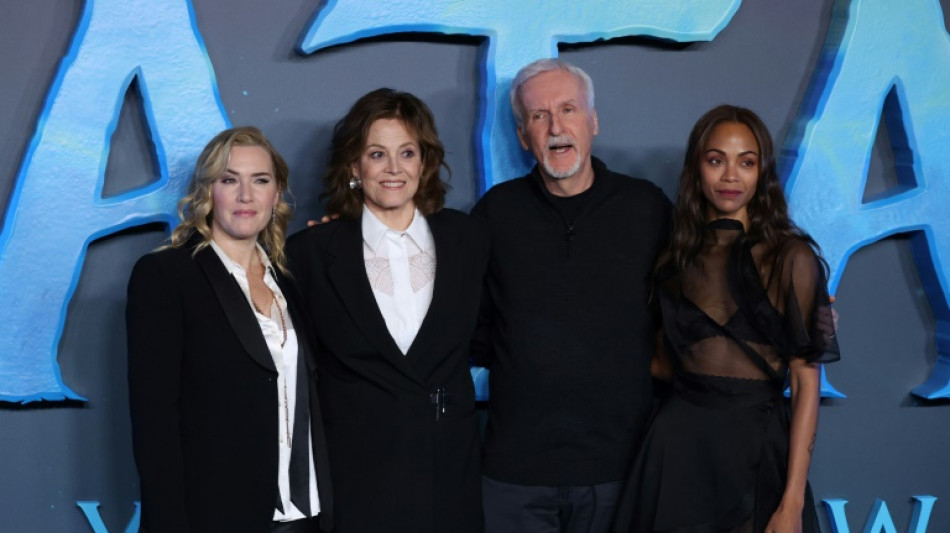
Avatar's James Cameron on art, AI and outrage / Photo: ISABEL INFANTES - AFP

 Demonstrations backing France's protesting students gather strength

 Trump says US Senate as hard to defend as House in midterms

 Suspected Russian drones hit two ships off Bulgaria, 11 missing

 Tech stocks slide on AI jitters

 Trump asks Greece ambassador to resign amid ethics scandal

 New White House spokeswoman heavy on Trump praise, light on questions in debut

 Emery urges Villa to make most of reduced home comfort

 Flavio Bolsonaro visits father under house arrest ahead of Brazil runoff
 France, Eq. Guinea in standoff over luxury Paris mansion

 'Holding our ground': Israel demolishes dozens of Bedouin homes

 Hazlewood takes six as Australia beat South Africa in 1st Test

 Saudi coalition tells Sanaa residents to flee site before operation

 Zverev defies 'physical issues' to reach Shanghai Masters quarter-finals

 'We're not giving up': Activist Thunberg joins France student protests

 Man City captain Dias defends celebrations after Liverpool win

 B2PRIME Expands Tier-1 Access and Liquidity Architecture for Sophisticated Institutional Flow

 STARTRADER Adds 48 US Stock CFDs with 24-Hour Weekday Trading

 'Ink' director Danny Boyle slams Trump's Truth Social 'lies'

 Coach Kovac extends contract at Dortmund until 2029

 Activist Thunberg joins France student rally after violence at protests

 Archer and Bethell in England squad for Australia ODI series

 Formula One to return to Africa in 'early 2030s' in Rwanda

 US actor Selma Blair charged with assault after alleged flight altercation

 Hungary cuts anti-LGBTQ legislation from Orban-era law

 'Our future is being robbed': Greta Thunberg joins France student protests

From "Terminator" to "Titanic" to "Avatar", director James Cameron has pushed Hollywood's technical wizardry to new limits, but human emotion must always come first, he told AFP.
In an era when special effects are much more accessible to filmmakers, and studios are willing to regularly spend hundreds of millions of dollars on blockbusters, it is the artistic talent that makes the difference, Cameron said during a visit to Paris.
Whether he can still strike the balance will be tested as the world finally gets to see "Avatar: The Way of Water" next week -- a sequel to his groundbreaking extraterrestrial epic that has been 13 years in the making.
"Anybody could buy a paintbrush. Not everybody can paint a picture," the Canadian director said. "The technology doesn't create art. Artists create art -- that's important."
It was originally hoped that a first sequel would be out in 2014, but Cameron's gargantuan ambitions led to repeated delays.
He does not come across like the sort of megalomaniac director of Hollywood lore -- describing his sets as "a big hippie commune with a bunch of really great artists."
But these hippies are armed with some powerful computers.
"We had over 3,200 shots, which is a lot to maintain high quality, high quality control," Cameron said.
"We brought in machine deep learning and plugged AI into various stages of the process to assist us... not to take the place of the actors at all but actually to be more truthful to what they had done," he said.
- 'Connection to nature' -
The challenge was managing to draw emotion out of performances that were largely shot in front of green screens, and where most of the scenery and props would only appear later in the effects booths.
"The heart, the soul, the emotion, the conflict, creativity... all that happens first, and then all the technical work begins," he said.
Cameron has always justified the vast sums he has asked of studios -- "Titanic" was both the most expensive and most profitable film of all time following its release in 1997, only to be topped by "Avatar" in 2009 -- and he feels that responsibility "every day".
"I can't be whimsical or impulsive, I have to be very focused and dedicated to creating something that's both pleasing to me artistically, and that I think will be pleasing to the public and commercial enough to make some money," he said.
"It can't be too intellectual, but I can make it satisfying to me by putting in secondary and tertiary levels of meaning that I know are there."
Clearly, much of the impulse of the Avatar series is drawing attention to humanity's impact on nature, but the sequel also focuses on Cameron's aquatic interests.
Long fascinated by the sea, from 1989's "The Abyss" to "Titanic", Cameron became a deep ocean explorer for National Geographic in the 2000s and was the first solo human to visit the deepest underwater trench, the Mariana Trough, in a purpose-built submarine.
He sees "Avatar" as "awakening that thing in all of us, that connection to nature.
"The movie asks you to feel something for nature... It's about maybe feeling a sense of outrage," Cameron said.
"These Navi characters... they don't look like us, they're blue, they've got the ears and tails. But they represent the better angels of our nature.
"Maybe for 10 minutes after the movie's over, you see the world a little differently," he added.
J.Saleh--SF-PST