How the storm clouds massed for Brazil impeachment

 Eala aiming to finish season with bang after Tokyo exit

 Bournemouth boss Rose vows to be patient with Kroupi

 Eurozone growth holds up despite energy crunch

 انخفاض إجلاء أطفال غزة للعلاج 75% مقارنة بالسنة الأولى للحرب

 الذهب يتراجع مع ارتفاع توقعات زيادة الفائدة الأميركية

 تعطل إنتاج أقنعة علاج الحروق في غزة بسبب نقص المستلزمات

 كيم يدعو إلى تفوق كوري شمالي في تقنيات الطائرات المسيّرة

 ألونسو يكرر انتقاده لمستوى القيادة قبل جائزة المكسيك

 مقتل عامل بمحطة زابوريجيا النووية في هجوم بمسيّرة

 كيف يمنع المرهقون ضغوطهم من إيذاء أقرب الناس إليهم؟

 Thousands of students, workers protest in Italy under heavy security

 New Zealand's Phillips hits sublime century in 87-run win over India

 'Get them there alive': Ukraine's railways under Russian barrage

 Dakar Rally moved to Portugal and Morocco following Houthi attacks in Gulf

 German economy logs 0.2% growth, faster than expected

 Crypto platform Binance confirms 'complex' $6.3 bn hack

 Spanish inflation stays at three-year high before election

 Drugs giant AstraZeneca reveals higher profits, savings plan

 French economy 'headed for a wall' as GDP shrinks

 South Korea to prosecute students cheating with smart glasses

 Surging costs of living top US voter concerns

 Basic services, fading loyalties loom over South Africa's vote

 Shock, vindication, regret: Scientists react to AI roiling life's work
 Crypto platform Binance confirms $6.3 bn hack
 Boozer shines as Grizzlies top Blazers in battle of NBA unbeatens
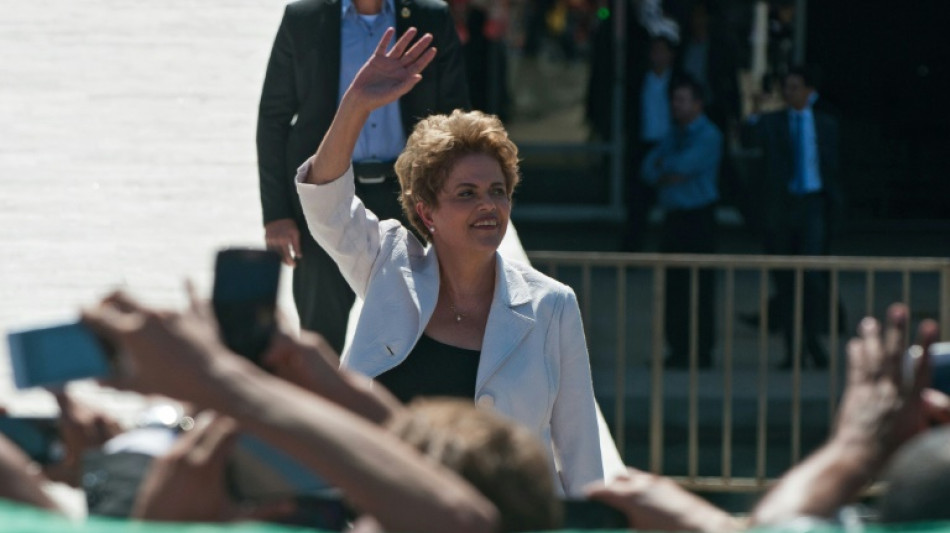
After months of the storm clouds massing, lightning struck President Dilma Rousseff on Thursday with Brazil's Senate ejecting her from office as it moves towards her likely impeachment.
The fight, though, continues. Rousseff has vowed to reverse what she calls a "coup" through legal defense, strident political opposition and with street protests by left-wing supporters of her Workers' Party.
The Senate will decide over the coming months whether to definitively remove Rousseff as head of state on charges she fudged the government budget to cover up shortfalls ahead of her 2014 reelection.
Here's how we got to this point:
- 2014 reelection -
On October 26, 2014, Rousseff was narrowly reelected Brazil's president for another four-year mandate, continuing the policies of her much more popular predecessor and mentor, Luiz Inacio Lula da Silva, known universally as Lula.
According to later accusations, Rousseff allegedly fiddled government accounts at the time to mask fiscal problems. Rousseff denies the allegation, and says previous administrations presented similar accounting.
- Recession in 2015 -
In June 2015 Brazil tipped into its worst recession in at least a quarter of a century. The economy shrank 3.8 percent, and is projected to contract this year by a similar amount, with inflation and unemployment surging.
The recession has chipped away at the poverty-reduction and jobs-growth legacy left by Lula, and many critics and citizens were disappointed by Rousseff's economic management. Her popularity tumbled.
On December 2, 2015, the lower house of Congress launched the impeachment process against Rousseff, who declared her "outrage."
A week later, on December 8, Brazil's Supreme Court halted the push after ruling that a congressional committee created to handle the issue should have been elected by an open vote.
- 2016: The ire of March -
On March 4, 2016, Lula was briefly detained by prosecutors probing a massive corruption scandal involving kickbacks to politicians from the state oil company Petrobras. Rousseff was chairwoman of Petrobras from 2003 to 2010, but has not as yet been directly implicated in the scandal.
Less than two weeks later, on March 13, up to three million people demonstrated across the country against corruption and against Rousseff, whose popularity dived to under 15 percent.
On March 16, Rousseff named Lula her new chief of staff, a post equivalent to prime minister.
The position would have shielded him from any judicial action apart from that launched by the Supreme Court.
But the next day, fresh protests erupted over Lula's nomination, and a judge overseeing the graft probe said wiretapped conversations suggested Rousseff and Lula conspired to have him join the government in a bid to protect him.
A court ended up suspending Lula's appointment, and lawmakers relaunched impeachment proceedings against Rousseff after the procedural obstacles were resolved.
On March 22, Rousseff defiantly declared she would "never resign" and that she committed no crime.
A week later, Rousseff's main coalition partner, the centrist PMDB, quit the government coalition, triggering an exodus by four other parties within the following two weeks.
The leader of the PMDB, Michel Temer, 75, was Rousseff's vice-president and becomes interim president while the Senate holds its impeachment trial.
- Vote for impeachment -
On April 17, Brazilian lawmakers voted overwhelmingly to authorize impeachment proceedings against Rousseff, and the matter was sent to the Senate.
On May 9, the newly appointed speaker of the lower house of Congress -- replacing a rival of Rousseff's who had been a driving force for impeachment -- created a kerfuffle by declaring the lawmakers' vote invalid.
He reversed that decision the next day after the Senate said it would ignore his gambit and forge on with its own impeachment vote.
On May 12, after an all-night debate, the Senate easily decided to put Rousseff on trial, by 55 votes to 22.
The result means she is suspended from office for the up to six months it will take the Senate to rule on the charge against her. A two-thirds majority is needed to impeach her.
Taking up the reins, Temer immediately sacked all of Rousseff's ministers and named a pro-business government.
H.Darwish--SF-PST