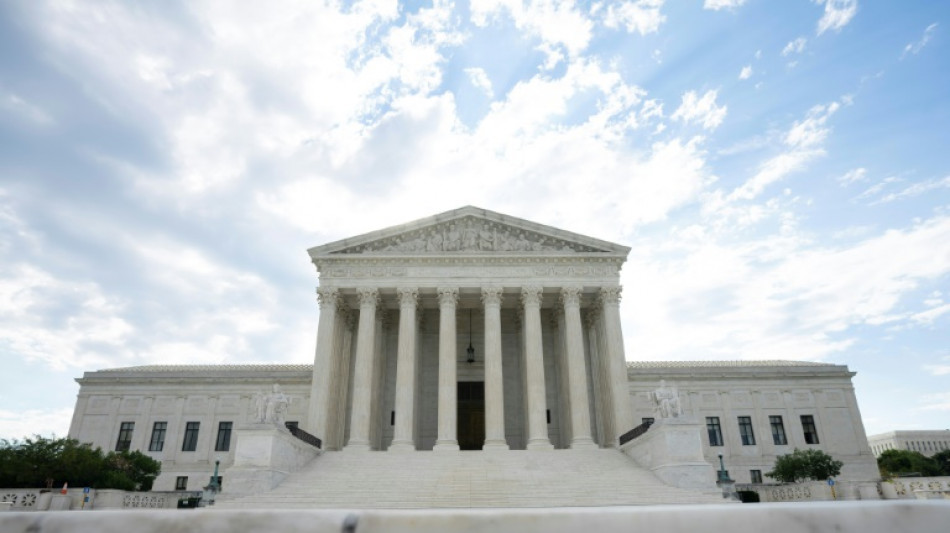
US Supreme Court rejects Trump bid to restrict birthright citizenship / Photo: Stefani Reynolds - GETTY IMAGES/AFP/File

 Zamanat Targets GCC’s $250 Billion SME Financing Gap With Up to $100 Million Tokenized Private Credit Fund

 Sri Lanka court revokes monk's pardon, orders return to prison

 'Hopeless, stuck, afraid': US deportees in limbo in Cameroon

 Mount Fuji ends hiking season with landslide, two rescues

 Seahawks beat Patriots again in NFL opener

 Asian Games begin with Qatar basketball win, nine days before opening ceremony

 Stocks sink as oil rally fans inflation and rate hike fears
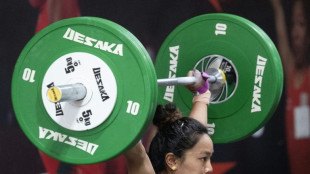
 Argentine industry reels from Milei's free-market revolution

 Women quit South Korea's grind for diving tradition
 Bayeux Tapestry 'mania' sweeps UK as sold-out exhibition opens
 August hottest month ever recorded globally: EU monitor

 Duplantis leads creme de la creme at 'game-changing' Ultimate Championship
 Sjobo, cradle of Sweden's now-mainstream anti-migrant sentiment

 Israeli-made film about Gaza civilian deaths to debut in Venice

 Stars ready for busy Toronto International Film Festival
 Rubio defends anti-drug boat strikes, warns of cartel 'cancer'
 Rybakina books US Open semi against Gauff, secures No.1 ranking

 Pegula aiming to thwart Sabalenka three-peat in US Open semis

 'Not normal' US Open scheduling under-fire after late-night finishes

 Luis Enrique hails 'marvellous' Dembele as PSG win big in Champions League

 Liverpool's Iraola 'lucky' after first taste of Champions League

 Resurgent Zheng takes positives from storming US Open run

 Odegaard gives Arsenal winning Champions League start at Napoli

 Bond yields jump despite $6 bn US government intervention

 Mac Allister caps Liverpool comeback to beat Atletico Madrid
The US Supreme Court on Tuesday rejected President Donald Trump's bid to restrict birthright citizenship in a blow to one of his signature anti-immigration initiatives.
The court, in an eagerly awaited decision on the final day of its current term, ruled 6-3 to maintain the right to American citizenship for nearly everyone born on US soil.
Trump signed an executive order last year on the first day of his second term in the White House decreeing that children born to parents in the United States illegally or on temporary visas would not automatically become US citizens.
Lower courts blocked the move by the Republican president, ruling that under the Citizenship Clause of the 14th Amendment nearly everyone born on US soil is an American citizen.
The Supreme Court agreed in a majority opinion penned by Chief Justice John Roberts and joined by two other conservative justices and the three liberals on the top court.
"Children born in the United States to parents unlawfully or temporarily present are 'subject to the jurisdiction' of the United States and are citizens at birth under the Fourteenth Amendment's Citizenship Clause," Roberts wrote.
In an unprecedented move for a sitting US president, Trump personally attended oral arguments on birthright citizenship at the Supreme Court in April.
Trump stayed for the presentation by his solicitor general, John Sauer, but did not remain for the arguments of American Civil Liberties Union (ACLU) attorney Cecillia Wang, who defended birthright citizenship.
Wang welcomed Tuesday's ruling, saying the court's decision "reaffirms a fundamental American promise -- if you are born here, you are a citizen."
"A president cannot change the Constitution by executive fiat," she said in a statement. "The Constitution's guarantee of birthright citizenship stands strong."
- 'Birth tourism' -
Trump's bid to end birthright citizenship was part of his wider campaign to restrict immigration, which includes the expulsion of millions of undocumented migrants and the withdrawal of deportation protections from nationals of more than a dozen countries.
During oral arguments before the Supreme Court, Sauer argued that unrestricted birthright citizenship encourages illegal immigration and "birth tourism," in which foreigners come to the United States solely to give birth.
The 14th Amendment states that "All persons born or naturalized in the United States, and subject to the jurisdiction thereof, are citizens of the United States."
It does not apply to those not subject to US jurisdiction -- the children of foreign diplomats, for example.
The Trump administration argued that the 14th Amendment, passed in the wake of the 1861-1865 Civil War, addresses citizenship rights of former slaves and not the children of undocumented migrants or visitors.
Trump's executive order banning birthright citizenship was premised on the notion that anyone in the United States illegally, or on a visa, is not "subject to the jurisdiction" of the country and therefore excluded from automatic citizenship.
The Supreme Court rejected such a narrow definition in a landmark 1898 case involving a man named Wong Kim Ark, who was born in San Francisco in 1873 to parents who had come to the United States from China.
After a visit to China, Wong Kim Ark was denied reentry into the United States in 1895 under the Chinese Exclusion Acts.
The Supreme Court ruled, however, that he was a US citizen by virtue of being born in the United States and Roberts, in his birthright opinion, referred to the case.
"We have repeatedly understood the rule of Wong Kim Ark to guarantee citizenship to all children born in the United States and subject to its power," Roberts said.
The Supreme Court's rejection of Trump's bid to end birthright citizenship is the third major loss for him this term. The justices struck down most of his global tariffs in February and on Monday they blocked his bid to fire Federal Reserve governor Lisa Cook.
T.Khatib--SF-PST