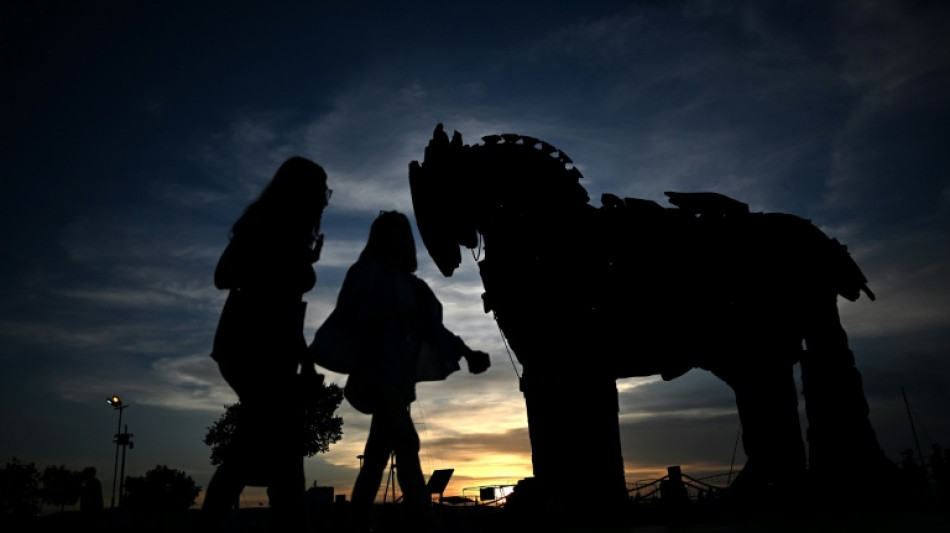
Between Homer and Hollywood: Troy a source of Turkish pride / Photo: Ozan KOSE - AFP

 England turn screw in 3rd Test against Pakistan

 France will not support Infantino in FIFA election: federation chief

 In their words: Israeli forces describe AI-backed Gaza killing in new film

 Yemen's Houthis seize key city on Red Sea: military source

 Oil prices extend gains as markets await ECB rate outlook
 Wars pose a test as India hosts BRICS summit with China, Russia, Iran leaders

 Messi to buy second Spanish lower league club
 Pochettino calls for Chelsea to lose 2016-17 Premier League title
 North Korea leader's daughter believed to have younger sibling: Seoul
 Wars pose a test as India hosts BRICS summit with Russia, Iran leaders

 Zamanat Targets GCC’s $250 Billion SME Financing Gap With Up to $100 Million Tokenized Private Credit Fund

 Stocks drop as oil spike fans inflation and interest rate fears
 Portugal harvests grapes at night to beat the heat
 Philippine ferry fire kills 5, dozens missing

 Oil prices flare as Iran tightens grip on Hormuz
 Japan gymnasts under injury cloud for home Asian Games
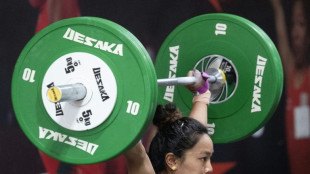 India trailblazer won't 'let go' of chance for Asian weightlifting glory

 Zverev cruises past van de Zandschulp into US Open semis
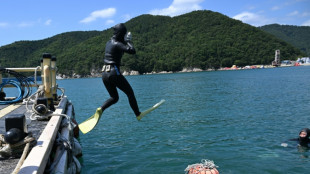
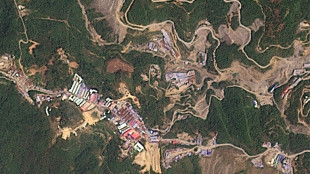 Myanmar tin mega-mine restarts operations: think tank
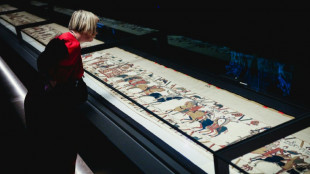
 Online and undercover: saving trafficked wildlife in Thailand
 Antonelli faces new challenge after stirring triumph in Monza

 Korda leads US bid to win first away Solheim Cup since 2015
 Eurozone rate-setters to hike borrowing costs as energy prices jump

 As oceans warm, Florida scientists hunt for heat-resistant coral

 Trump takes center stage as Republicans fight midterm tide
A gift from the film set of "Troy", a giant Trojan Horse replica looms over the port of Canakkale on the Dardanelles Strait in western Turkey.
First related by Homer, then retold for the silver screen in 2004, with Brad Pitt as Achilles, the legend of the ancient city travels to Rome's Colosseum this week, where a major new exhibition opens on Friday.
Keen to showcase the city's Anatolian roots, Turkey has loaned out more than 220 artefacts that will be on show at the exhibition, "Troy and Rome", which runs until mid-October.
"When you read Homer, you don't get a very clear idea of the Trojans' identity. But at the time of the Trojan War, they were certainly among the Anatolian peoples," said Reyhan Korpe, deputy head of the Troy excavations and an ancient history expert at Canakkale University.
Located on Turkey's Aegean coastline, the remains of Troy are a UNESCO-listed World Heritage site comprising 185 hectares (457 acres) of stones and crumbling ramparts dotted with poppies and scampering squirrels.
For 30 years, Korpe has walked every inch of this huge site, whose layers tell the story of nine different settlements, the remains of their ramparts intertwined and layered on top of one another.
- Western flank of the east -
"I spent a whole year just walking through the stones, maps in hand, trying to understand how they fit together," he told AFP.
His passion is evident for the site, which was founded in 3,000 BC and was constantly inhabited until being abandoned in the sixth century AD.
"It was the most western part of eastern civilisation," which is what gave Troy its significance, Korpe said.
The Trojan War, which took place around 1,200 BC and lasted 10 years, until the siege and the city's defeat -- parts of which are recounted in the Iliad -- "was the first confrontation between the East and the West", he said of the Anatolian world and its Greek equivalent, referring to it as "the first world war".
It is an idea with strong resonance in these wooded hills, which several millennia later witnessed the World War I battles of 1915, when Allied troops suffered a bloody defeat trying to seize the Dardanelles from the Ottoman Empire.
- Luwian hieroglyphics -
Of the hundreds of artefacts Turkey has loaned to the Rome exhibition, more than 100 come from the Troy museum, some of which will be on display for the first time.
One piece is a bronze seal marked with hieroglyphics that was discovered in 1995, which offers important clues about the city's Anatolian roots.
"It's the only trace of writing found at Troy that was written in an Anatolian language, which proves that the first language spoken there was that of the Luwian peoples," explained museum director Sinem Duzgoren.
The Luwians were an ancient people who lived in western and southern Anatolia during the Bronze and early Iron Ages, whose language played a major role in the Hittite empire.
- From Wilusa to Ilion -
Although Troy was not a Hittite city, it was part of the Hittite empire, which referred to it as Wilusa. That became Ilion for the Greeks -- or Ilios for Homer.
"These pieces may not be the most spectacular, but they are the most important from a historical point of view, because they bear witness to the history of Troy," Duzgoren told AFP.
Also sent to Rome are a large number of weapons for use in war -- stones for use in a sling, knives, spears and arrowheads.
"These weapons are mentioned in the Iliad and date from the same period that they were mentioned by Homer," she said.
But it is a reality that is a far cry from the epic, romanticised fighting that plays out in Wolfgang Petersen's "Troy" (2004).
Apart from bequeathing the 12-tonne replica of the Trojan Horse looming over Canakkale's waterfront, the film did a lot to fuel renewed interest in Troy, Korpe said.
"Neither the producers nor the director came here, even though that was when we made some of the most significant discoveries," he said sadly.
"But the number of tourists did grow, even if they were just looking for traces of Brad Pitt among the ruins!"
R.AbuNasser--SF-PST